
In this article
- Confirm You’re Preparing for the Right Test
- TEF Canada or TEFAQ: Which One Applies If You’re Aiming for Quebec
- How TEF Canada Scores Convert to NCLC (and Which Numbers IRCC Wants)
- The Four Modules, and What Each One Actually Rewards
- A Three-Phase Plan That Adapts to Your Starting Level
- How to Tell If You’re Actually Making Progress
- Exam Day Logistics Worth Planning Around
- Frequently Asked Questions About TEF Canada Preparation
If you’re starting TEF Canada preparation for Express Entry, the first useful step isn’t a vocabulary list — it’s a diagnostic test that tells you where you’re weakest right now.
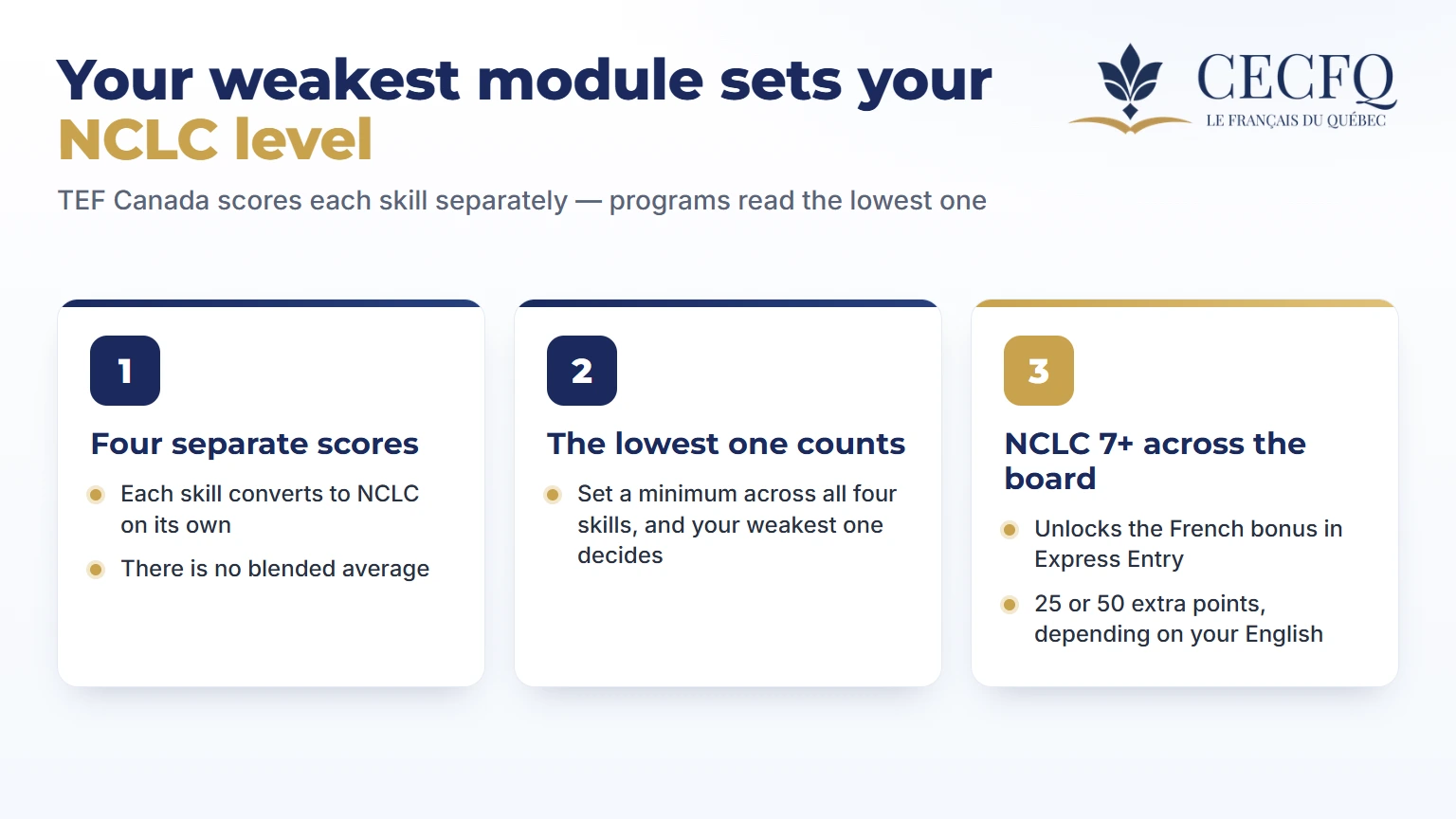
That’s because Immigration, Refugees and Citizenship Canada (IRCC) doesn’t average your four TEF Canada scores into one tidy number. Your certificate reports four separate results, each converted to its own level on the NCLC scale — the Niveaux de compétence linguistique canadiens, the French-language counterpart to the Canadian Language Benchmarks (CLB). Wherever a program sets a minimum across all four skills, it is your lowest result that decides whether you meet it.
That rule has real points attached to it. Claiming the French-language bonus in Express Entry requires NCLC 7 or higher in all four skills — worth 25 additional points if your English is CLB 4 or lower or you didn’t take an English test, and 50 points if you also have CLB 5 or higher in all four English skills. One module sitting at NCLC 6 costs you the entire bonus, however strong the other three are.
NCLC 7 in all four skills is also the requirement for Express Entry’s French-language proficiency category, one of the categories IRCC holds invitation rounds for. So a single module below 7 costs you more than points: it also keeps you out of those category rounds.
This changes how you should plan: your weakest module deserves the most attention. This article walks through how to find it, work on it, and check whether it’s improving.

Confirm You’re Preparing for the Right Test
Before you commit to preparing for TEF Canada, confirm the certificate is accepted for the specific program you’re using it for. It’s a five-minute check that can save you months.
For Express Entry, IRCC accepts exactly two French tests: TEF Canada and TCF Canada. DELF and DALF, however strong your results, are not accepted for Express Entry points at all — see the official language testing requirements on canada.ca.
A result accepted by one program isn’t automatically accepted by another. Someone who already sat the DELF to meet Quebec’s Programme de sélection des travailleurs qualifiés (PSTQ) language requirement, or the DALF for Canadian citizenship, still needs a separate TEF Canada or TCF Canada result before Express Entry will count it.
TEF Canada or TEFAQ: Which One Applies If You’re Aiming for Quebec
Settle this before you book anything, because it decides which modules you need to prepare. TEF Canada is used for federal programs, including Express Entry, where all four skills are assessed. TEFAQ is the Quebec-oriented version: its four tests can be taken separately, the Quebec program you apply to decides which ones you need, and IRCC does not accept it for Express Entry.
Quebec’s PSTQ, on the other hand, accepts both TEFAQ and TEF Canada, so a single TEF Canada result can serve a federal and a Quebec application if the levels line up. Our comparison of TEF and TEFAQ covers the remaining differences.
In practice, what you train depends on the stream, not just the province. For Express Entry, all four modules count. In the PSTQ, Stream 1 (and regulated professions at FEER 0–2) requires oral level 7 and written level 5 on the Échelle québécoise (Quebec’s own French scale, not NCLC), so reading and writing still matter; Stream 2 and the other regulated professions ask for spoken French only, and that is where a mostly oral plan makes sense. Requirements change, so check the current ones for your program before you build a schedule.
Put simply: if Quebec is your only target, TEFAQ lets you sit just the tests your stream requires; if Express Entry is also on the table, TEF Canada can cover both, provided your levels meet each program’s minimum. Either way, the modules the two exams share follow the same format, so the method in this article applies to both — what changes is how you divide your time, not how you work.
How TEF Canada Scores Convert to NCLC (and Which Numbers IRCC Wants)
Each module has its own point scale, and each converts to NCLC independently. The table below is IRCC’s official conversion grid — note that it still uses the older TEF score scale, explained just after it.
| NCLC | Listening /360 | Reading /300 | Writing /450 | Speaking /450 |
| 10 | 316–360 | 263–300 | 393–450 | 393–450 |
| 9 | 298–315 | 248–262 | 371–392 | 371–392 |
| 8 | 280–297 | 233–247 | 349–370 | 349–370 |
| 7 | 249–279 | 207–232 | 310–348 | 310–348 |
| 6 | 217–248 | 181–206 | 271–309 | 271–309 |
| 5 | 181–216 | 151–180 | 226–270 | 226–270 |
| 4 | 145–180 | 121–150 | 181–225 | 181–225 |
Read it by row: every module has to reach at least the row of the NCLC level you’re targeting.
Here is a common point of confusion when you read your own results. Your certificate reports each test on a 0–699 scale, and it also states your CEFR level (the Common European Framework of Reference, A1 to C2) and your NCLC/CLB equivalence level for each test. The IRCC conversion table reproduced above uses the earlier score scale — which is why candidates sometimes can’t find their numbers in it. IRCC itself says the 0–699 scores aren’t compatible with its system at this time.
The operator is explicit about what to do with that, and IRCC asks for the same: when you fill in your Express Entry profile, enter only the figures from the “Old score equivalence” column printed on your certificate, not the 0–699 scores. The CLB level on the certificate is there for your own reading, and the official TEF–NCLC correspondence chart shows which NCLC level each 0–699 score corresponds to, if you want to check the conversion yourself.
For reference, NCLC 7 on the current 0–699 scale starts at 434 in Reading and Listening, 428 in Writing and 456 in Speaking — useful if a practice platform reports your mock scores out of 699. For your Express Entry profile, still use the “Old score equivalence” figures.
One related detail that trips people up at the same step: the test results form number IRCC asks for is the first part of the attestation number at the bottom left of your certificate, before the hyphen.
The Four Modules, and What Each One Actually Rewards
Preparation works best when it matches how each module runs in the exam room, rather than relying on generic language practice. TEF Canada is designed and run by Le français des affaires (CCI Paris Île-de-France). Its published exam structure, together with the candidate handbook, sets very different rules for each section — the figures below reflect the format in place since December 2023, when Listening was cut from 60 questions to 40 and Reading from 50 to 40.
| Module | Length | Questions or tasks | Can you revisit a question? |
| Listening | 40 min | 40 questions | No |
| Reading | 60 min | 40 questions | Yes |
| Writing | 60 min | 2 separately timed sections (80 and 200 words minimum), double-scored | — |
| Speaking | 15 min | 2 sections, in person, recorded and double-scored | — |
Listening: no replays, no notes
Listening gives you 40 questions in 40 minutes, and every recording plays once. You can’t go back to a question once you’ve moved past it, and drafts or scratch paper aren’t allowed during this module. That combination means note-taking habits built around replayable audio don’t transfer well here — you need to hold the answer in memory and decide fast, not review notes afterward.
Practice accordingly: use recordings you only allow yourself to hear once, answer immediately, and move on. News bulletins in simplified French, such as RFI’s Journal en français facile, work well for this. Training your ear to hold information for a few seconds is the skill this module actually tests.
One scoring detail matters most here, where you can’t come back later: a wrong answer scores zero, and so does a blank one. There’s no penalty for guessing, so never leave a question unanswered — if the audio got away from you, eliminate what you can and pick. A guess has better odds than a blank.
Reading: freedom to navigate
Reading works the opposite way. You get 40 questions and a full hour, and — unlike Listening — you can move freely between questions, though scratch paper isn’t allowed here either. Use that freedom: skim the full set first, answer whatever feels straightforward, and come back to the longer or harder passages with whatever time is left.
The same scoring rule applies here, with one difference in how you use it: since you can return to a question, skip the hard ones on the first pass, then sweep back through the question list and fill in every remaining blank before time runs out.
Writing: two sections, two clocks
Writing runs 60 minutes across two sections. Section A gives 25 minutes to continue a short article, with a minimum of 80 words. Section B gives 35 minutes to state and defend a position, with a minimum of 200 words. If your keyboard doesn’t have French accents, the exam interface includes an on-screen virtual keyboard for é, è, ê, ç and à — practise with it in advance so it doesn’t cost you time on exam day.
Two habits help here. First, learn what 80 and 200 words look like when you type them, so you stop counting mid-answer: write a few timed responses, count them once, and you’ll recognize the length by eye afterward. Second, spend the first few minutes of each section on a rough plan — for Section A, where the article goes next; for Section B, your position, two arguments and a conclusion — rather than starting to write immediately. Section B asks for more than twice the words in only ten extra minutes, and that’s where an unplanned answer usually stalls.
A related principle: a correct simple sentence is usually a safer bet than an ambitious complex one full of errors. Use elaborate constructions only when you can produce them reliably.
Speaking: recorded and double-scored
Speaking takes 15 minutes total, in person with an examiner, and the session is recorded, with no scratch paper allowed; the operator states that Speaking and Writing are both systematically double-marked. Section A (5 minutes) asks you to gather information by asking questions. Section B (10 minutes) asks you to argue a position and convince the examiner.
Notice how different those two tasks are. Section A asks you to obtain information — that is, to ask questions, a skill that tends to get less classroom time than answering them. Practising question forms out loud, until they come without hesitation, targets exactly this section. Favour open questions (“Quels horaires proposez-vous ?”) over yes/no ones (“Vous êtes ouverts le samedi ?”): each one draws a fuller answer and gives you more to react to.
Section B asks you to argue and convince, which tends to reward structure over vocabulary: a clear position, two supported reasons and a closing line. And since the real session is recorded, recording your own practice answers is the closest thing to rehearsing under real conditions — you’ll hear the hesitations and filler you can’t notice while speaking.
For a closer look at building reflexes and templates for both Speaking and Writing under time pressure, see our guide to TEF/TCF speaking and writing strategies.
Check your speaking before exam day
Speaking is often where candidates lose points without noticing: their French is correct, but their answers don’t do what the scoring grid rewards. A one-on-one TEF speaking simulation (CAD $45, 30 minutes; new students pay a one-time $20 registration fee) runs both speaking tasks under exam conditions, followed by immediate feedback from your teacher on structure, vocabulary, timing and delivery.

A Three-Phase Plan That Adapts to Your Starting Level
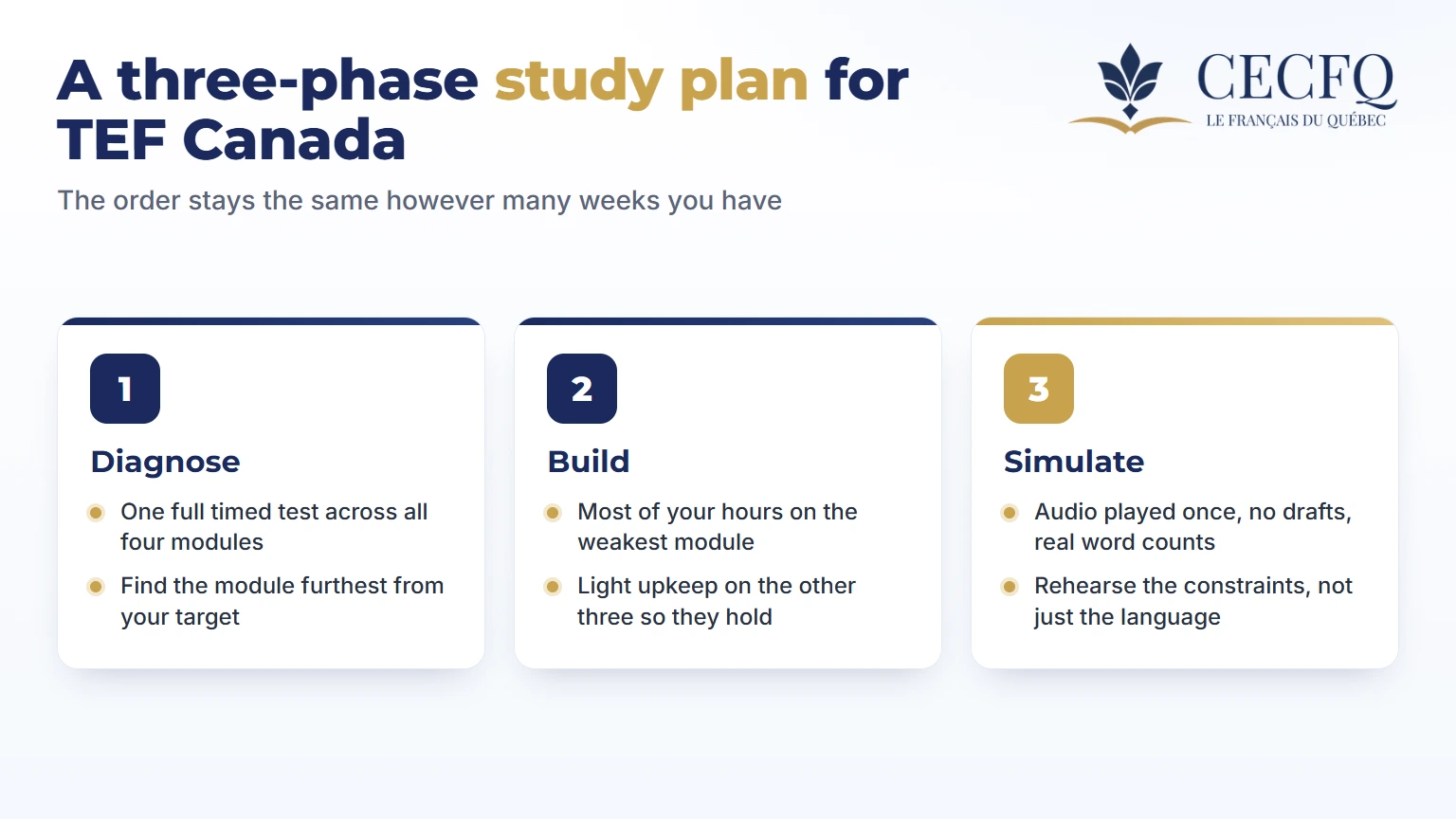
There’s no fixed number of weeks that works for every candidate — it depends on your starting level, how many hours a week you can commit, and which module needs the most work. What does stay constant is the order of the phases.
Start — diagnose. Take a full practice test across all four modules under timed conditions. Self-study plans often skip this step, yet it’s the one that tells you where to spend your time. The operator’s official preparation resources include sample papers for all four modules (with audio for Listening) and interactive tutorials, which show you the real task types. The same page also links recorded preparation workshops, a training book and the operator’s PrepMyTEF online platform, which offers mock exams.
On their own, the sample papers and tutorials don’t give you a scored result, though. For a reliable starting point, a supervised full-length simulation, with Writing and Speaking marked by a certified examiner, gives you a far more realistic mark.
The middle stretch — build. This is where most of the work happens. Split time roughly in proportion to need: more hours on your weakest module, enough maintenance practice on the other three that they don’t slip while you’re focused elsewhere.
To make the split concrete, here is one illustrative example, not a standard: with about eight hours a week and Listening as the weak module, you might give four hours to Listening, roughly an hour and a half each to Speaking and Writing, and one hour to Reading.
The final stretch — simulate. Shift from skill-building to exam conditions: full-length timed mock exams, a single listening pass, no scratch paper during Listening, Reading or Speaking. By this point, rehearsing the real constraints can matter almost as much as the language itself. On a plan of two months or more, that usually means the diagnostic in the first week, roughly the last three to four weeks for full mock exams, and the build phase in between.
The same three phases apply whether you’re working with an instructor or building the plan yourself. What changes is who’s checking that you’re following it — and, for Writing and Speaking, who is qualified to tell you where you stand.
2 Real Cases:
Karim was preparing for Express Entry with a profile requiring NCLC 7. His first timed diagnostic put Reading and Writing comfortably above target and Speaking close. Listening was the surprise: two full NCLC levels behind the others, largely because he had always practised with audio he could replay and take notes on. Giving most of his study time to timed, single-listen practice, with short maintenance sessions for the other three modules, narrowed that gap before his test date.
Nadia skipped the eligibility check described above. She had passed the DELF B2 for a Quebec PSTQ application, then opened a federal Express Entry profile as well in case she settled outside Quebec, and assumed the same diploma would be accepted there. It wasn’t, and she found out only after building her timeline around it — a second exam, a second round of preparation, and several months lost.
How to Tell If You’re Actually Making Progress
Studying without measuring is the easiest way to feel busy and still miss your target NCLC level. A few concrete checkpoints help:
- Retake a full timed mock exam at regular intervals, for example every three to four weeks during the build phase, and track your score by module, not just overall.
- Watch the gap between your weakest and strongest module. The plan is working if that gap is narrowing, even before your top score moves.
- Keep an error log for Listening and Reading: for every wrong answer, note whether you missed a word, fell for a distractor or ran out of time. The cause that keeps coming back is what next week’s practice should target.
- For Speaking and Writing, get a second opinion. Self-assessment is often unreliable for both; a scoring grid or an outside ear catches errors you’ve stopped hearing in your own French.
If your weakest module isn’t moving after several weeks of targeted work, that’s usually a sign the practice itself needs to change, not a sign to add more hours of the same. Our breakdown of why strong French speakers still underperform on the TCF/TEF Canada covers the most common versions of this exact stall.
Exam Day Logistics Worth Planning Around
A few organizational details affect how you plan your last few weeks, not just exam day itself. All four TEF Canada modules must be taken on the same day — a certificate assembled from separate sessions isn’t recognized by Canadian immigration authorities. Bring the same photo ID you registered with: for TEF Canada, the operator’s rules require the ID shown on exam day to match the one presented at registration.
The operator says results are sent within 1 to 10 business days; leave some margin anyway. What matters for immigration is IRCC’s validity rule: your results must be less than two years old both when you complete your Express Entry profile and on the day you submit your permanent residence application. Booking the exam long before your file is ready can mean paying for it twice, so plan the test around the application, not the other way around.
Registration fees vary by test centre and aren’t standardized across Canada, so we won’t quote a figure here — confirm the current price directly with the centre where you plan to sit the exam.
A last point about our role: CECFQ prepares candidates for TEF Canada through a private TEF Canada preparation course, but we don’t administer the test itself. You register for and sit the exam through an approved TEF Canada test centre — the operator’s centre finder lists them — and our part is getting you ready for it.
Frequently Asked Questions About TEF Canada Preparation
1. My exam is booked and one module clearly isn’t ready. Should I sit it anyway?
Compare the two costs. Sitting it now means the weak module caps what the whole result is worth for any program with a minimum in every skill, and fixing that later means a full retake. Rescheduling, if your centre allows it, often costs less, so check its policy first. If the date can’t move, sitting the exam still gives you a real score for that module, which is more telling than any practice test.
One exception is worth knowing, though it isn’t a way to buy extra study time: if you miss the session for a documented reason, justified within a month of the session and accepted by the operator, its rules allow one postponement to another session within six months of the original date, and centres are asked not to charge extra for it.
2. Is TEF Canada harder to prepare for than TCF Canada?
Neither test is harder for everyone — they suit different strengths, and the better fit depends on your profile. Our comparison of TEF Canada and TCF Canada covers the format differences that tend to matter most.
3. How long does TEF Canada preparation take?
It depends on the gap your diagnostic shows, not on a standard calendar. If each module is within about one NCLC level of your target, focused exam training on the weakest one is usually the main job. If several modules sit two or more levels below target, you’ll generally get further by strengthening your overall French first and switching to exam-specific practice once your mock scores start approaching the target.
4. How far in advance should I book the exam?
Work backwards from two dates: when your weakest module should be ready, and when you plan to apply. The operator advises registering as early as possible, so check your centre’s session dates well ahead and reserve a date that still leaves room for your final simulation weeks. Registering early isn’t the same as sitting early, though: the reporting delay and the two-year validity window described above still have to line up with your application date.
5. My certificate shows a score out of 699, but the IRCC table uses different numbers. Which do I enter?
Enter the figures from the “Old score equivalence” column of your certificate, not the 0–699 scores, as explained in the score conversion section above. The CLB level printed alongside them is for reading your own result, not for the form.
6. Can I retake only the module I did badly on?
Not for Express Entry. The operator requires all four modules to be taken on the same day for the certificate to be recognized by Canadian immigration authorities, so a retake means sitting and paying for the whole test again, after waiting at least 20 days. That’s why the diagnostic and simulation phases matter: they’re how you avoid needing one.
Disclaimer: This article is for general information only, based on publicly available exam and immigration guidance at the time of writing. Exam formats, scoring, fees and immigration requirements can change, and requirements vary by program and individual situation. For exact, current details, confirm directly with the official TEF Canada test operator and with IRCC or the relevant immigration authority. This is not immigration advice.
Ready to stop guessing which module needs the work?
To find out where each of your four modules stands, you need a full-length simulation marked against the exam’s own criteria. That’s what our TEF Canada preparation course is built around: exam-format training, skill-by-skill practice targeted at your weak points, and real test simulations corrected by certified examiners.
If you’re at an earlier stage and simply want to know roughly where your French sits before choosing a course, our French level test places you on the CEFR scale in 30–45 minutes for CAD $20, credited toward your first invoice if you enroll within 5 days. Be clear about what it is, though: a placement tool covering A1 to B2, not an official certificate and not a substitute for the diagnostic above.
Questions about TEF Canada preparation? Contact CECFQ:
Email: info@cecfq.ca
Website: cecfq.ca
Address: 50 Rue Saint-Charles O, local 100, Longueuil, QC J4H 1C6
Hours: Mon–Fri 9:00 a.m.–6:00 p.m., Sat 9:00 a.m.–2:00 p.m.