
6 things you’ll learn
- What each of the three speaking tasks and three writing tasks asks, with timing and word limits
- How two independent markers produce each mark out of 20 (re-marking is paused, with resumption planned for autumn 2027)
- Six sample answers in French, each broken down against what France Éducation international says it assesses
- The four conditions that may send a writing paper to “A1 non atteint”
- Which marks out of 20 equal NCLC 7 (10–11), and why a 9 is a full level lower
- A starting split for the 60 minutes of the writing paper
In this article (contents)
- How TCF Canada Marks Speaking and Writing: Two Scores Out of 20
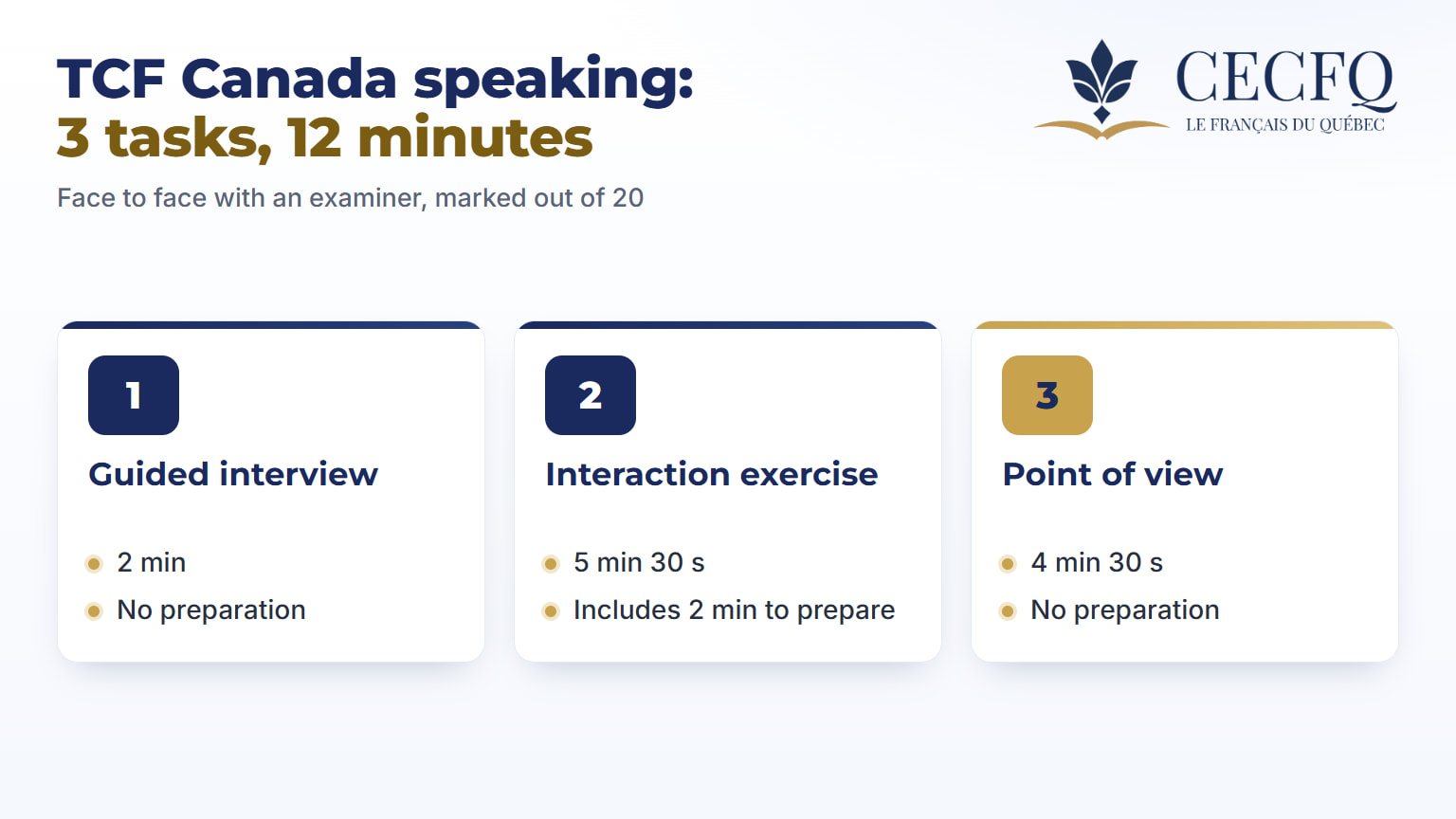
- TCF Canada Speaking (expression orale): Three Tasks in 12 Minutes
- TCF Canada Writing (expression écrite): Three Tasks in 60 Minutes
- Writing Task 3: Comparing Two Points of View, 120–180 Words
- What Can Drop a Writing Paper to “A1 non atteint”
- From a Mark Out of 20 to NCLC 7
- Frequently Asked Questions
- Work Through These Six Tasks With an Examiner-Teacher
TCF Canada tests speaking and writing in six tasks: three in speaking (expression orale) and three in writing (expression écrite). Speaking is a one-on-one test with an examiner, 12 minutes in total, 2 of them for preparation. Writing is one 60-minute paper with word limits of 60–120, 120–150 and 120–180. Each part gets a mark out of 20, and 10 out of 20 is the line for NCLC 7.
Below, each task has three parts: what France Éducation international (FEI) says it tests, a sample answer in French, and a breakdown of what that kind of answer shows against FEI’s criteria. The samples were written by our team for illustration. They are not FEI material or student work, and none comes with a promised mark. Listening, reading and a full study plan are in our TCF Canada preparation guide.
The six tasks at a glance, from FEI’s description:
| Part | Task | Time | Preparation | Words |
| Speaking | 1. Guided interview | 2 min | None | — |
| Speaking | 2. Interaction exercise | 5 min 30 s | 2 min (included) | — |
| Speaking | 3. Giving your point of view | 4 min 30 s | None | — |
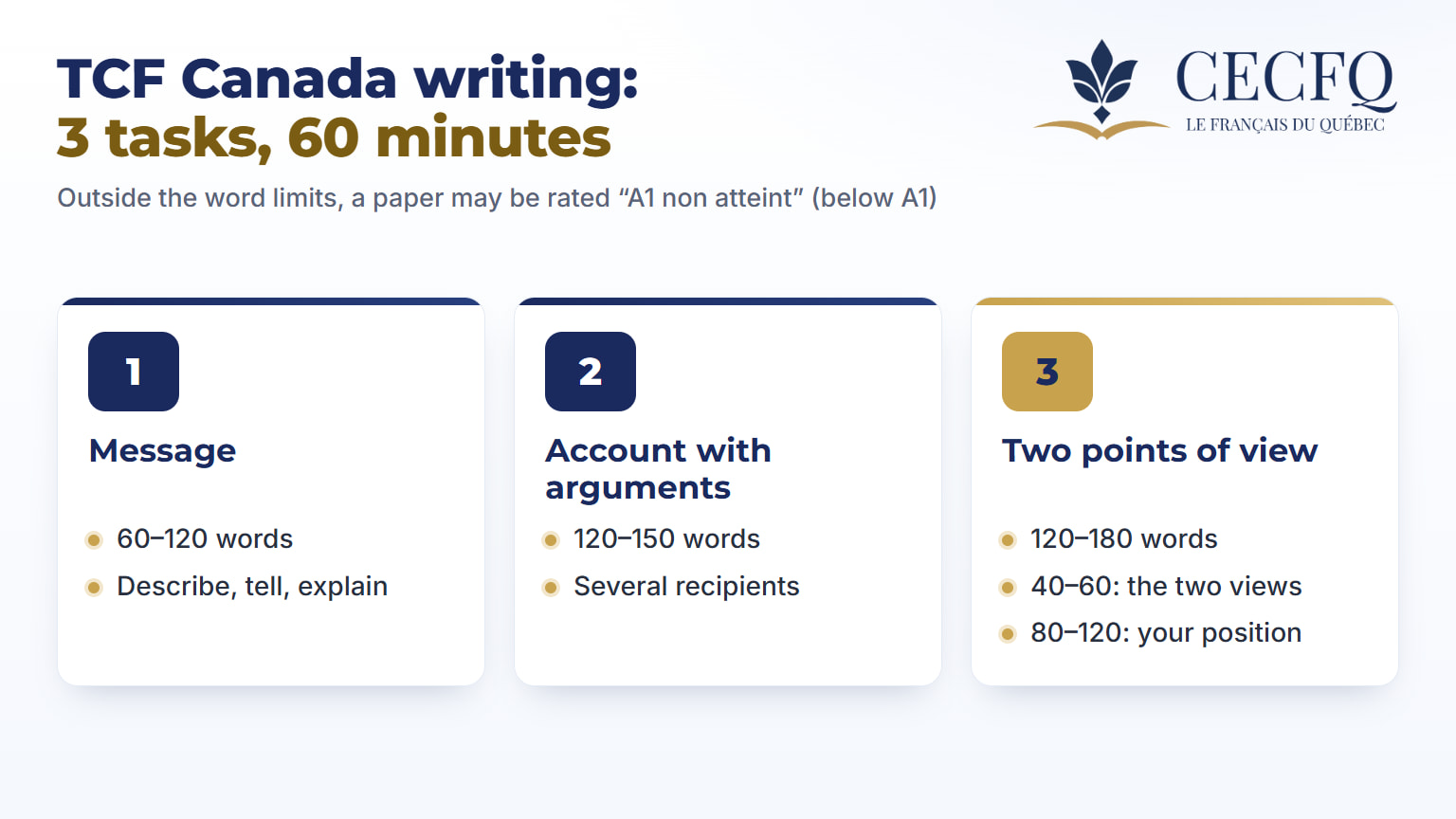
| Writing | 1. Message | 60 min for all three tasks | — | 60–120 |
| Writing | 2. Account with arguments | (shared) | — | 120–150 |
| Writing | 3. Comparing two points of view | (shared) | — | 120–180 |
How TCF Canada Marks Speaking and Writing: Two Scores Out of 20
FEI centralizes the marking of all TCF tests. In TCF Canada, speaking and writing each end in one mark out of 20, which FEI also expresses as a CEFR level (Common European Framework of Reference), from “A1 non atteint” to C2. At least two independent assessments sit behind each mark.
- Speaking. The examiner at your centre, trained by FEI, runs the interview, records it and marks it first. The recording then goes to a second FEI-trained marker. The two evaluations are fully independent and double-blind (en double aveugle, in FEI’s French). In the rare cases where the gap between them is large, a third marking is always carried out.
- Writing. Your paper is marked twice, independently and in double blind, by FEI’s team of markers.
For speaking, FEI names three families of criteria, with examples rather than a closed list:
- Linguistic: range and control of vocabulary, grammatical accuracy, ease, pronunciation, overall fluency.
- Pragmatic: interaction, structure of the discourse, coherence and cohesion, development of the topic.
- Sociolinguistic: fit with the communication situation.
For writing, FEI lists abilities rather than families. They include communicating a clear message, linking ideas coherently, comparing two points of view, and using vocabulary and structures suited to the task. The breakdowns below use both lists.
For TCF sessions from 1 September 2026, FEI no longer accepts requests to re-mark speaking or writing, for about a year. The service is planned to resume in autumn 2027. Until then, the practical way to improve a mark is a new sitting (see the retake answer in the FAQ at the end).

TCF Canada Speaking (expression orale): Three Tasks in 12 Minutes
The samples below are excerpts or condensed versions, because task 3 alone lasts 4½ minutes.
Task 1: Guided Interview (entretien dirigé), 2 Minutes, No Preparation
FEI says this task tests whether you can talk with someone you don’t know: the examiner. Its list for speaking includes talking about yourself and your family and professional surroundings.
Sample answer:
Examinateur : Pouvez-vous vous présenter ?
Candidat : Bien sûr. Je m’appelle Daniel, j’ai trente-quatre ans et je viens de Colombie. J’habite à Montréal depuis deux ans avec ma femme et notre fils. J’ai été infirmier pendant dix ans en Colombie, et maintenant je cherche un poste dans un hôpital ici.
Examinateur : Qu’est-ce que vous aimez dans votre métier ?
Candidat : J’aime le contact avec les patients. Quand quelqu’un repart rassuré, j’ai l’impression que ma journée a servi à quelque chose. En revanche, les horaires de nuit sont difficiles avec un jeune enfant.
What this answer shows against the criteria:
- It answers the question, then adds a detail or a reason: a job, a plan, a feeling.
- It develops the topic and links ideas (“quand… j’ai l’impression que…”, “en revanche”), which falls under the pragmatic criteria.
- It uses the present, the passé composé and “depuis” correctly, in short sentences with no recited block.
- It uses vous and a neutral tone, as with a stranger (sociolinguistic).
Task 2: Interaction Exercise (exercice en interaction), 5½ Minutes With 2 for Preparation
You must obtain information in an everyday situation. The instruction states the status of the person you are speaking to and your own.
Instruction (written by us): Vous voulez inscrire votre fils de huit ans à des cours de natation. Vous vous adressez à l’accueil du centre sportif de votre quartier. L’examinateur joue le rôle de la personne à l’accueil.
Sample answer:
Candidat : Bonjour, madame. Je voudrais inscrire mon fils à des cours de natation. Il a huit ans et il sait déjà un peu nager. Est-ce qu’il y a un groupe pour son niveau ?
(L’examinateur répond.)
Candidat : D’accord, le groupe du samedi matin lui conviendrait bien. À quelle heure commence le cours, et combien de temps dure-t-il ? Pourriez-vous aussi me dire combien coûte la session ?
(L’examinateur répond.)
Candidat : Merci. Est-ce qu’il faut apporter du matériel, par exemple des lunettes de natation ? Et comment puis-je m’inscrire : sur place ou en ligne ?
What this answer shows against the criteria:
- The questions fit the situation: level, schedule, price, equipment, registration. FEI’s list includes asking questions suited to the communication situation.
- The register matches the stated statuses (“madame,” “pourriez-vous”).
- The question forms vary: est-ce que, inversion in “dure-t-il,” the conditional. That helps the linguistic range.
- Interaction is a pragmatic criterion: the second turn picks up on the examiner’s answer (“le groupe du samedi matin”) instead of moving down a list. Use the 2 minutes of preparation to choose four or five things you need to find out.
Task 3: Giving Your Point of View (expression d’un point de vue), 4½ Minutes, No Preparation
You answer a question chosen by the examiner. FEI describes the task as speaking spontaneously, continuously and convincingly.
Sample answer, condensed (a full answer develops each point with an example):
Question : Faut-il limiter la circulation des voitures au centre-ville ?
Candidat : À mon avis, il faut limiter la circulation au centre-ville. D’abord, c’est une question de santé : moins de voitures, c’est moins de pollution, et les enfants respirent mieux. Ensuite, un centre-ville plus calme profite aux commerçants, parce que les gens prennent le temps de marcher et de s’arrêter. Certains diront que les personnes âgées ont besoin de leur voiture. C’est vrai, mais on peut prévoir des exceptions et améliorer le service d’autobus. Pour conclure, je pense que le centre-ville appartient d’abord à ceux qui y vivent et y travaillent.
What this answer shows against the criteria:
- The position comes first, followed by two reasons. FEI’s list includes presenting a clear, structured argument and, for complex topics, developing them and concluding.
- “D’abord… Ensuite… Pour conclure” makes the structure audible. The second marker works from your recording, so spoken signposts matter.
- It states a counter-argument and answers it, which touches the advantages-and-drawbacks side of FEI’s list.
- To fill 4½ minutes, give each reason a concrete example.
For phrase banks and drills for all three tasks, see our guide to TEF and TCF speaking and writing strategies.
TCF Canada Writing (expression écrite): Three Tasks in 60 Minutes
The three tasks share one 60-minute paper, and FEI gives no time per task. Together the word limits add up to 300–450 words. As a starting point for practice, try about 12, 20 and 22 minutes, with a few minutes to reread (our suggestion, not FEI’s). FEI’s sample paper defines a word as any group of characters between two spaces, so j’ai or c’est-à-dire counts as one word. Aim for the middle of each range anyway, so a small miscount does not push you outside it. Tasks 1 and 2 follow below; task 3, the longest and the only one built on two documents, has its own section after them.
Task 1: A Message, 60–120 Words
FEI describes a message to describe, narrate and/or explain, addressed to one or more recipients whose status is given in the instruction.
Instruction (written by us): Vous venez d’emménager dans un nouveau quartier. Vous écrivez à un ami pour décrire votre logement et l’inviter. (60 à 120 mots)
Sample answer, about 91 words:
Salut Marc,
Je t’écris pour te donner des nouvelles. Je viens d’emménager dans un petit appartement à Montréal, près du métro. Il est lumineux, avec deux chambres et un balcon. Le quartier est calme, avec un parc et une boulangerie à deux pas. Les voisins ont l’air très accueillants, et je me plais déjà beaucoup ici.
Dimanche prochain, j’organise un repas pour fêter mon installation. Est-ce que tu pourrais venir vers midi ? Tu peux amener ta sœur si elle est libre. Dis-moi vite si tu es disponible !
À bientôt,
Sofia
What this answer shows against the criteria:
- It describes (apartment, neighbourhood), gives the requested information and ends on a clear purpose: the invitation.
- Tu and Salut suit a friend. To a landlord the same message would need vous.
- “Est-ce que tu pourrais venir” softens the invitation with the conditional: friendly, but still polite.
Task 2: An Account With Arguments, 120–150 Words
FEI describes an article, letter or note for several recipients that reports an experience or tells a story, backed by comments, opinions or arguments in line with an objective such as claiming something (revendiquer) or making peace.
Instruction (written by us): Dans votre immeuble, il n’y a pas de bac de recyclage. Vous écrivez une lettre aux autres locataires et au propriétaire pour raconter la situation et demander une solution. (120 à 150 mots)
Sample answer, about 132 words:
Chers voisins, cher propriétaire,
Depuis mon arrivée dans cet immeuble, il y a six mois, je constate qu’il n’existe aucun bac de recyclage. Chaque semaine, je vois des bouteilles, des cartons et du papier jetés avec les ordures, alors qu’on pourrait les recycler. Le mois dernier, j’ai demandé au concierge d’installer des bacs ; il m’a répondu que ce n’était pas prévu.
Pourtant, la solution est simple : trois bacs dans le local près de l’entrée suffiraient. Plusieurs voisins m’ont dit qu’ils aimeraient trier leurs déchets. De plus, tous les locataires y gagneraient, car l’immeuble serait plus propre et nous produirions moins de déchets.
Je demande donc au propriétaire d’installer ces bacs d’ici la fin du mois. Je propose aussi une réunion des locataires pour en discuter. Merci de votre réponse.
Cordialement,
Amina Diallo
What this answer shows against the criteria:
- It tells what happened (six months, last month, the caretaker’s answer), then argues, then makes a dated request. That is a revendiquer objective with an account behind it.
- The greeting addresses both recipient groups, and the formal register holds to the end.
- “Pourtant,” “de plus” and “donc” chain the ideas, which FEI lists as coherence.
Writing Task 3: Comparing Two Points of View, 120–180 Words
FEI describes a text for a newspaper, website, colleague or superior that compares two points of view on a social issue, each expressed in a document, and gives your opinion. FEI’s sample paper (exemple d’épreuve) splits the task in two: 40–60 words presenting the two opinions in your own words, then 80–120 words giving your position on the general theme. The sample below follows that split: its first paragraph runs about 54 words, the other two about 93.
Instruction (written by us; in the exam the two documents are provided): Document 1, une journaliste défend le télétravail : plus de temps et d’autonomie. Document 2, un directeur défend le bureau : travail d’équipe et formation des jeunes. Rédigez un texte pour l’intranet de votre entreprise : comparez ces deux points de vue et donnez votre avis. (120 à 180 mots)
Sample answer, about 148 words:
Le télétravail divise les employés et les employeurs. Dans le premier document, une journaliste affirme qu’il fait gagner du temps et laisse plus de liberté, parce qu’on évite les trajets et qu’on organise sa journée. Dans le second, un directeur répond que le bureau reste indispensable pour collaborer et pour accompagner les nouveaux employés.
Ces deux points de vue ne s’opposent pas complètement. Tous deux veulent que le travail soit efficace ; ils diffèrent surtout sur la manière d’y arriver. La journaliste pense au bien-être de chacun, tandis que le directeur pense au fonctionnement de l’équipe.
Pour ma part, je crois qu’une solution mixte est préférable. Deux ou trois jours au bureau permettent de se voir, d’échanger et d’apprendre les uns des autres, et le reste de la semaine, chacun peut se concentrer chez soi. Cette organisation me semble plus équilibrée que l’une ou l’autre des deux positions.
What this answer shows against the criteria:
- It compares instead of summarizing two texts in a row: it names each position, finds the common ground, then states the real difference.
- The opinion comes last, with a reason (FEI: give your opinion and argue it).
- Each paragraph does one job: present, compare, conclude. Words like “tandis que” and “pour ma part” carry the links.
- It restates both documents in its own words. FEI lists the ability to reformulate (reformuler), which sentences copied from the documents would not show.
What Can Drop a Writing Paper to “A1 non atteint”
FEI’s TCF Canada page says a writing paper “could be rated” (pourrait être évaluée) “A1 non atteint,” the level below A1, in these four cases:
- the handwriting is not legible (paper sittings only);
- the required number of words is not respected in each task (chaque tâche n’est pas réalisée avec le nombre de mots exigé);
- the production is off-topic;
- one or more tasks are not done.
FEI’s wording on word count doesn’t say how many tasks must be off before it applies, so treat every range as binding. Legibility, length and unfinished tasks are about format more than the quality of your French. You control length and completion by finishing all three tasks and counting words in practice, and the topic by answering exactly what the instruction asks. The samples above run about 91, 132 and 148 words, near the middle of each range.
2 Real Cases:
Case 1 — good French, wrong length. An accountant preparing for Express Entry wrote her practice papers without a clock. Timed for the first time, she spent 25 minutes on task 1 and wrote 85 words for task 3, under its 120 minimum. Over the next two weeks, drills with a word range and a time slot per task brought task 3 back into range and task 1 back to its time slot.
Case 2 — right ideas, no structure. A developer spoke fluently in speaking task 3, but her answer was a string of loosely linked opinions. In practice sessions she learned to state her position, signpost two reasons, answer one objection and conclude. Her next recorded mock answer filled the 4½ minutes, and the structure could be heard.

From a Mark Out of 20 to NCLC 7
IRCC converts TCF Canada marks into NCLC levels with a published table, and the ranges are the same for speaking and writing. Here are the three levels around the NCLC 7 line (the full table is in our NCLC 7 guide):
| NCLC | Speaking and writing mark (out of 20) |
| 8 | 12–13 |
| 7 | 10–11 |
| 6 | 7–9 |
NCLC 7 starts at 10 out of 20. A 9 is NCLC 6, so one mark separates two levels, while 10 and 11 are the same level. The comprehension parts use another scale: NCLC 7 means at least 458 in listening and 453 in reading, from IRCC’s language test results page.
For Express Entry, NCLC 7 or higher in all four French skills adds 25 CRS points if your English is CLB 4 or lower (or untested), and 50 if it is CLB 5 or higher in all four English skills. Quebec’s PSTQ also accepts TCF Canada, but MIFI reads the results on its own scale; our NCLC 7 guide covers both.
Frequently Asked Questions
1. Can I sit the TCF Canada at CECFQ?
No. CECFQ prepares candidates for the TCF Canada but does not hold TCF sessions. FEI says the accredited centre where you register gives the session dates, the registration procedure and the fee. If you have not chosen your test yet, our TEF vs TCF Canada comparison sets out the differences; CECFQ is an accredited TEF test centre.
2. Is the writing paper handwritten or typed?
It depends on the centre, which tells you whether the test is on paper or on computer. Legibility is only a condition for paper sittings, so practise by hand if that is your format.
3. Are the word limits strict?
Treat them as strict (see the “A1 non atteint” section above). In practice, learn what 120 and 180 words look like in your own writing, so you can check length without counting every word.
4. How soon can I retake if a mark falls short?
FEI sets 20 days between two sittings, with no limit on attempts. Results appear in your TCF-Candidat space within 15 business days of FEI receiving the session’s material, and the certificate is valid for 2 years from the date of issue.
5. Where can I find an official TCF Canada sample test?
FEI publishes sample tasks (Exemples d’épreuves) for the TCF, and its TCF Canada page links to the candidate handbook (Manuel du candidat). For TCF Canada, open the writing and speaking files labelled TCF TP / TCF CANADA / TCF QUÉBEC (the three versions share them), not the TCF IRN ones.
Disclaimer: This article is general information, not immigration advice. Exam formats, scoring rules and conversion tables are set by France Éducation international and IRCC and can change; check their official pages before you register or apply. The sample answers are illustrations and do not predict any mark.
Work Through These Six Tasks With an Examiner-Teacher
CECFQ prepares candidates for TCF Canada with examiner-teachers. There are two ways to work on the tasks above with feedback.
A 30-minute online speaking simulation runs the three speaking tasks timed as on exam day, and an examiner gives you feedback afterwards. It costs $65 CAD, which includes the $20 registration fee paid once a year.
The 14-hour package of private lessons covers the three speaking and three writing tasks with feedback on each. It costs $818 CAD, registration fee included. Details and booking are on the TCF preparation page.
Email: info@cecfq.ca
Website: cecfq.ca
Hours: Monday–Friday, 9:00 a.m.–6:00 p.m.; Saturday, 9:00 a.m.–2:00 p.m.