
5 things you’ll learn
- The four work situations your team meets in French (email, meeting, client call, presentation), what each one demands and what a gap looks like from a manager’s side
- How to set a French requirement for each role skill by skill, and how to read a requirement such as NCLC 7
- What Quebec’s Charter of the French language changes for training and hiring
- How our online business French training is built: a level assessment in four skills, groups by level, reports for HR, a certificate on request
- Five things to have ready before the first call
In this article (contents)
Your team reads French emails without trouble, yet French-speaking clients who call always end up with the same two people, and nobody volunteers to present at the Monday meeting. That is the gap business French training for teams is meant to close. At CECFQ it runs online, live with a teacher on Microsoft Teams: we assess each person in four skills, group people by level (up to 6) or teach one-on-one, start from 10 hours, and send HR a progress report. The material is your team’s own emails, meetings and calls, not French in general.
Workplace French is narrower than a general course. Each situation leans on different skills, and one employee can be strong in reading and weak in speaking while a colleague is the reverse, so a team program starts with finding out where each person stands.

Four Workplace French Situations to Train Your Team For
Our business French programs work on the tasks of a working day: taking part in a meeting, talking with colleagues or clients, writing an email, answering the phone, following instructions and using work documents.
Here is what each situation demands, and how a gap tends to show from a manager’s side.
If you already know which of these situations matter for which roles, you can skip ahead and request a proposal for business French courses for your team.
Writing an email
Email gives time, so mistakes are less about speed than about register. A message to a new client usually needs vous, Bonjour Madame Tremblay and Cordialement; a colleague the writer works with every day may get tu and Bonne journée.
In Quebec offices, courriel is the usual word for email, and in writing planifier une réunion is safer than the spoken céduler un meeting.
A gap often shows as client emails that wait for a colleague to check them, or English replies to messages written in French.
The most useful practice material is real messages from the employee’s own job, corrected line by line. Ready-made email and phone phrases are in our A2–B2 workplace guide.
Taking part in a meeting
A meeting is live listening: several speakers, interruptions, no pause button. Speaking in one also means disagreeing politely and asking for clarification without stopping the room (Si je comprends bien…, Je ne suis pas tout à fait d’accord).
The typical sign is people who follow the meeting but stay silent, then send their questions by email afterwards. Our group classes include role-play between participants, such as meetings, negotiations and client service.
Talking to a client on the phone
On a call there are no slides, no body language and no time to look up a word.
Listening and speaking carry the whole exchange, so the useful skills are small and concrete: asking someone to repeat or spell a name (Pourriez-vous répéter, s’il vous plaît?), reading a number back to confirm it, and ending the call with a clear next step.
From the outside, you see French-speaking callers transferred to one colleague, or calls that switch to English after the first sentence.
Giving a presentation
A presentation is a prepared text followed by questions nobody prepared. Our sector-specific training for business, finance and professional services lists presentations, together with meetings, client emails, negotiations and reports.
A workable method is to write the opening and the closing in full, keep the middle as notes, and have a phrase ready for the question the presenter cannot answer yet (Je vérifie et je vous réponds d’ici demain).
If some roles present to clients or management, say so on the first call so it goes into the program.
Setting a French Level for Each Role
When a French requirement goes into a job offer or a training goal, the first temptation is one number: “B2” or “NCLC 7.”
As far as we know, no official Quebec or Canadian table says that a phone call needs B1 or a presentation needs B2. What does exist are requirements set skill by skill.
The federal public service is one model. Each bilingual position gets a three-letter profile in the second official language for reading, writing and oral communication, on levels A (basic), B (intermediate) and C (advanced): a CBC position requires C in reading, B in writing and C in oral communication (Treasury Board rules).
The idea carries over to a private company: a role that reads contracts and a role that takes calls need different profiles.
If you hire newcomers, note that NCLC 7, common in immigration programs, does not mean B2. A 2018 report for the Centre for Canadian Language Benchmarks, which aligned the English benchmarks (CLB) with the CEFR and which the CCLB says also bears on their French counterpart, NCLC, places benchmark 7 at a strong B1 (B1+).
More on the scores in our NCLC 7 guide.
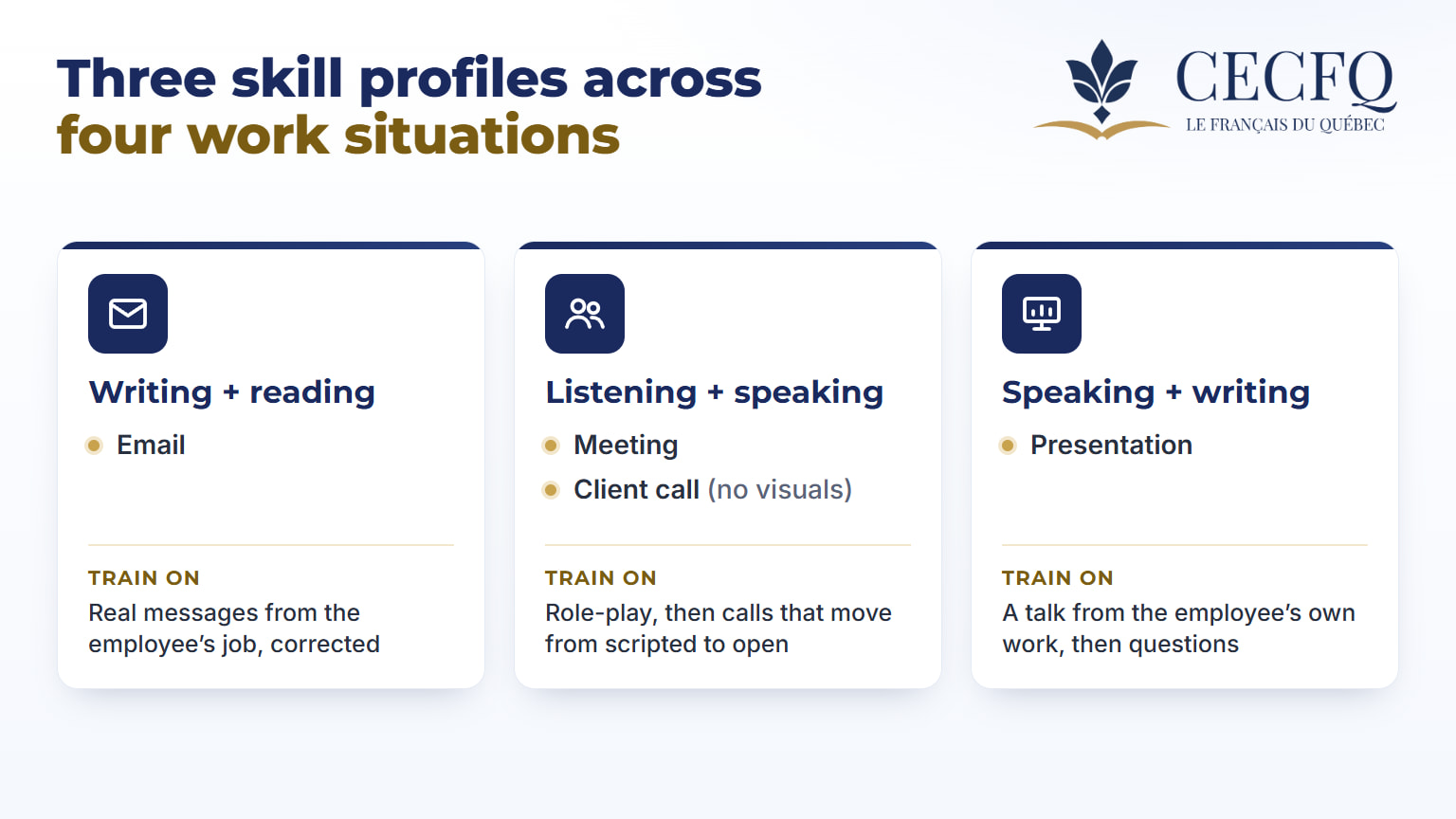
The table below is our own reading, not an official standard. Think in profiles instead of one number:
| Situation | Skills that carry the most weight | What to train on |
| Writing, reading | Real messages from the employee’s job, corrected | |
| Meeting | Listening, speaking | Role-play with colleagues at the same level |
| Client call | Listening, speaking | Calls that move from scripted to open |
| Presentation | Speaking, writing | A talk from the employee’s own work, then questions |
The level assessment at the start of a program replaces this table with each participant’s own results, so the plan for a reading-heavy role and a calls-heavy role can look quite different.
Our programs run from A1 to C2, and our sector-specific training starts at A2, so each participant’s starting point comes from the assessment, not from the course title.
Quebec’s Charter: What It Means for Training
If your team works in Quebec, the Charter of the French language sets rules that bear directly on training and hiring (Quebec government page on employer obligations, in French):
- Working and training in French. Your staff have the right to carry on their work in French, and training documents given to them must be in French.
- No penalty for language (section 45). You may not penalize an employee only because they speak only French or do not know another language well enough.
- Requiring another language (section 46). You may require English or another language only when the duties need it and you have first taken all reasonable means to avoid it; the job offer must state the reasons.
Job offers and contracts, francization duties by company size and a compliance checklist are in Bill 96 for Quebec Employers. These rules cover employment in Quebec; teams based in other provinces or in the US generally fall outside them.

Online Business French Training: How Our Program Works
Our programs run online on Microsoft Teams, live with a teacher. Each participant joins through a link as a guest, without creating an account.
For companies in Greater Montréal, in-person classes at your offices can also be arranged; mention it when you contact us. The steps:
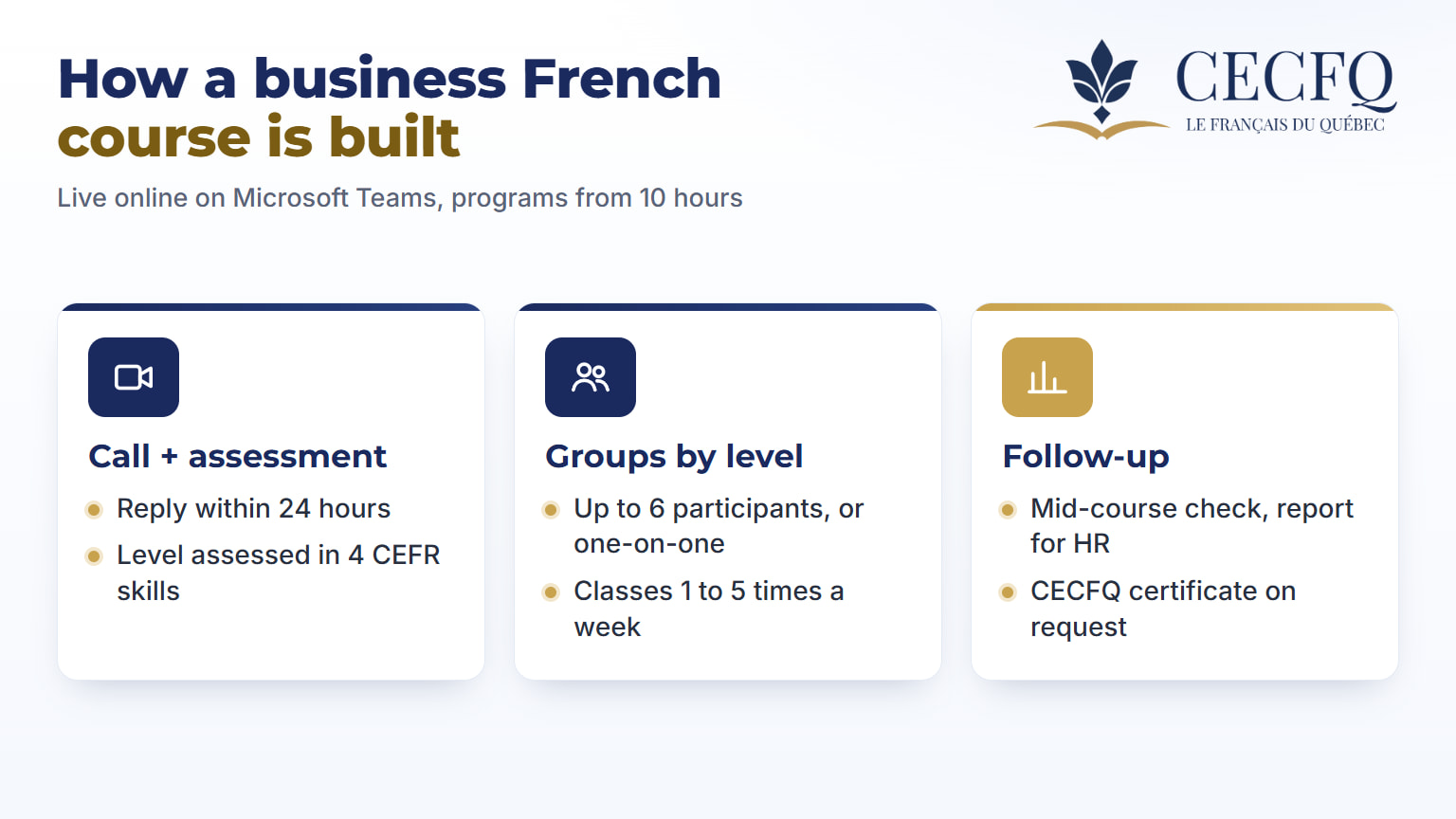
- Request and call. You send a request. We reply within 24 hours to schedule a short call at a time that suits you.
- Level assessment. We assess each participant in the four CEFR skills and set the goals to work on.
- Groups. The results let us build consistent groups of up to 6 and, when needed, smaller sub-groups. One-on-one French for professionals is the alternative for managers, executives and specialists with a specific goal.
- Proposal and classes. You receive a custom proposal with the format, number of hours, schedule and price. Programs start at 10 hours, and one participant is enough. Classes run 1 to 5 times a week: morning, lunchtime, evening or weekends.
- Follow-up. The program includes ongoing follow-up, a mid-course progress check, program adjustment and a final assessment.
- Certificate on request. A participant can ask for a CECFQ school certificate for each level or sub-level completed.
Our teachers are French as a foreign and second language (FLE/FLS) professionals who have taught adults, and the team includes licensed examiners.
CECFQ is also an accredited TEF test centre and an official DELF-DALF test-taking location, so a group preparing for an exam trains with people who know it from the examiner’s side.
What HR receives
The report for your organization is a summary: attendance, progress, skills developed, goals reached, points to strengthen and our recommendations. For training formats, exam costs and using exams as benchmarks, see our corporate French training guide.
Before the first call: five things to have ready
- The people to train and their roles (one is enough).
- For each role, which situations matter: email, meetings, client calls, presentations.
- Any official exam a role or an authority asks for (TEF, TCF, DELF, DALF, DFP).
- Where the team works and which slots suit it (Eastern Time: morning, lunchtime, evening, weekend).
- Whether you want a CECFQ certificate per level, and what HR expects to see in the report.
2 Real Cases:
Case 1: A company has been training with us since spring 2026. Its people sit at many different levels, new levels keep being added, and one group is now preparing for an exam.
Separate groups by level mean the exam candidates and the newer learners do not share a class.
Case 2: Another company’s team is learning French from scratch, starting at A1. As with every client, the program started with a call and a level assessment for each participant. Recent clients come from restaurants, finance and technology.
Frequently Asked Questions
1. Our employees are at very different levels. Can one organization’s program cover all of them?
Yes. That is what the level assessment is for: it places each person by level, so groups stay consistent, with smaller sub-groups or one-on-one when needed. In Case 1 above, exam candidates and newer learners train in separate groups.
2. How is French training for employees priced, and does it need a whole team?
Prices are not published: after the call and the level assessment, each proposal sets the format, number of hours, schedule and price for your team, and one participant is enough.
We invoice in Canadian dollars, including companies in the US. Request a proposal.
3. We are outside Quebec or in the US. Can our employees take corporate French lessons with you?
Yes. Classes are online on Microsoft Teams and schedules are set in Eastern Time, so teams in other provinces or in the US can pick morning, lunchtime, evening or weekend slots that fit their working day.
4. Is a CECFQ certificate an official result?
No. It is a school certificate, issued on request for each level or sub-level completed and separate from official exams such as the TEF or DELF.
If a role or an authority names an official exam, the employee sits that exam; our programs can prepare for the TEF, TCF, DELF, DALF and DFP (Diplômes de français professionnel), a family of exams in professional French.
5. Will our team learn Quebec French or standard French?
Standard French used across French-speaking markets, plus Quebec vocabulary and pronunciation when your clients and partners are in Quebec.
Disclaimer: This article is for general information only and is not legal or immigration advice. Language rules, exam procedures and program conditions change, and your situation may differ. Check current requirements with the OQLF, quebec.ca or a lawyer before you rely on them.
Get a Proposal for Your Team
Send a request on the Business French Courses for Your Employees page. The form asks how many people, where they work, what they need French for and the preferred format; add the roles and the situations involved: meetings, emails, calls or presentations.
We reply within 24 hours to set up the call.
Email: info@cecfq.ca
Website: cecfq.ca
Hours: Monday–Friday, 9:00 a.m.–6:00 p.m.; Saturday, 9:00 a.m.–2:00 p.m.