In this article
- Bill 96 Requirements for Every Quebec Employer (Section 41)
- Protection From Retaliation (Section 45)
- When Can You Require English or Another Language? (Section 46)
- Francization Obligations by Company Size
- What Happens If You Don’t Comply
- Is French Training Legally Required?
- Free Public Courses vs. Private Corporate Training
- Signage and Other Customer-Facing Rules
- A Practical Compliance Checklist
- Frequently Asked Questions
- Get Your Team’s French Moving in the Right Direction
Bill 96, adopted in 2022, significantly strengthened Quebec’s Charter of the French language — the law most people still know as Bill 101. For employers, the core idea is simple: workers in Quebec have the right to carry on their work in French, and businesses that employ 25 or more people for six months must register with the Office québécois de la langue française (OQLF) and go through its francization process, which leads to a formal francization program if French isn’t already generalized at all levels.
French training for businesses
Quebec Bill 96 touches job postings, employment contracts, internal communications, and — once a company reaches the francization threshold — a direct relationship with the OQLF. This guide walks through what the Charter requires at the section level, how francization scales with company size, what the real financial risks are, and where the line sits between what the law requires and what is simply good practice.
Among other changes, Bill 96 extended OQLF registration to businesses with 25 to 49 employees as of June 1, 2025, and tightened signage rules. None of this replaces legal advice — see the disclaimer near the end.

Bill 96 Requirements for Every Quebec Employer (Section 41)
Section 41 of the Charter sets out duties that apply to every employer, not just companies large enough to trigger francization:
- Publish offers of employment, transfer or promotion in French.
- Draw up written individual employment contracts in French. The parties may choose another language at their express wish; for a standard-form contract (“contract of adhesion”), that is only possible after the employee has first examined the French version.
- Use French in written communications with staff, individual workers, and associations representing workers — including after employment ends. A worker may ask to receive written communications exclusively in another language.
- Make employment application forms, documents on conditions of employment, and training documents available in French; if another-language version exists, the French one must be available on terms at least as favourable.
These four duties apply from the first employee hired. They don’t depend on headcount — that’s a separate set of rules, covered further down.
Protection From Retaliation (Section 45)
Section 45 prohibits an employer from dismissing, laying off, demoting or transferring a staff member, taking reprisals against them, or imposing any other penalty for the sole reason that the person is exclusively French-speaking or doesn’t have sufficient knowledge of a language other than French. The Charter extends the same protection to several related situations, including serving on a francization committee, providing information to the OQLF in good faith, or cooperating in an investigation that follows such a report.
In practice, this means a performance review, a transfer, or a termination can’t be built around “not enough English” once French is sufficient to do the job. If a role genuinely requires another language, that requirement has its own rules, covered next.
When Can You Require English or Another Language? (Section 46)
An employer can’t require a candidate or employee to know a language other than French unless the nature of the duties genuinely requires it (s. 46). Even then, the employer has to first take “all reasonable means” to avoid imposing that requirement — not simply decide it would be convenient.
Section 46.1 spells out what “reasonable means” has to include. An employer is deemed not to have met it unless all three of the following are true (s. 46.1):
- The employer assessed the actual language needs tied to the tasks involved.
- The employer confirmed that the language skills already required of other staff weren’t sufficient to cover those needs.
- The employer limited, as much as possible, the number of positions requiring the other language.
When a posting does require another language, the Charter also requires the employer to state the reasons for that requirement directly in the job posting (s. 46). An employee or job applicant who believes these rules weren’t followed can file a complaint with the Commission des normes, de l’équité, de la santé et de la sécurité du travail (CNESST) within 45 days of the practice in question (s. 47).
Francization Obligations by Company Size
“Francization” is the Charter’s term for the process of making French the working language of a business — not only in postings and contracts, but across internal systems, software, and daily operations. The obligation scales with the number of people a business employs in Quebec.
| Company size | What’s required |
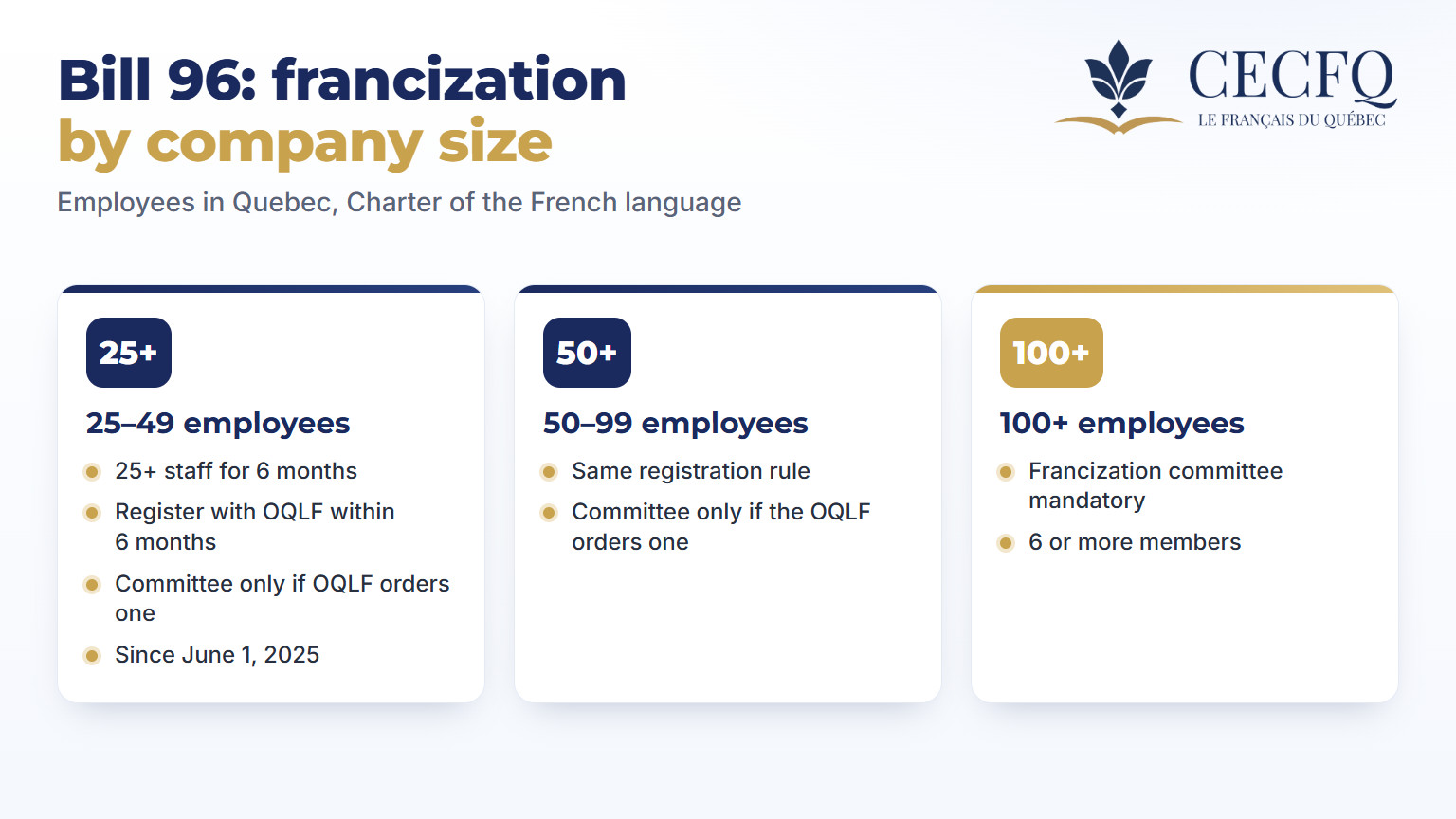
| 25–49 employees | Must register with the OQLF within six months after employing 25 or more people for a six-month period; this threshold has applied since June 1, 2025 (s. 139). The OQLF may order a francization committee of 4 or 6 members (s. 140) |
| 50–99 employees | Same registration rule, in effect before Bill 96 extended it downward; a francization committee is required only if the OQLF orders one, with 4 or 6 members (s. 140) |
| 100+ employees | Same registration rule; a francization committee is mandatory, with 6 or more members (s. 136) |
Registration is only the first step. Within three months after its certificate of registration is issued, the business analyses its use of French and sends that analysis to the OQLF. If French is already generalized at all levels, the OQLF issues a francization certificate; if not, it asks the business to adopt a francization program, which must be submitted within three months of that notice (ss. 139, 140).
Once the OQLF approves the program, it issues an attestation of implementation (s. 143), and a francization certificate once the program is completed (s. 145). Businesses holding a certificate then submit a progress report every three years, with an action plan if shortfalls appear (ss. 146, 146.1).
What Happens If You Don’t Comply
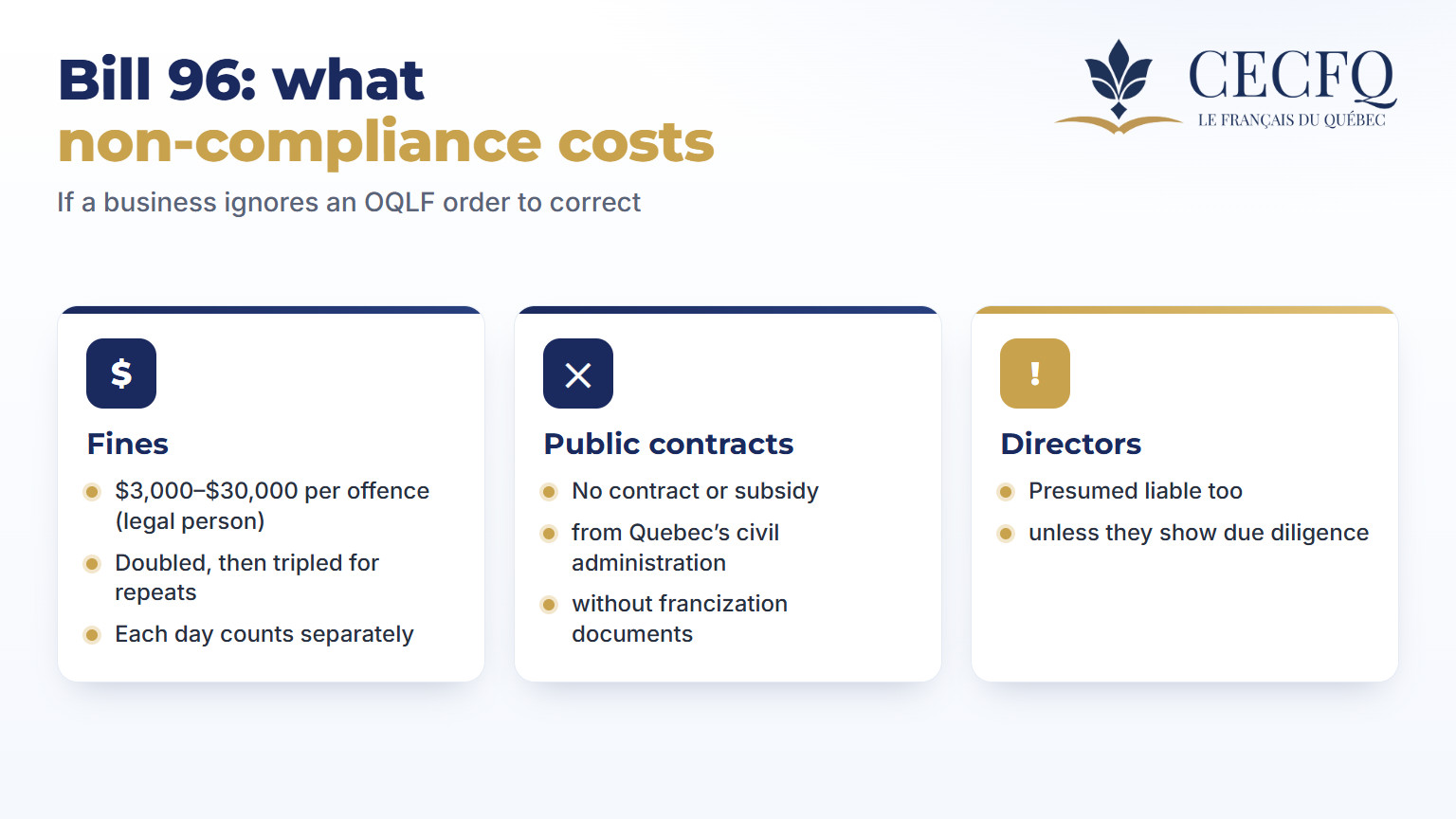
The fines tied to Bill 96 aren’t an automatic penalty for simply being unregistered. They apply when a business ignores a formal order from the OQLF to correct a specific situation (ss. 205, 207). Once that line is crossed, the amounts are meaningful: CAD $700 to $7,000 for an individual, and CAD $3,000 to $30,000 for a legal person such as a corporation, doubled for a second offence and tripled for any offence after that (s. 207).
An offence that continues for more than one day counts as a separate offence for each day (s. 208.0.1), and when a corporation commits an offence, its directors are presumed to have committed it too unless they show they exercised due diligence (s. 208.4.2).
There’s a second, quieter risk that matters more for businesses that work with the public sector: a company that doesn’t hold the required francization document — a certificate of registration, a language-situation analysis, an attestation of implementation, or a francization certificate — can’t sign a contract with Quebec’s civil administration (government departments and public bodies) or receive a subsidy from it (s. 152.1).
The same bar applies to a business with 5 to 24 employees that refused an OQLF offer of Francisation Québec courses (explained in the training section below), unless it later agreed to implement them (s. 152.1).
Is French Training Legally Required?
Not exactly, and this is where some online guidance overstates the law. The Charter doesn’t contain a standalone section saying “employers must provide French courses.” What section 141 requires, once a business is in the francization process, is a program covering the generalized use of French inside the business — things like a good knowledge of French among management and staff, the language used in internal systems and documents, and terminology (s. 141).
Training is one of the tools businesses commonly use to meet that obligation, not a separate legal checkbox.
The closest the Charter comes to requiring French courses concerns businesses with 5 to 24 employees. Each year, in sectors it selects, the OQLF can offer businesses that employ at least five people but aren’t required to register the option of implementing French-language learning services provided by Francisation Québec (s. 149).
A business that accepts such an offer must let employees who can’t communicate in French take those courses (s. 150). One that refuses the offer (and doesn’t accept it later), or doesn’t respect the terms agreed with Francisation Québec, falls under the contract-and-subsidy bar described in the previous section (s. 152.1).
Free Public Courses vs. Private Corporate Training
Francisation Québec is the government’s single access point for French-language learning, offered at no cost to eligible learners, including courses delivered in the workplace and online. For many businesses, especially without an urgent OQLF deadline, this is a reasonable starting point.
Private corporate training tends to make more sense when a business needs things the free stream doesn’t prioritize: a schedule built around the company’s own calendar, vocabulary tied to the actual industry, groups split by existing level, and a faster start without waiting for a public intake. None of this guarantees a specific outcome with the OQLF — it gives a business more control over how the training happens.
CECFQ offers business French and corporate courses built around that second approach: practical workplace vocabulary, level-based groups, and schedules set around a company’s calendar. For the planning side of a program, see our guide to structuring corporate French training in Quebec.

Signage and Other Customer-Facing Rules
Bill 96 also changed signage rules. Since June 1, 2025, French must be “markedly predominant” on any sign visible from outside a business when that sign carries a trademark or business name in another language (ss. 58.1 and 68.1). This is separate from the workplace-language rules above, but worth checking at the same time as internal francization work.
Customer-facing rules sit in the same Charter, several of them tightened by Bill 96: contracts of adhesion with clients (s. 55), product labelling (s. 51), and the consumer’s right to be informed and served in French (ss. 5 and 50.2). They fall outside this workplace guide but belong on the same compliance review.
A Practical Compliance Checklist
- Count employees across any rolling six-month period, not just today’s headcount — the francization threshold is based on sustained employment, not a snapshot.
- Review current job postings and employment contracts for language requirements that aren’t documented or justified.
- Audit written communications to staff and training documents for French versions (required for every employer, s. 41); for registered businesses, extend the review to software and internal systems (part of the francization program, s. 141).
- For any role that genuinely needs another language, document the needs assessment, the check on existing staff skills, and the effort to limit how many positions carry the requirement (s. 46.1).
- If the business has carried 25 or more employees for six months, start the OQLF registration — the law gives up to six more months to complete it, but the clock is already running.
- If the business has 5 to 24 employees and receives an OQLF offer to implement Francisation Québec courses, treat it as a real decision: refusing it (without accepting it later) bars government contracts and subsidies (s. 152.1).
- If the business employs 100 or more people, start planning a francization committee with at least six members.
- If a francization certificate is already in place, calendar the three-year progress report so it isn’t missed.
2 Real Cases:
A Montreal software company grew from 18 to 32 employees over a single year. No one was tracking the francization threshold. Only during a routine finance review did the company realize it had employed 25 or more people for more than six months — meaning its six-month registration window was already running, or close to closing.
A regional distributor required English on every job posting, including warehouse and administrative roles with no client-facing component. When an employee raised the issue, the company had never documented why those specific roles needed English or whether French-speaking staff could have covered the work — the kind of gap section 46.1 is built to catch.
These are illustrative scenarios, not real client files. The outcome of any similar situation depends on the specific facts involved and on the OQLF’s own assessment.
Frequently Asked Questions
1. Does Bill 96 apply to businesses with fewer than 25 employees?
Yes, in part. The core workplace duties in section 41 — French job postings, contracts, and communications — apply to every employer regardless of size. Francization registration and committees only start at 25 employees and up. Businesses with 5 to 24 employees may also receive an OQLF offer to bring Francisation Québec courses into the workplace; refusing it (and not accepting it later) closes the door to Quebec government contracts and subsidies (ss. 149, 152.1).
2. Do all businesses need a francization committee?
No. A committee is mandatory only once a business employs 100 or more people. Smaller registered businesses may still be ordered to form one, with 4 or 6 members, but it isn’t automatic below that threshold.
3. Can we require English for a specific role?
Only if the nature of the duties genuinely requires it, and only after taking “all reasonable means” to avoid the requirement — a documented needs assessment, a check on existing staff skills, and keeping the number of such positions as low as possible (s. 46.1). The job posting also has to state the reason.
4. What happens if the OQLF orders changes and the business doesn’t act?
That’s when fines apply — up to $7,000 for an individual and up to $30,000 for a legal person, doubled or tripled for repeat non-compliance. Being late to register isn’t the same as ignoring a formal order, but both are worth avoiding.
5. Is French training legally required under Bill 96?
Not as a standalone rule. Training is one way businesses meet their broader francization program once registered, but the Charter doesn’t mandate courses specifically. The closest case is a business with 5 to 24 employees that accepts an OQLF offer of Francisation Québec courses: it must then let employees who can’t communicate in French take them (s. 150). See “Is French Training Legally Required?” above for the details.
6. Where can employees learn French at no cost?
Francisation Québec offers free government-funded courses, including options delivered in the workplace and online. Businesses that need a faster timeline or workplace-specific vocabulary often pair this with private corporate training.
Disclaimer: This article is for general information only and does not constitute legal advice. Quebec’s French Language Charter and the OQLF’s enforcement practices continue to evolve, and how these rules apply can depend on the specific facts of a business. For guidance on your situation, consult a lawyer and, where relevant, contact the OQLF directly.
Get Your Team’s French Moving in the Right Direction
For corporate training, write to us about your team’s needs at info@cecfq.ca.
We reply within 24 hours to set up a short call, then assess each employee’s level and build groups by level. On request, participants receive a CECFQ certificate for each level or sub-level completed — a school certificate, separate from official exams such as the TEF or DELF.
To see where each employee stands before training, they can take our French level test (CAD $20, credited back as a promo code toward a course).
Email: info@cecfq.ca
Website: cecfq.ca
Address: 50 Rue Saint-Charles O, local 100, Longueuil, QC J4H 1C6
Hours: Monday–Friday 9:00 a.m.–6:00 p.m., Saturday 9:00 a.m.–2:00 p.m.