
In this article
- TEF Canada → NCLC: the Official IRCC Table
- TCF Canada → NCLC: the Official IRCC Table
- What NCLC 7 Actually Unlocks
- French-Language Proficiency Category: 2026 Draws
- Other French Thresholds Worth Knowing
- Quebec’s Separate Scale: Why “Niveau 7” Isn’t NCLC 7
- Which Skill Usually Needs the Most Work
- Frequently Asked Questions
- Ready to Find Out Where Your French Stands?
NCLC stands for Niveaux de compétence linguistique canadiens, the French-language equivalent of the Canadian Language Benchmarks (CLB) used for English. “NCLC 7” means a score of at least 7, out of 12, in each of the four skills: speaking, listening, reading, and writing. One weak skill below 7 means you don’t have NCLC 7 overall, even if the other three are higher.
NCLC 7 is one of the thresholds Immigration, Refugees and Citizenship Canada (IRCC) uses across federal immigration programs — though the exact bar shifts by program and even by job type. It’s the minimum for the Express Entry “French-language proficiency” category, and once IRCC converts your TEF Canada or TCF Canada results to NCLC, each level, including 7, carries a set number of Comprehensive Ranking System (CRS) points. This guide walks through the official score tables, what reaching NCLC 7 actually opens up, and where people get tripped up — especially the difference between NCLC and Quebec’s own French scale.
In practice, NCLC 7 means at least 310 in speaking and writing, 249 in listening and 207 in reading on TEF Canada (the “Équivalence ancien score” column), or 10/20 in speaking and writing, 458 in listening and 453 in reading on TCF Canada.
If you’re still deciding which exam to take, our guide on which French exam you need for Canada covers that first step.

TEF Canada → NCLC: the Official IRCC Table
IRCC converts TEF Canada results to NCLC using the table below. These are the current ranges, by skill, for NCLC 4 and up.
| NCLC | Speaking | Listening | Reading | Writing |
| 10+ | 393–450 | 316–360 | 263–300 | 393–450 |
| 9 | 371–392 | 298–315 | 248–262 | 371–392 |
| 8 | 349–370 | 280–297 | 233–247 | 349–370 |
| 7 | 310–348 | 249–279 | 207–232 | 310–348 |
| 6 | 271–309 | 217–248 | 181–206 | 271–309 |
| 5 | 226–270 | 181–216 | 151–180 | 226–270 |
| 4 | 181–225 | 145–180 | 121–150 | 181–225 |
Source: IRCC — Express Entry language test results.
The trap: two columns on your certificate. Your TEF Canada attestation de résultats shows two sets of numbers side by side: one labelled “Équivalence ancien score” (previous score equivalency) and one labelled “Score / 699.” For Express Entry, you must enter only the “Équivalence ancien score” figures — the ones in the table above. IRCC says entering the wrong column “may” lead to a refused application. Don’t use the “Score / 699” numbers in your profile, even though they’re printed on the same page.
Between December 11, 2023 and May 6, 2024, TEF Canada results were temporarily converted to NCLC with a different grid; IRCC has since reverted to the grid above. Certificates from that window are now more than two years old, so for a current Express Entry profile, the table above is the one that applies.
TCF Canada → NCLC: the Official IRCC Table
TCF Canada uses a different point scale — listening and reading are scored out of 699, speaking and writing out of 20 — and IRCC maps it to NCLC separately. Here’s the current table, from NCLC 4 up to the top band.
| NCLC | Speaking | Listening | Reading | Writing |
| 10+ | 16–20 | 549–699 | 549–699 | 16–20 |
| 9 | 14–15 | 523–548 | 524–548 | 14–15 |
| 8 | 12–13 | 503–522 | 499–523 | 12–13 |
| 7 | 10–11 | 458–502 | 453–498 | 10–11 |
| 6 | 7–9 | 398–457 | 406–452 | 7–9 |
| 5 | 6 | 369–397 | 375–405 | 6 |
| 4 | 4–5 | 331–368 | 342–374 | 4–5 |
Source: IRCC — Express Entry language test results.
Both TEF Canada and TCF Canada results are accepted for Express Entry, but your results must be less than two years old on the day you submit your profile and on the day you submit your permanent residence application — not just one or the other.
What NCLC 7 Actually Unlocks
Reaching NCLC 7 in all four skills matters differently depending on which Express Entry program or category you’re using.
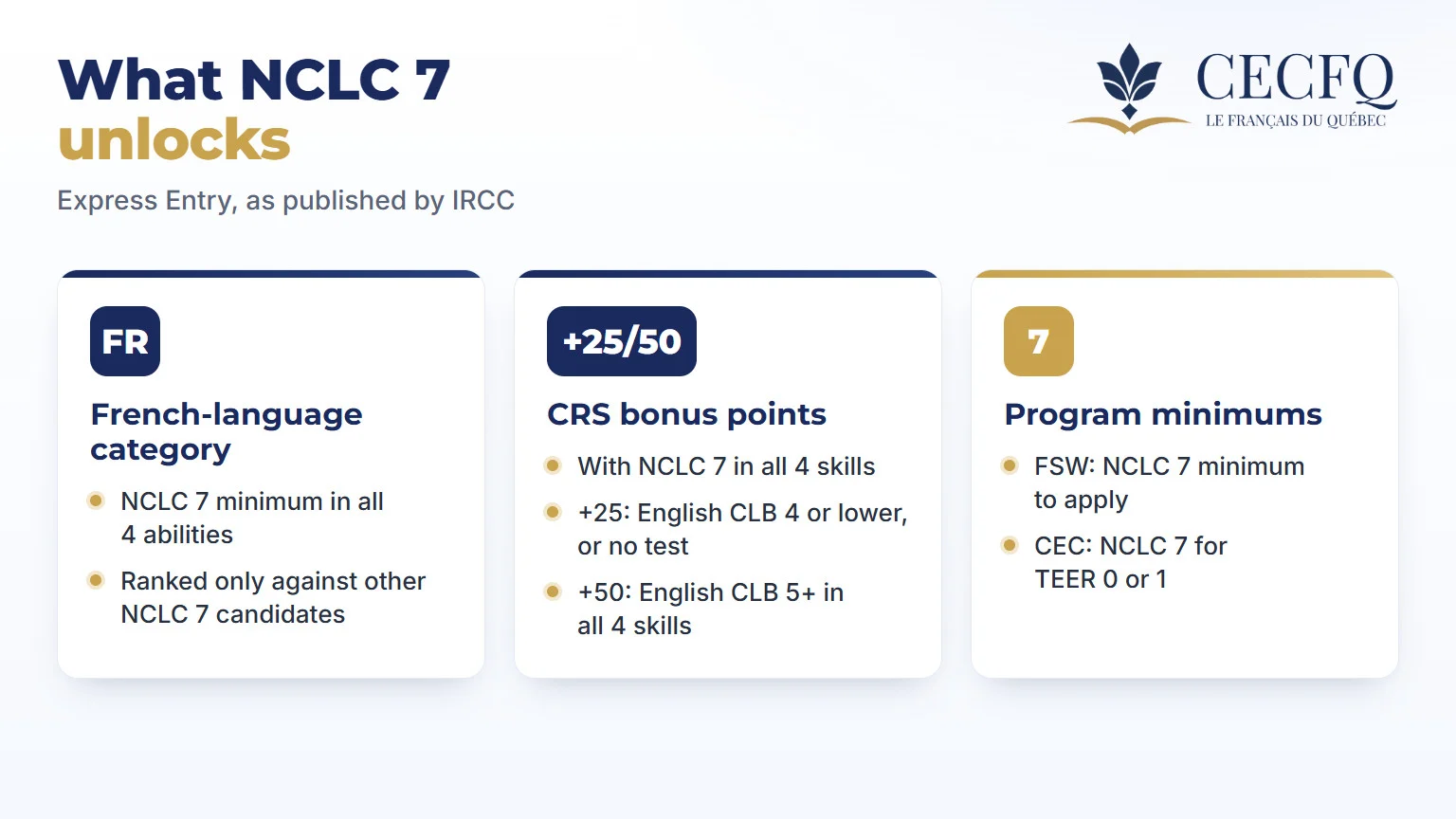
- Federal Skilled Worker (first official language): NCLC 7 in all four skills is the minimum to be eligible at all — below NCLC 7 in any one skill, you can’t apply under FSW with French as your first official language. Once you meet it, the FSW eligibility grid (separate from CRS) gives 4 points per skill at NCLC 7, 5 at NCLC 8, and 6 at NCLC 9 or higher — on both the TEF Canada and TCF Canada scales shown above.
- Canadian Experience Class: jobs classified TEER 0 or 1 need NCLC 7; jobs classified TEER 2 or 3 need only NCLC 5.
- French-language proficiency category: this Express Entry category requires a minimum of NCLC 7 in all four abilities.
- Core CRS language points: French counts toward your CRS score even before any bonus. If French is your first official language, each skill at NCLC 7 is worth 17 CRS points (16 if your spouse or common-law partner is coming with you) — 68 for all four, versus 23 per skill at NCLC 8 and 31 at NCLC 9. If French is your second official language, NCLC 7 or 8 gives 3 points per skill, so 12 in total.
- CRS bonus points: scoring NCLC 7 or higher on all four French skills adds 25 CRS points if your English is CLB 4 or lower (or you didn’t take an English test), and 50 points if your English also reaches CLB 5 or higher on all four skills. For example, a candidate whose first official language is English (CLB 5 or higher in all four skills) and who reaches NCLC 7 in French gets 12 core points plus the 50-point bonus — 62 CRS points from French alone.
In short, NCLC 7 is the line between “French helps a little” and “French changes your eligibility and your score in a meaningful way.”
French-Language Proficiency Category: 2026 Draws
Candidates who meet the NCLC 7 bar in all four skills can be invited through Express Entry’s category-based selection for French-language proficiency. In these rounds, you’re ranked only against other candidates who meet the same bar, not against the whole pool. Here are the rounds held so far in 2026, as published by IRCC.
| Draw date | Invitations issued | CRS cutoff |
| Feb 6, 2026 | 8,500 | 400 |
| Mar 4, 2026 | 5,500 | 397 |
| Mar 18, 2026 | 4,000 | 393 |
| Apr 15, 2026 | 4,000 | 419 |
| Apr 29, 2026 | 4,000 | 400 |
| May 28, 2026 | 4,500 | 409 |
| Jul 9, 2026 | 5,000 | 420 |
| Jul 22, 2026 | 5,000 | 399 |
| Aug 6, 2026 | 5,000 | 391 |
| Aug 19, 2026 | 5,000 | 382 |
| Oct 16, 2026 | 5,000 | 435 |
As of October 20, 2026. These are IRCC’s own figures, not a projection — the CRS cutoff moves from round to round based on who’s in the pool. It went from 382 on August 19 to 435 on October 16, so a score that was enough in August was no longer enough in October — and the cutoff can move again in the next round.
Other French Thresholds Worth Knowing
NCLC 7 isn’t the only French threshold IRCC uses — two others often come up outside Express Entry.
- Canadian citizenship only requires NCLC 4 in speaking and listening (not reading or writing) if you’re between 18 and 54 years old. It’s a much lower bar, but it only applies to the citizenship application itself, not to Express Entry scoring.
- Francophone Mobility work permits ask for an intermediate level, equivalent to NCLC 5 or higher, in speaking and listening only. It’s a lower bar than Express Entry’s French category, but it only applies to that specific work permit stream.

Quebec’s Separate Scale: Why “Niveau 7” Isn’t NCLC 7
First, a basic split: Express Entry is only for people who plan to live outside Quebec. IRCC puts it plainly: “The province of Quebec selects its own skilled workers.” If you intend to settle in Quebec, your target isn’t NCLC 7 but the French level set by Quebec’s own programs — and Quebec doesn’t use NCLC. The Programme de l’expérience québécoise (PEQ) and the Programme de sélection des travailleurs qualifiés (PSTQ) both measure French against Quebec’s own Échelle québécoise des niveaux de compétence en français — a different scale with its own number system.
Under PEQ’s Volet Diplômés du Québec stream, candidates need niveau 7 or higher oral and niveau 5 or higher written on that Quebec scale. The Volet Travailleurs étrangers temporaires stream, by contrast, asks only for niveau 7 oral — there’s no written requirement listed for that stream. Under PSTQ, candidates in FEER categories 0, 1, or 2 need niveau 7 oral and niveau 5 written; those in FEER 3, 4, or 5 need only niveau 5 oral.
Quebec’s Ministère de l’Immigration, de la Francisation et de l’Intégration (MIFI) publishes a correspondence chart showing that Échelle québécoise levels 7–8 line up with CEFR B2 — but that’s a statement about Quebec’s own scale, not about NCLC. IRCC’s Express Entry pages don’t publish an NCLC-to-CEFR chart, so treat “NCLC 7 ≈ B2” as a rough comparison at best, not an interchangeable label.
One more wrinkle: PEQ intake opens and closes in periods set by MIFI, so check the program’s current status before planning around it rather than assuming it’s always accepting applications.
Which Skill Usually Needs the Most Work
Every candidate’s profile is different, but in practice, the two production skills — speaking and writing — are often the ones that take the most additional practice to push from NCLC 5–6 up to 7. Both require producing language on the spot rather than recognizing it, which is harder to practice passively than reading or listening. It’s worth doing a few timed practice sessions in speaking and writing specifically, rather than assuming that strong reading comprehension means your overall score will follow.
For a structured plan built around TCF Canada’s format, see our TCF Canada 2026 study plan. For TEF, our TEF Canada study plan shows how to structure your practice. For the exam-day details themselves, see our guide to what to expect when you sit the TEF Canada exam.

2 Real Cases:
Case 1 — three strong skills, one gap. A candidate preparing for Express Entry scored NCLC 8 in speaking, listening, and reading on TEF Canada, but NCLC 6 in writing. Because NCLC 7 requires all four skills to clear the bar, the writing score alone kept the file out of the French-language proficiency category until targeted writing practice brought that skill up to NCLC 7 on a retake.
Case 2 — “niveau 7” isn’t NCLC 7. Another candidate had planned on PEQ, then decided to settle in Ontario and switch to Express Entry. They assumed their niveau 7 on Quebec’s Échelle québécoise would automatically count as NCLC 7. It doesn’t — the label doesn’t transfer. Their Quebec proof was a DELF diploma, which Express Entry doesn’t accept, so they had to sit TEF Canada or TCF Canada for the federal file. Had the Quebec proof been a TEF Canada or TCF Canada result under two years old, the same scores could have been converted with IRCC’s table instead.
Frequently Asked Questions
1. What’s the difference between NCLC and CLB?
CLB (Canadian Language Benchmarks) measures English proficiency; NCLC (Niveaux de compétence linguistique canadiens) measures French proficiency. Both use the same 1–12 numbering scale, one for each language.
2. Does NCLC 7 guarantee an Express Entry invitation?
No. NCLC 7 in all four skills makes you eligible for the French-language proficiency category and adds CRS points, but invitations depend on the CRS cutoff in each draw, which changes based on who else is in the pool that round.
3. Can I use the “Score / 699” column on my TEF Canada certificate for Express Entry?
No. Only the “Équivalence ancien score” column counts toward your Express Entry profile — IRCC says not to enter the “Score / 699” numbers there, and using them may lead to a refused application.
4. How long are TEF Canada and TCF Canada results valid for Express Entry?
Less than two years. That requirement applies twice — once when you submit your Express Entry profile, and again later when you submit your permanent residence application — so a test taken early in a long wait could expire before the file is finished.
5. Is NCLC 7 the same as PEQ’s “niveau 7”?
No. PEQ and PSTQ use Quebec’s Échelle québécoise, a separate scale from NCLC. A niveau 7 on Quebec’s scale doesn’t automatically translate to NCLC 7. For Express Entry, only a TEF Canada or TCF Canada result converted with IRCC’s table counts.
6. Which exam should I take, TEF Canada or TCF Canada?
Both are accepted for Express Entry and convert to NCLC through the tables above. The right one often comes down to format and availability near you — our exam comparison guide walks through the practical differences.
Disclaimer: This article is for general information only and isn’t immigration advice. Express Entry rules, score tables, category-based selection, and draw results are set and updated by IRCC and Quebec’s MIFI, and they can change. Confirm current requirements and your own eligibility directly with IRCC, Quebec’s ministry, or a licensed immigration professional before making decisions based on this content.
Ready to Find Out Where Your French Stands?
A level test gives you a realistic picture of where your French stands before you book an official exam, so you can choose the right TEF Canada or TCF Canada preparation. CECFQ is an accredited TEF test centre in Longueuil, so you can also prepare for and sit the TEF with us — session dates and the exact exam address haven’t been published yet; check the TEF preparation page for current availability. The level test costs CAD $20, and that amount comes back to you as a promo code toward a course. Take your French level test, then move into TEF or TCF preparation once you know your starting point.
Email: info@cecfq.ca
Website: cecfq.ca
Address: 50 Rue Saint-Charles O, local 100, Longueuil, QC J4H 1C6
Hours: Monday–Friday 9:00 a.m.–6:00 p.m., Saturday 9:00 a.m.–2:00 p.m.