
Three names show up whenever “French exam for Canada” gets searched, and they don’t serve the same purpose. Get the wrong one and you’ve spent 200 to 400 CAD and several weeks of preparation on a result the office that asked for it won’t accept. The answer usually comes down to one question: who exactly is asking for your French result?
This guide walks through the rule that decides most cases, compares DELF, DALF, TEF Canada and TCF Canada side by side, and clears up the two points that confuse candidates most — a diploma that never expires next to a two-year validity rule, and an exam you can fail next to a test you can’t.

Which French Exam Does Each Program Accept?
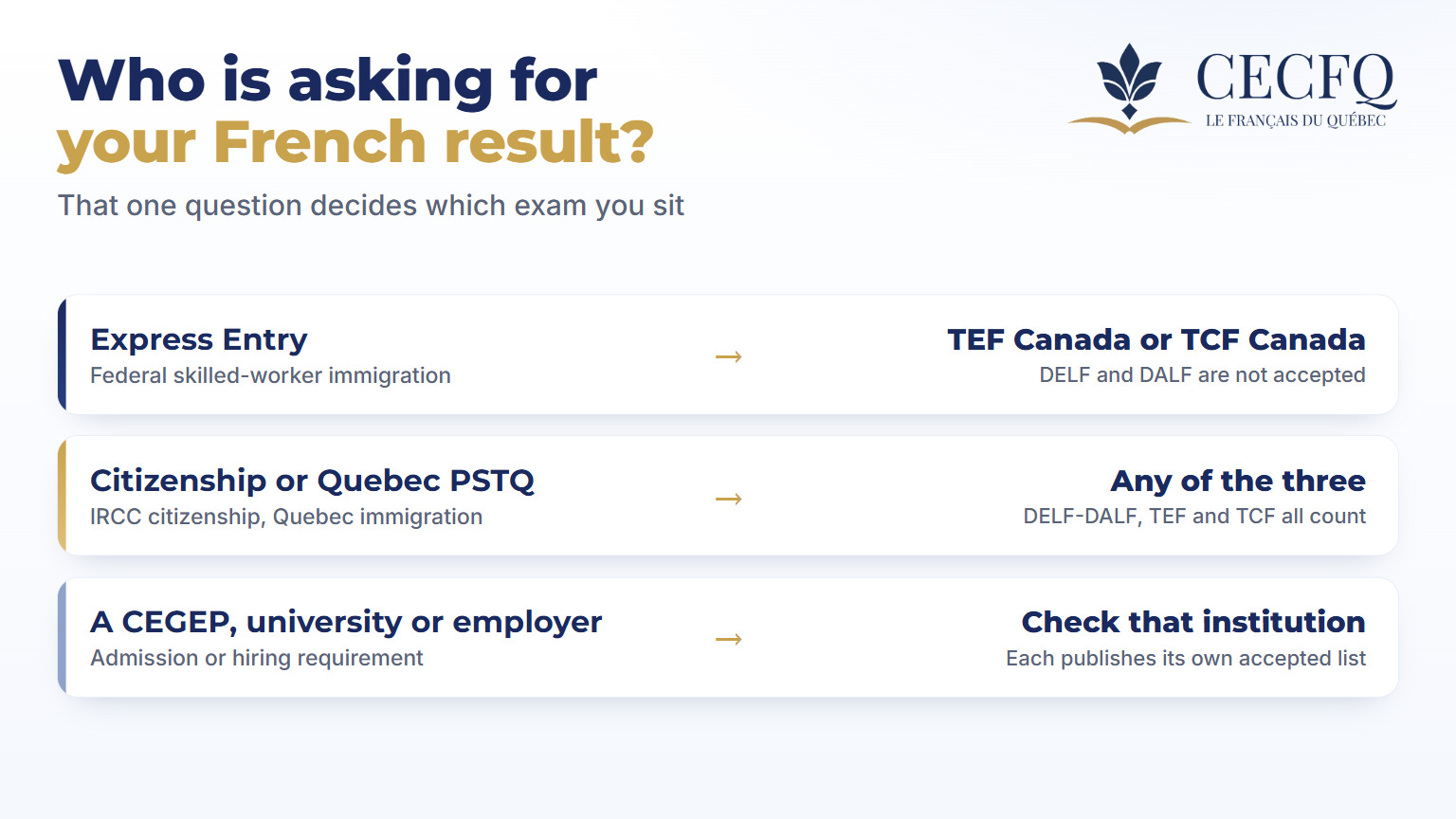
If you’re applying through Express Entry, the federal system that manages applications to programs such as the Federal Skilled Worker Program, IRCC accepts TEF Canada and TCF Canada for your French result — the only two French tests on IRCC’s list of approved language tests. DELF and DALF are not on it. This is a common reason candidates end up with the wrong exam: they prepare for DELF because it’s the one they’ve heard of, then discover their federal application needs a different test entirely.
Outside Express Entry, the picture opens up, but the exact proof still depends on the authority reviewing your file. For Canadian citizenship, IRCC. accepts several third-party French proofs, including DELF B1 or higher, DALF, TEF/TEFAQ and TCF-family tests when the required results are met. For permanent immigration to Quebec through the Programme de sélection des travailleurs qualifiés (PSTQ), MIFI lists DELF, DALF, TCF-Québec, TCF-Canada, TCF, TEFAQ, TEF Canada and TEF as accepted proofs, with results required to be two years or less on the date you apply.
Schools and colleges decide on their own. Dawson College, for example, asks for a minimum B2 level and accepts DELF B2, DALF, TEF/TEFAQ and TCF tout public among its accepted proofs. Dawson specifically notes that TCF Québec and TCF Canada are not accepted for its French admission requirement, which is exactly why candidates must check each institution’s own list before registering.
So the shortcut is this: Express Entry narrows you to TEF Canada or TCF Canada. For citizenship, Quebec immigration and schools, DELF-DALF may also be accepted, but the final rule is always set by the program, institution or authority reviewing your file.
Three Exams at a Glance
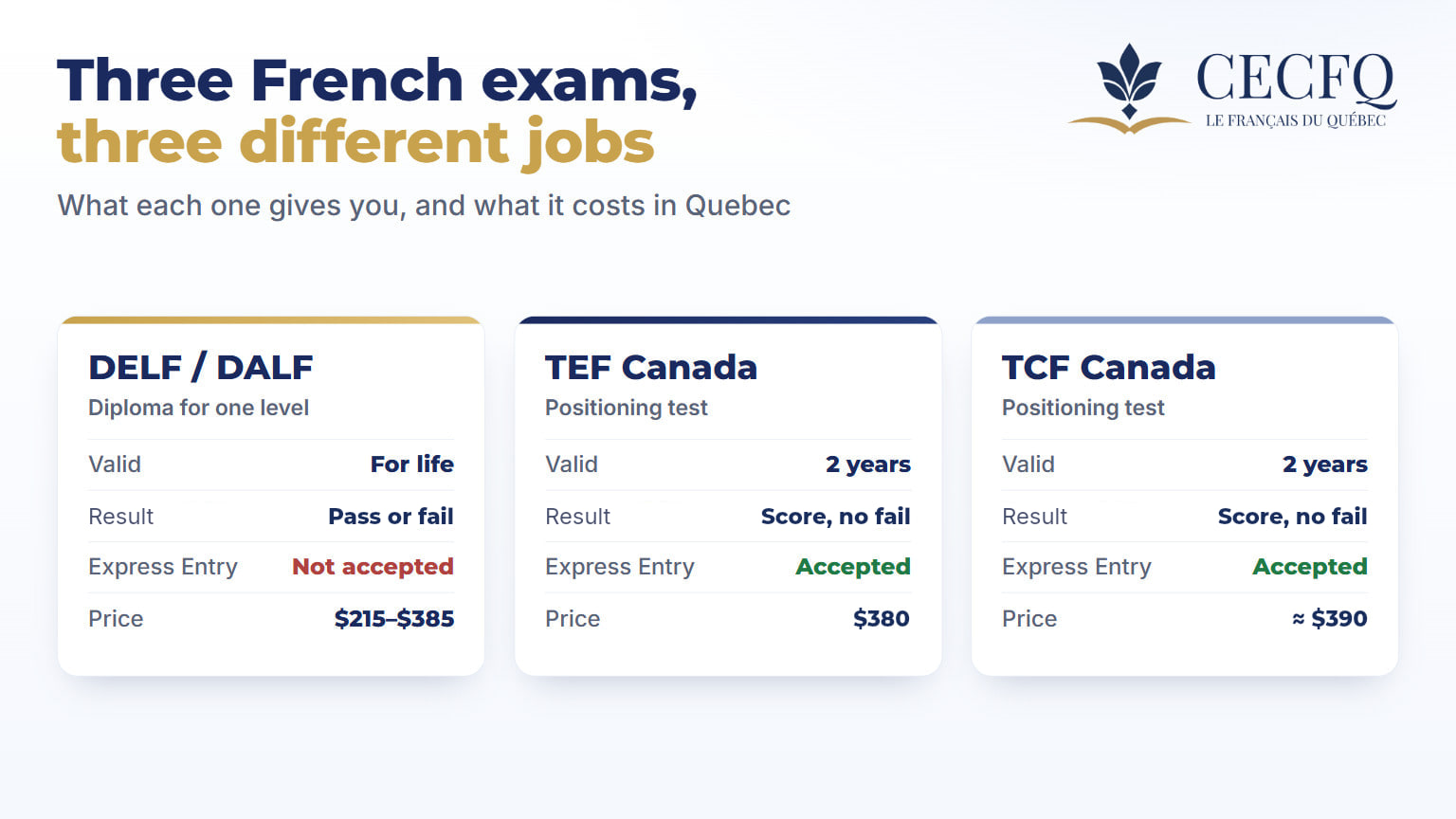
| DELF / DALF | TEF Canada | TCF Canada | |
| What it is | Level-specific diploma (A1–B2 DELF, C1–C2 DALF) | Positioning test, four skills in one sitting | Positioning test, four skills in one sitting |
| Result | Pass or fail: the diploma requires 50/100 overall, with at least 5/25 in each skill | A score, no fail: your actual level is always certified | A score, no fail: your actual level is always certified |
| Result validity | Diploma never expires; authorities like the PSTQ and Dawson want results 2 years old or less | 2 years from the test date | 2 years from the test date |
| Accepted for Express Entry? | No | Yes | Yes |
| Fall 2026 price in Quebec | 215–385 CAD by level (CECFQ, Longueuil) | 380 CAD, all four sections (CECFQ, Longueuil) | About 390 CAD, depending on the test centre |
| Results timeline | Attestation about 2 weeks, diploma 8–10 weeks | About 2 weeks | About 2 weeks, depending on the centre |
Already deciding between the two positioning tests specifically? Our separate TEF Canada vs TCF Canada comparison goes through their formats side by side — this guide focuses on the bigger fork, DELF-DALF against the other two.
Why a Lifetime Diploma Can Still Be Too Old
Here’s where most of the confusion sits. A DELF or DALF diploma, once you’ve earned it, never expires. It’s issued by France Éducation international and stays valid for life — a B2 diploma from ten years ago is still a real B2 diploma today.
But Quebec’s PSTQ page states it plainly: “Your results must be two years or less from the date you apply for permanent selection.” Individual schools, including Dawson in the example above, set the same two-year window.
These two facts aren’t in conflict — they come from different sources. The diploma’s lifespan is set by the exam operator, and it’s permanent. The application deadline is set by whoever is reviewing your file, and it’s usually two years. A DELF B2 from 2018 is still a legitimate B2, but if the office asking for it wants proof from the last two years, that old diploma won’t satisfy the requirement — not because it expired, but because the requester’s rule is stricter than the diploma’s own shelf life.
TEF Canada and TCF Canada sidestep this distinction entirely: their certificates themselves are only valid for two years, full stop, so there’s no separate “diploma vs. application” gap to track.
Pass-or-Fail Exam vs. Positioning Test
DELF and DALF work like a school exam: you register for a specific level — say B2 — and either clear the bar or you don’t. The threshold is fixed: 50 points out of 100 overall, with a minimum of 5 out of 25 in each of the four skills. Miss that floor in even one skill, and the result is a fail at that level, regardless of how well you did elsewhere. (Our guide to DELF scoring and what the B2 writing grid measures cover the detail.)
TEF Canada and TCF Canada don’t work that way. They’re positioning tests: you sit the same exam regardless of your level, and the result tells you where you land on the scale. Le français des affaires, the CCIP-IDF body behind TEF Canada, states it directly: “TEF Canada is not a pass/fail exam… candidates always receive certification of their actual proficiency level.” TCF Canada comes from France Éducation international, the same organisation that issues DELF and DALF. There’s no floor to clear — a lower score is still a valid, usable result, just for a lower level.
That difference changes how you prepare. For DELF or DALF, your target is the specific level you registered for — study to clear B2, and clearing it comfortably is enough; there’s little benefit in over-preparing past the threshold. For TEF or TCF, there’s no threshold to aim at, only a ceiling to push toward: a higher result can carry more weight where points are awarded, as in Express Entry, while a program with a fixed bar — citizenship, or a college asking for B2 — only needs you to reach it.
Candidates who prepare for TEF or TCF as if it were pass/fail — cramming to “get past” a level rather than maximizing their score — tend to leave points on the table; our guide to why candidates underperform on TCF/TEF walks through the common patterns.
Which Exam Fits Your Situation
- Express Entry → TEF Canada or TCF Canada, and confirm on IRCC’s page before you book.
- Citizenship or the PSTQ → several DELF/DALF, TEF and TCF options may be accepted, but the required level, skills and document age depend on the authority reviewing your file.
- A CEGEP, university or employer → their own published list decides, so check it before you register.
- An old DELF-DALF diploma in hand → still valid, but check whether that file wants a result from the last two years.
- A score that has to compete, not just qualify → TEF or TCF, where there is no threshold to stop at.

What Each Exam Costs in Quebec This Fall
DELF-DALF, through CECFQ’s affiliated exam location in Longueuil, runs from 215 CAD at A1 to 385 CAD at C1 and C2, with sessions in September and November — the fall 2026 registration guide has the full fee table, exam dates and payment deadlines. These sessions are administered on behalf of the LBPSB DELF Examination Centre — the same official exam, sat locally on the South Shore.
TEF Canada can also be taken at CECFQ in Longueuil: we are an accredited centre of Le français des affaires, and all four sections cost 380 CAD. Our first sessions are coming very soon — dates and the waiting list are on our TEF exam page. TCF Canada is taken at a centre accredited by France Éducation international (CECFQ doesn’t administer it): expect about 390 CAD for all four sections, with results usually back in about two weeks. We prepare you for it online, with examiners.
If you’re preparing for DELF or DALF specifically, CECFQ also runs an intensive DELF-DALF preparation course — 12 hours over four weeks, 240 CAD plus a 20 CAD registration fee, for levels B1 through C2, taught by certified DELF-DALF examiners. One session runs August 24 to September 16, 2026, ahead of the September exam; a second runs October 26 to November 18, 2026, ahead of November. Not sure which level to prepare for in the first place? A French level test gives you a starting read before you commit to a date.
2 Real Cases:
Case 1: The Wrong Exam for the Program
A candidate preparing an Express Entry profile spent three months studying for DELF B2, on the assumption that any recognized French diploma would strengthen his application. He registered for a session, passed comfortably, and only then found — while assembling the rest of his federal file — that Express Entry doesn’t accept DELF or DALF at all.
His diploma remained a legitimate, permanent B2 result, useful for citizenship later and for job applications, but it did nothing for the federal points calculation he’d actually been preparing for. He ended up booking a TEF Canada sitting afterward, effectively preparing twice for two different exams that measure similar French but serve different offices.
Case 2: Checking the Two-Year Window First
A candidate applying to the PSTQ held a DELF B2 diploma from several years earlier and assumed it would simply carry over, since the diploma itself doesn’t expire. Before registering for anything, she checked Quebec’s PSTQ requirements page and confirmed results needed to date less than two years back from her application date. Rather than resitting the full DELF B2, she compared timelines and costs against a fresh TCF Canada sitting, since either would satisfy the two-year rule, and chose TCF Canada mainly because the next available sitting fit her application window better than the next DELF session in Longueuil.
Frequently Asked Questions
1. Can I use TEF or TCF instead of DELF for Quebec immigration?
Yes. The PSTQ lists DELF, DALF, TCF (in its various forms) and TEF/TEFAQ together as accepted proof of French, with results converted to the Échelle québécoise scale either way. The choice usually comes down to cost, scheduling and whether you want a pass/fail diploma or a positioning score.
2. My DELF diploma is more than two years old — is it still valid?
The diploma never expires. Whether it satisfies a given application is a separate question: the PSTQ and schools like Dawson ask for results from the last two years, so an older diploma may need a fresh sitting for that file.
3. Can I fail the TEF or TCF Canada test?
Not in the way you can fail DELF or DALF. TEF Canada and TCF Canada are positioning tests — you always receive a certified result showing your actual level, whatever it is. What can happen is that your level comes in lower than a program requires, which has the same practical effect as a fail for that application, even though the exam itself doesn’t score it as pass/fail.
4. What exactly should I look for on a school’s admissions page?
Four things, and they’re rarely in the same paragraph: which exams appear on the accepted list, the minimum level required, whether a higher diploma counts in place of the one named (a DALF C1 where B2 is asked for, say), and the date the two-year window is counted from — your application date, or the start of the program. Programs with selective admission sometimes add a separate requirement on top, so read the program page as well as the general admissions one.
5. Where can I actually sit these exams in Quebec?
DELF and DALF are sat in person; CECFQ is an affiliated exam location on the South Shore, administering sessions on behalf of the LBPSB DELF Examination Centre. TEF Canada can also be taken at CECFQ, an accredited TEF centre (first sessions coming very soon). TCF Canada is taken at a centre accredited by France Éducation international.
Disclaimer: This article is for general information purposes only. Which exams are accepted, their fees, formats and validity periods can change, and requirements vary by program, institution and immigration stream. Always confirm current eligibility and accepted exams directly with IRCC, the Quebec government, the exam operator, or the institution reviewing your application before making decisions based on this guide. Nothing here constitutes immigration advice.
Not sure yet which exam matches your situation? Take your French level test to get a starting read, or look at the DELF-DALF preparation course if you’ve already confirmed DELF or DALF is the right fit. Questions about registration or which exam applies to you? Contact CECFQ:
Email: info@cecfq.ca
Website: cecfq.ca
Exam location, where DELF-DALF sessions are administered on behalf of the LBPSB DELF Examination Centre: 50 Rue Saint-Charles O, local 100, Longueuil, QC J4H 1C6
Courses and exam preparation are available in English and French.