
Many candidates understand the DELF format but not the specific scoring. This lack of clarity hinders focused practice and can increase exam-day stress.
Knowing how examiners evaluate performance allows you to target key skills, avoid common mistakes, and better understand your results. It builds confidence by clarifying expectations.
This guide details DELF exam scoring: how examiners assess each skill (listening, reading, writing, speaking), point allocation, and the true meaning of a passing score.
DELF Scoring System Explained
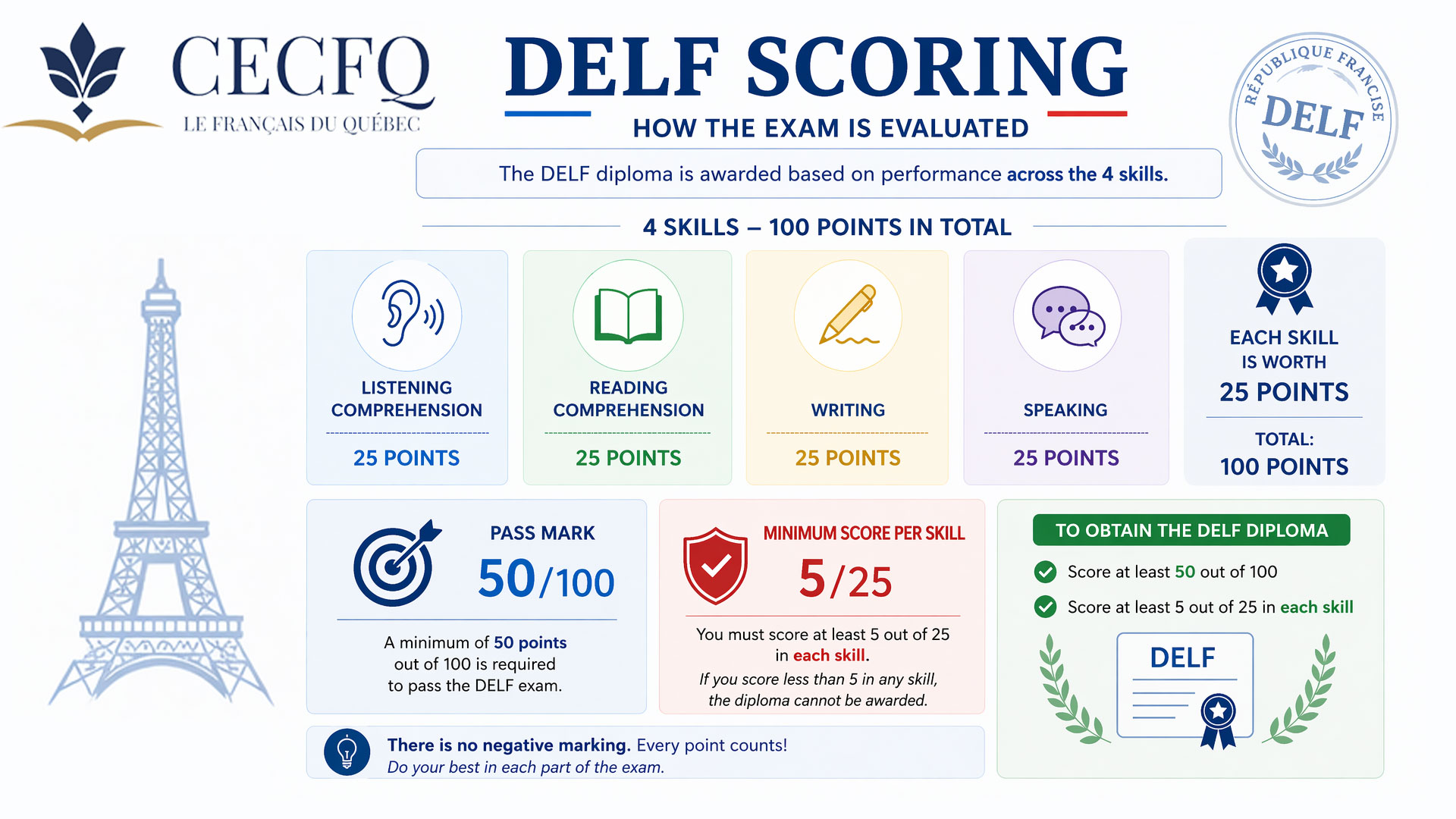
The DELF (A1-B2) employs a standardized scoring system from France Éducation International, applied globally. The exam comprises four skills: listening, reading, writing, and speaking. For DELF A1–B2, each skill is worth 25 points, totaling 100.
In 2026, the passing score remains 50/100. Crucially, a minimum of 5/25 is required in each skill. Strong performance in one area cannot compensate for a significant deficit in another. Examiners use official evaluation grids, ensuring consistent assessment for all candidates.
This unified scoring makes DELF results universally recognized by employers, academic institutions, and immigration authorities.
Scoring Criteria Overview
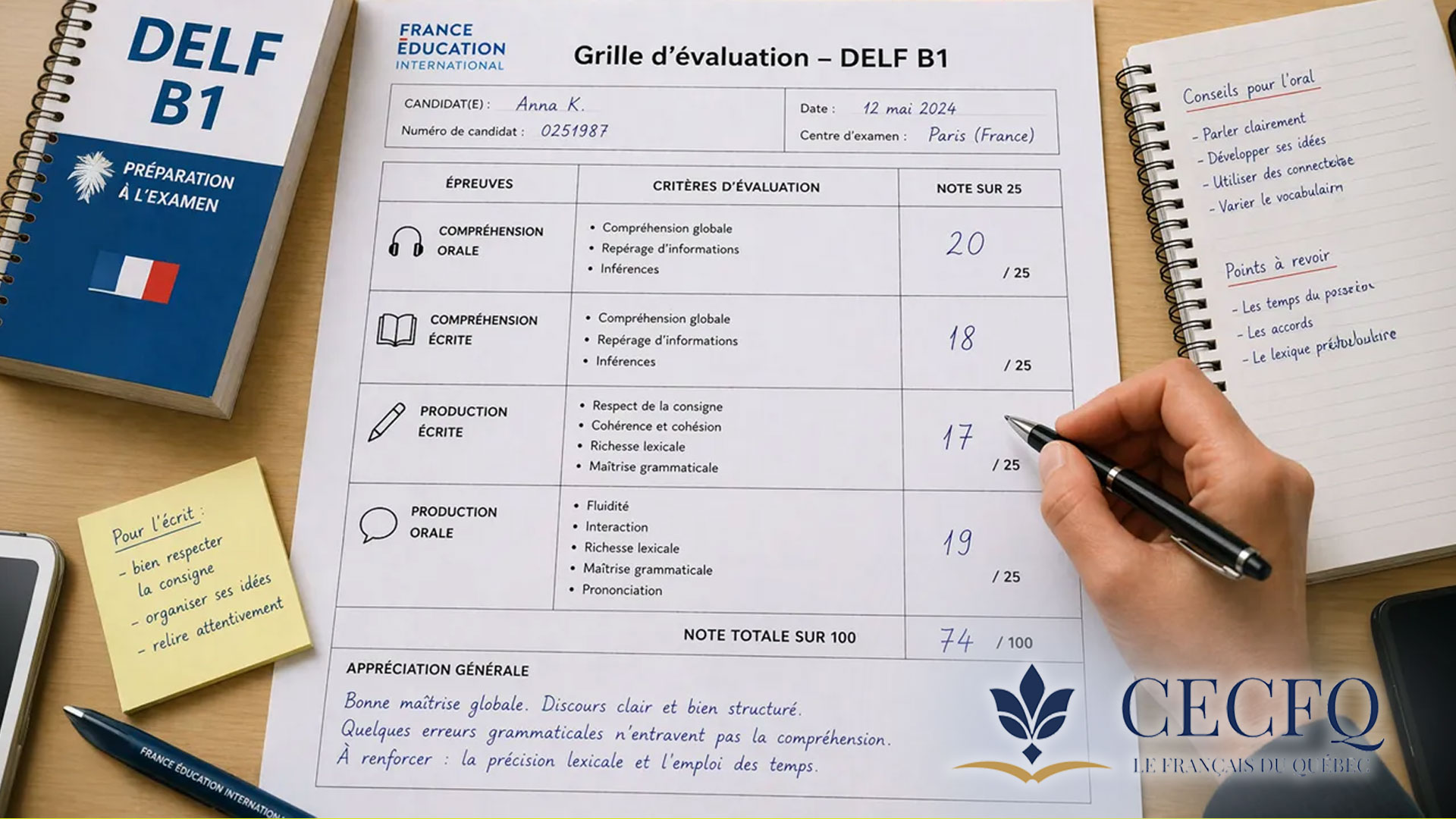
While each DELF paper has a specific grid, the core evaluation logic is consistent: examiners assess language accuracy, task completion, and communicative effectiveness. They verify if you answered questions, organized your thoughts, and used clear, appropriate French.
Listening and reading are scored objectively using official correction keys. Writing and speaking tasks are evaluated using analytic scales that consider content, vocabulary, grammar, and coherence. This ensures the DELF exam scoring is objective and based on measurable performance.
Examiner Evaluation Process
Examiners undergo specific training and calibration for consistent scoring. Some centers may use a second marker for quality assurance, particularly at B2 level. Oral exams are assessed according to the official grid; in many centers, one examiner conducts the interaction while another may co-assess.
They adhere strictly to time limits and provide only standardized instructions. Scoring is completed promptly post-session to maintain objectivity. This process ensures the DELF scoring system is transparent, fair, and comparable across all test centers.
DELF Evaluation by Skill
| DELF Skill | Max Points (per level) | Examiners Focus On |
| Listening (Compréhension orale) | 25 | Global understanding, key details, and ability to correctly answer task-based questions |
| Reading (Compréhension écrite) | 25 | Main ideas, information retrieval, and inference supported by the text |
| Writing (Production écrite) | 25 | Task achievement, structure, accuracy |
| Speaking (Production orale) | 25 | Fluency, interaction, range, correctness |
Speaking Test Evaluation
The speaking test, often a source of anxiety, is scored out of 25. The specific sub-criteria vary slightly by level (A1-B2). Examiners use a standardized grid focusing on four main areas: task fulfillment, lexical range, grammatical control, and pronunciation/fluency.
For A1-A2, the focus is on clear communication of basic information, accepting minor errors. For B1-B2, more complex structures, organized arguments, and effective use of tenses and connectors are expected. Examiners assess performance against the defined level, not for absolute perfection.
Speaking Band Descriptors
Band descriptors outline performance expectations for different score ranges. For B1, a score in the upper band indicates comprehensive answers, organized ideas, and sustained interaction with few significant errors, according to the official DELF speaking grid.
A mid-range score (12-16) might reflect communication challenges, limited vocabulary, or recurring grammatical issues. Examiners balance components like fluency and grammar accuracy to determine a final score aligned with the DELF exam scoring.

Speaking Mistakes That Lose Points
Common issues leading to lower speaking scores include:
- Inadequate use of preparation time for planning.
- Brief answers that do not develop the topic sufficiently.
- Over-reliance on simple structures without attempting more complex forms.
Pronunciation is assessed for clarity, not accent. While nervousness is understood, it should not impede your ability to speak adequately. Clear articulation, comprehensive responses, and demonstration of the target level are key.
Writing Test Evaluation
Writing assessments evaluate both content and form. Similar to speaking, scripts are scored using a grid covering task achievement, organization, vocabulary, grammar, and spelling. The emphasis may shift by level, but the principle remains: accurately address the prompt in the specified format.
For instance, a B1 writing task might require a letter or email. Examiners first verify the correct format, salutation, closing, and register. They then assess if you conveyed opinions, reasons, or arguments as requested, followed by an evaluation of grammar and vocabulary against B1 standards.
Writing Task Completion
Task completion is a frequent area for preventable score reduction. Even with good language skills, failing to:
- adhere to word count guidelines,
- cover all required points, or
- use the appropriate register,
can significantly impact the score. Examiners prioritize successful completion of the communicative task over sentence-level accuracy alone. This practical ability is highly valued in professional and academic settings.

Writing Common Penalties
Common reasons for reduced scores include:
- Texts falling below the minimum suggested length.
- Content that is off-topic or only partially relevant.
- Using generic, memorized phrases not tailored to the prompt.
Systematic errors in grammar or agreement, especially at B2, can lower scores. While isolated spelling mistakes are less critical if the message is clear, consistent errors affect the assessment of accuracy. The DELF exam scoring rewards clear, structured, level-appropriate writing.
Writing vs. Speaking: Scoring Differences
| Aspect | Writing Evaluation | Speaking Evaluation |
| Task focus | Format, structure, register | Interaction, spontaneity, adaptation |
| Planning time | Longer, you can draft and revise | Short prep, performance is live |
| Error tolerance | Slightly stricter on grammar and spelling | More tolerant if communication is clear |
| Key success factor | Organized, complete response | Fluency and ability to keep communication flowing |
Listening & Reading Comprehension Scoring
Listening and reading sections are scored more objectively than production skills. Each correct answer earns set points; partial credit is rare. Scoring relies heavily on predefined answer keys.
For listening, audio is played a fixed number of times. Examiners compare your responses to the official key. For reading, they assess your ability to extract information, grasp main ideas, and infer meaning or attitude.
Listening Comprehension Scoring
Lower levels feature tasks like matching, multiple-choice, and short answers based on specific details. Higher levels involve more complex audio and require understanding main points and nuances.
Score reduction often stems from:
- Misinterpreting key details like numbers or dates.
- Providing overly general answers instead of specific ones.
Precise answer keys govern DELF exam scoring. Effective preparation involves practicing with official materials and identifying keywords, rather than attempting to decipher every word.
Reading Comprehension Scoring
A1-A2 reading tasks focus on locating factual information in everyday texts. B1-B2 texts become longer, more abstract, and may include opinion pieces or formal documents, requiring deeper comprehension.
Examiners verify that:
- Your answers are directly supported by the text.
- Your responses are sufficiently precise and not vague.
Leaving answers blank means losing a chance to earn points. Attempting all questions, especially multiple‑choice, is a practical strategy to avoid unnecessary score loss.
Real Cases: DELF Scoring in Practice
Case 1: Strong speaking, borderline writing (B1)
A newcomer to Quebec focused on conversational practice for DELF B1. She achieved: listening 22/25, reading 20/25, speaking 23/25, but writing only 7/25. Her total score was 72/100, allowing her to pass as she met the global and per-skill minimums.
Her low writing score resulted from incorrect format and missed content points. This shows that strong skills in some areas are recognized, but minimum requirements per skill are strictly enforced.
Case 2: High global score but failed skill (B2)
An international student aiming for DELF B2 received: listening 19/25, reading 21/25, writing 20/25, speaking 4/25. Despite a total of 64/100, he failed because his speaking score was below the 5/25 threshold.
Examiners noted his difficulty maintaining interaction and frequent one- or two-word responses. This case highlights the critical importance of the minimum score per skill within the DELF exam scoring, alongside the overall total.
FAQ
1. How is the DELF exam scored overall?
Each DELF level (A1-B2) is scored out of 100 points (25 per skill). A passing score requires at least 50/100 globally and a minimum of 5/25 in each skill.
2. What do DELF examiners look for in speaking?
They assess task completion, message clarity, interaction, vocabulary range, grammar control, and pronunciation. For DELF exam scoring, effective communication and level-appropriate language are prioritized over perfection.
3. Are spelling and grammar very strict in DELF writing?
Errors are tolerated if they don't impede understanding and are consistent with the candidate's level. However, frequent or significant errors, particularly at B2, will lower scores for accuracy and potentially task achievement.
4. Can a very good score in one DELF skill compensate for a poor one?
No. A score below 5/25 in any skill leads to failing the exam, regardless of the total score. Each skill must meet the minimum threshold.
5. How can I know if my performance matches DELF scoring criteria?
Seek feedback based on official evaluation grids and practice materials simulating exam conditions. This helps you understand how examiners apply the DELF exam scoring to your current abilities and identify areas for focused preparation.
Ready to Master the DELF Exam?
Stop guessing what examiners want. At CECFQ, our certified teachers use official DELF scoring grids to evaluate your practice tests, highlighting exactly where you lose points and how to fix it.
Book your free consultation with CECFQ today to get a personalized preparation roadmap and walk into your exam with confidence.
Disclaimer: The DELF scoring system and evaluation criteria mentioned in this article are based on the official guidelines provided by France Éducation international as of 2026. While the core structure (50/100 pass mark, 5/25 minimum per skill) remains stable, grading rubrics may be updated. Always consult your certified testing center or the official France Éducation international website for the most current information.