
Immigration programs for Quebec and Canada often require an approved French test. TEF Canada and TCF Canada are widely accepted, leading many to ask which is easier for immigration.
The easier test varies based on your profile, French proficiency, and immigration program (Express Entry, PEQ/PSTQ, family, work, studies).
This guide details the differences between TEF Canada and TCF Canada, score conversions to NCLC/CLB in 2026, and helps you choose the exam that best meets your immigration goals.
Disclaimer: Immigration programs and language test formats are subject to change. The information in this article reflects the guidelines from IRCC, MIFI, and test providers as of Spring 2026. Please note that Quebec's immigration pathways for graduates and workers (such as the transition between PEQ and PSTQ) are currently undergoing active legislative reviews and updates. Always verify current requirements and accepted tests on the official government websites before submitting your application.
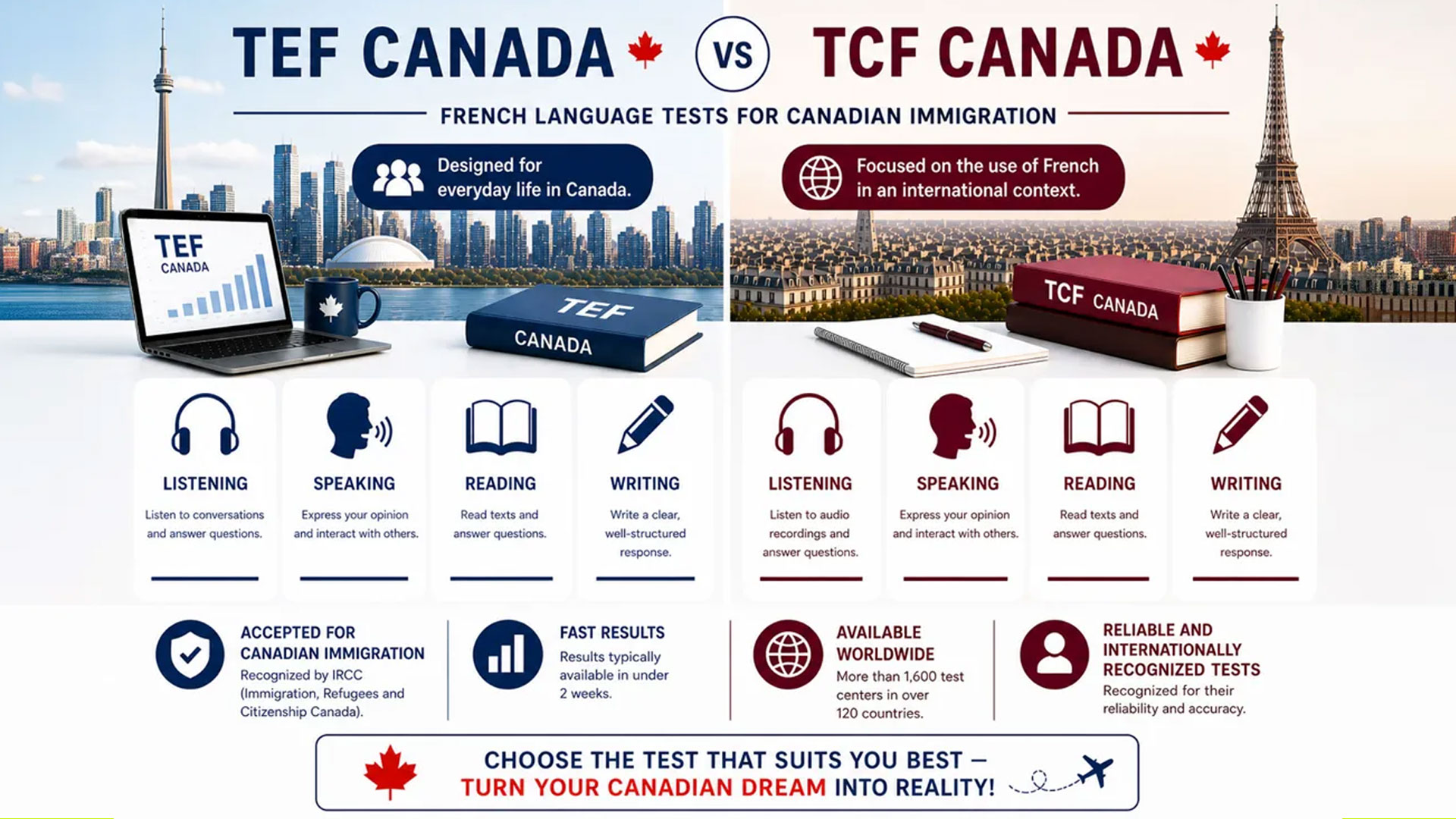
TEF Canada Exam Format
TEF Canada is one of the French tests recognized by Immigration, Refugees and Citizenship Canada (IRCC) and Quebec immigration authorities in 2026. Its standardized, predictable format can be an advantage.
For immigration, four skills are mandatory: oral comprehension, written comprehension, oral expression, and written expression. Listening and reading use multiple-choice questions. Speaking involves a structured interview, and writing requires completing specific tasks.
TEF Canada Scoring and NCLC/CLB Levels
TEF Canada scores range from 0 to 699 per skill. For federal programs like Express Entry, these scores convert to Niveaux de compétence linguistique canadiens (NCLC/CLB). However, it is important to note that Quebec's immigration ministry (MIFI) officially uses its own scale: the Échelle québécoise des niveaux de compétence en français. In many Quebec immigration contexts, level 7 on the Échelle québécoise corresponds to NCLC 7, which is commonly considered equivalent to a solid B2 level.
TEF Canada Pros and Cons for Immigration
Candidates value TEF Canada's clear structure and established preparation resources. However, time pressure is significant, particularly for listening and reading. Written expression demands precise format, argumentation, and connector use, which can challenge self-taught learners.
An important update for candidates: As of late 2025, TEF Canada listening includes updated task formats: short audio clips (micro-trottoirs) now offer 3 multiple-choice options instead of 4, and some interview segments are heard twice. These changes may make the section feel more manageable for some candidates, but the test remains time-pressured and demanding.
TEF Canada vs TCF Canada: which test may feel easier for immigration?
| Aspect | TEF Canada | TCF Canada |
| Format | Standardized, fixed task structure | Standardized, with task progression depending on version |
| Listening & Reading | Multiple-choice, fast-paced | Multiple-choice, with structured progression |
| Speaking | Structured tasks with role-play elements | Guided interview-style tasks |
| Writing | Two tasks with formal/semi-formal register | Two tasks, often perceived as somewhat more flexible |
| Use in immigration | Accepted by IRCC & Quebec | Accepted by IRCC & Quebec |
| Perceived difficulty* (2026) | Often feels more intense because of timing | Often feels more flexible to some candidates, depending on profile |
*Perception based on aggregated feedback from adult learners and immigration candidates up to 2026, not official data.
TCF Canada Structure
TCF Canada is another major test accepted by IRCC and Quebec. It assesses listening, reading, speaking, and writing, but its structure and scoring differ from TEF Canada.
TCF Canada features a modular yet standardized format. Comprehension sections use multiple-choice questions. Oral and written production follow a clear progression from simpler to more complex tasks. The test uses adaptive statistical design to pinpoint a candidate's level accurately.
TCF Canada Scoring and NCLC Equivalence
TCF Canada scores also convert to NCLC/CLB levels for immigration. Many 2026 immigration programs require NCLC 7 for speaking and listening. Some candidates find TCF Canada more accommodating for uneven skill profiles, as it identifies an overall level without overly penalizing specific errors, but this depends on the individual test-taker and the specific version taken.
TCF Canada Advantages and Disadvantages for Immigrants
Learners often find TCF Canada's written expression slightly less stressful due to more flexible task formats. However, the test's adaptive nature can surprise candidates facing progressively harder questions. Session and center availability may also differ from TEF Canada regionally.

Immigration Points and Test Scores
The crucial comparison is not theoretical ease, but which exam helps you reliably reach your target NCLC level. For instance, a one-NCLC-level difference in speaking or listening can significantly impact Express Entry points.
Intermediate learners (B1-B2) may find TCF Canada's structure better showcases their abilities, especially if they excel orally over written skills. Advanced learners targeting NCLC 9-10 might prefer TEF Canada, which rewards precise preparation and exam strategy mastery.
Program Requirements: Quebec vs the Rest of Canada
Quebec programs (such as the transitioning PEQ / PSTQ pathways and work permits) typically require a minimum of level 7 on the Échelle québécoise for oral skills. Both TEF Canada and TCF Canada are accepted. However, some Quebec institutions or professional bodies might recommend one test for administrative reasons.
Outside Quebec, for Express Entry and federal programs, tests are equivalent; only the NCLC score matters. The test that feels easier or more suitable aligns best with your current skills and intensive training capacity.
Immigration Perspective
| Material type | Typical durability profile | Main limitation |
| Wood slat | Good multi-season use | Moisture and rot over time |
| Synthetic mesh | Lightweight and practical | Tear risk in severe wind |
| Rigid panel | Stronger structure | Higher handling and anchoring needs |
Preparation Strategy
An initially difficult exam can become easier with appropriate preparation. Choose the test that best matches your profile, then create a focused training plan.
TEF Canada success often involves intensive work on time management and standard task formats, especially for listening and writing. Regular simulations with mock exams are essential.
TCF Canada success relies on consolidating your general level and learning to respond clearly and coherently, even when questions become complex. Improving quick reactions in oral tasks is key.
Common Mistakes When Choosing Between TEF Canada and TCF Canada
Many underestimate written tasks, especially those using French primarily in spoken contexts. Others choose a test based solely on availability, ignoring format suitability. In 2026, with immigration thresholds remaining high, this initial choice significantly impacts reaching your target NCLC level on the first try.

Real Cases: TEF Canada vs TCF Canada for Quebec Immigrants
Case 1 – Skilled worker in Quebec (Navigating PEQ / PSTQ Pathways)
A 34-year-old engineer, with B2 oral French and B1 writing, needed NCLC 7 for a Quebec skilled worker program (navigating the transition between PEQ and PSTQ requirements). He first chose TEF Canada, but found written expression difficult. Structuring formal letters under time pressure limited him to NCLC 6.
He switched to TCF Canada, focusing preparation on arguments and coherence rather than strict formats. The exam yielded NCLC 8 in listening and speaking, and NCLC 7 in reading and writing, meeting the MIFI immigration requirements for his profile. TCF Canada was "easier" as its adaptive tasks matched his strengths.
Case 2 – Federal Express Entry Candidate Outside Quebec
A 29-year-old IT specialist, with C1 French level and using it daily at work, aimed to maximize Express Entry points with NCLC 9. She chose TEF Canada for its predictable written and oral tasks.
Her preparation focused on exam techniques: managing listening time, using advanced connectors, and practicing complex oral structures. She achieved NCLC 10 in listening and speaking, and NCLC 9 in reading and writing. TEF Canada was her best strategic choice due to its demanding yet structured approach.
FAQ
1. For immigration, is TEF Canada or TCF Canada easier?
It depends on your level and strengths. TCF Canada is often perceived as more flexible for intermediate candidates, while TEF Canada may be more suitable for advanced learners who are strong in exam strategy. The test that feels easier will usually be the one that best matches your abilities.
2. Do Quebec immigration programs prefer TEF Canada or TCF Canada?
Most Quebec programs accept both tests and convert scores to NCLC levels. While some institutions might favor one test, they are considered equivalent for immigration purposes.
3. Can I switch from TEF Canada to TCF Canada if my first result is too low?
Yes. You can submit results from either test, or both, while they are valid. Many candidates switch exams after an initial attempt if they feel the other format suits them better.
4. How long are TEF Canada and TCF Canada results valid for immigration?
In 2026, IRCC generally accepts results less than two years old at the time of application. Quebec authorities have a similar validity period. Always check the latest official guidelines.
5. How can I know in advance which test will be easier for my immigration project?
Take diagnostic practice tests for both exams under timed conditions. Compare your approximate NCLC levels and analyze performance by skill. This will reveal which exam offers the best margin to reach your program's required level.
Ready to Optimize Your French Test Choice?
Discuss your immigration goals, French level, and prior exam experience with an instructor knowledgeable about Canadian and Quebec language requirements. Identify the best test (TEF Canada or TCF Canada) for your profile and create a preparation plan aligned with your immigration deadlines.