
Many adult learners are surprised by low TCF or TEF results, despite using French daily at work or in Quebec society. They feel comfortable conversing, understanding colleagues, and managing daily life, yet their official score doesn't reflect their true level.
This gap between practical French and exam performance is common in high-stakes language tests. The good news: reasons are usually identifiable and correctable with specific strategies, practice formats, and exam-specific habits.
This guide explains why candidates with good French struggle on the TCF/TEF. We cover how exam format and timing affect performance, and what adjustments can help achieve your target score.
Understanding the TCF/TEF Canada Exam Format and Timing
Strong French speakers often underperform because they underestimate how exam format and timing impact results. These tests evaluate language skills, speed, strategic responses, and standardized performance under pressure.
In 2026, both TCF and TEF remain primarily multiple-choice for listening and reading, with strict time limits. Many adult learners are used to natural, open-ended French conversations, rarely practicing "the best possible answer" under a clock. This mismatch often leads to avoidable errors and unfinished sections.
The "Trap" of Multiple-Choice Questions (QCM)
Fluent speakers often rely on global comprehension—understanding the gist of a conversation. However, the TCF and TEF are designed to test precision.
Why you lose points:
- Distractors: Examiners use "traps" where three answers sound plausible. One might use the same keywords but change the logic (negation, frequency, or modality).
- Nuance over Context: In daily life, you use context to fill gaps. In the exam, if you miss a single connector like "pourtant" (however) or "bien que" (although), you might choose the opposite of the correct answer.
Expert Tip: Don't look for the "right" answer. Learn to eliminate the wrong ones by identifying why they are distractors.
Time Management: The Silent Score-Killer
Time management is critical for TCF/TEF success. The TCF and TEF are high‑pressure, time‑limited tests that reward fast, accurate decisions. Many adult learners read and listen at a reasonable pace daily, but the test demands sustained concentration and quick decisions.
Common issues include spending too long on difficult questions, re-reading entire texts, or mentally translating. These habits slow candidates, leading to rushed or unanswered questions. Both can significantly lower scores, even with strong overall comprehension.
- Listening: You have only seconds to answer between tracks. Fluent speakers often "over-think" a question, missing the start of the next one.
- Reading: You cannot afford to read every word of every text. You must master skimming and scanning.
- Writing: Many candidates write a beautiful essay but fail to finish the conclusion. A perfect unfinished text scores lower than a good finished one.
Minimizing Exam Stress for TCF/TEF Canada Success
Psychological factors explain many discrepancies between real-life ability and test results. Even daily French users can freeze under exam pressure, especially when the test is for immigration, employment, or professional recognition in Quebec.
In 2026, language tests remain central to many immigration and professional procedures.The stakes for TCF/TEF Canada are high. Whether it's for the Express Entry or Quebec’s Arrima, your future in Canada often depends on this single day.
The emotional weight attached to TCF/TEF can trigger stress responses, disrupting concentration, memory, and fluency in both oral and written sections.
Performance anxiety may cause candidates to misread questions, forget known vocabulary, use simpler words to avoid mistakes, and speak slowly or lose your natural "flow". Many report feeling they "did not recognize themselves" in their exam performance.
Result: The examiner grades you lower on fluidité (fluency) and richesse lexicale (vocabulary range), even though you know the words.
The "Recorder" Effect: Many fluent speakers freeze when they see the examiner start the digital recorder.

Strategies for Managing Oral Interview Pressure
The oral expression component is a frequent source of disappointment. Many speak French confidently with friends but freeze before an examiner with a recorder and strict timing.
Without prior exam-style task simulation—structured monologues, role plays, argumentative responses within fixed time limits—candidates may:
- Give answers too short for the required level.
- Use simple structures instead of complex grammar expected at B2–C1.
- Lose coherence or forget to support opinions with examples.
Psychological Preparation and Effective Test-Day Habits
Emotional preparation is as crucial as linguistic preparation. Candidates who avoid full mock exams under realistic conditions often underestimate their body and mind's reaction under pressure.
Developing routines, such as controlled breathing, clear time strategies, and familiarity with instructions, reduces cognitive overload. Neglecting these aspects means strong French speakers can underperform, as mental energy is spent managing stress instead of processing language.
The Crucial Role of TCF/TEF Canada Exam-Specific Training
Many adult learners have strong general French but little exposure to TCF/TEF-specific logic. They may have taken grammar and conversation classes but never systematically practiced exam tasks, timing, or scoring criteria.
At CECFQ, all exam preparation courses are taught by certified TCF/TEF examiners, which means your training is aligned with the real evaluation criteria used on test day.
This disconnect explains why good French speakers fail the TCF/TEF. The test is calibrated to the CEFR (A1–C2), with distinct expectations for vocabulary range, complex structure control, coherence, and response adequacy. Without explicit awareness, candidates produce "good French," not "B2/C1 exam French."
Addressing Common Weaknesses in Written and Oral Expression
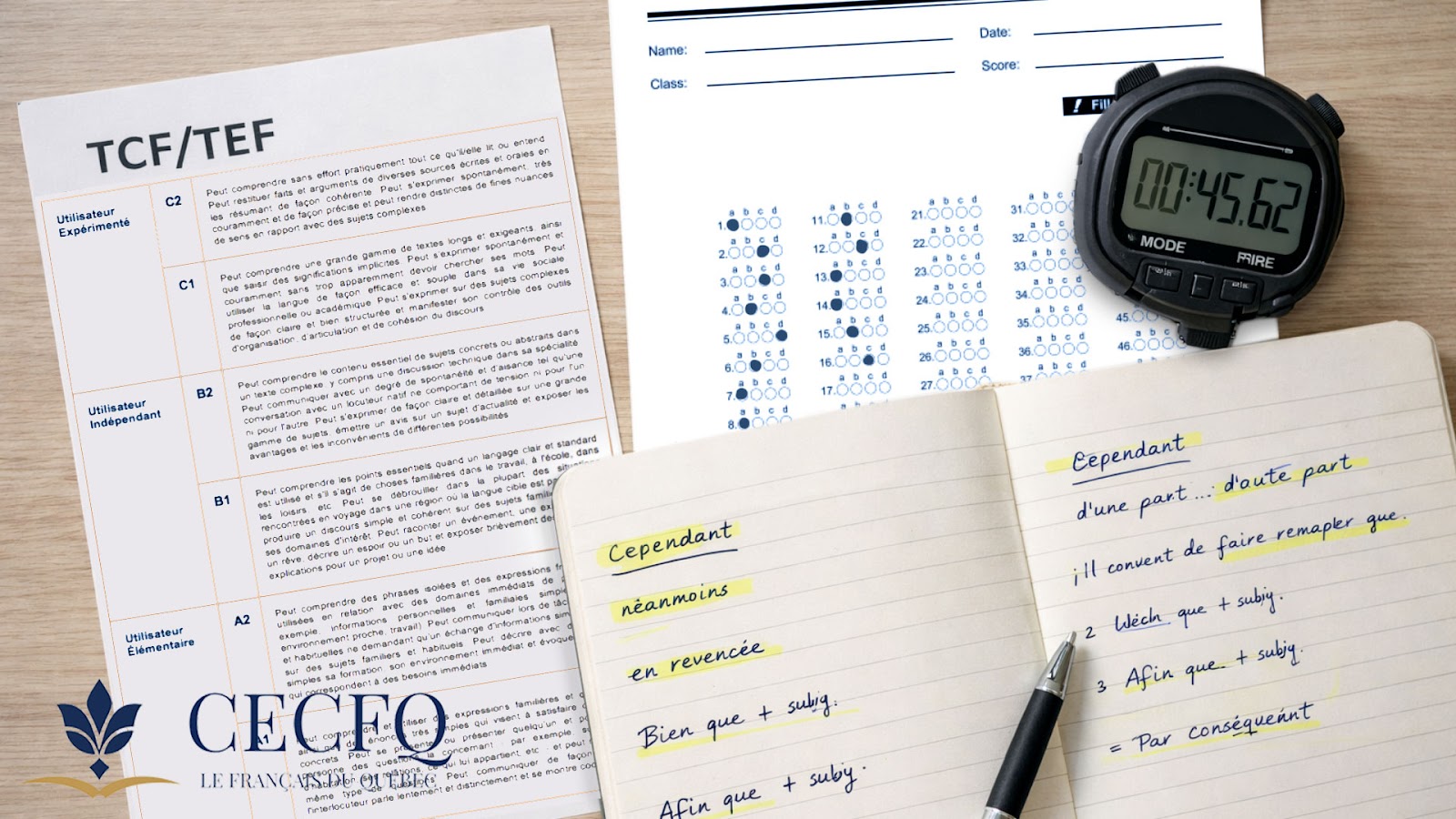
In written tasks, many candidates write correctly but fail to fully respond to the prompt. They may miss communicative objectives, struggle with clear paragraph organization, or neglect connectors and argumentative structure.
Similarly, in oral tasks, candidates sometimes:
- Do not adapt register (formal/informal) to the situation.
- Use repetitive vocabulary instead of varied lexical fields.
- Avoid complex sentences with subordination, reducing perceived level.
These issues do not indicate weak French; they show responses do not align with the exam's descriptors for the targeted level.
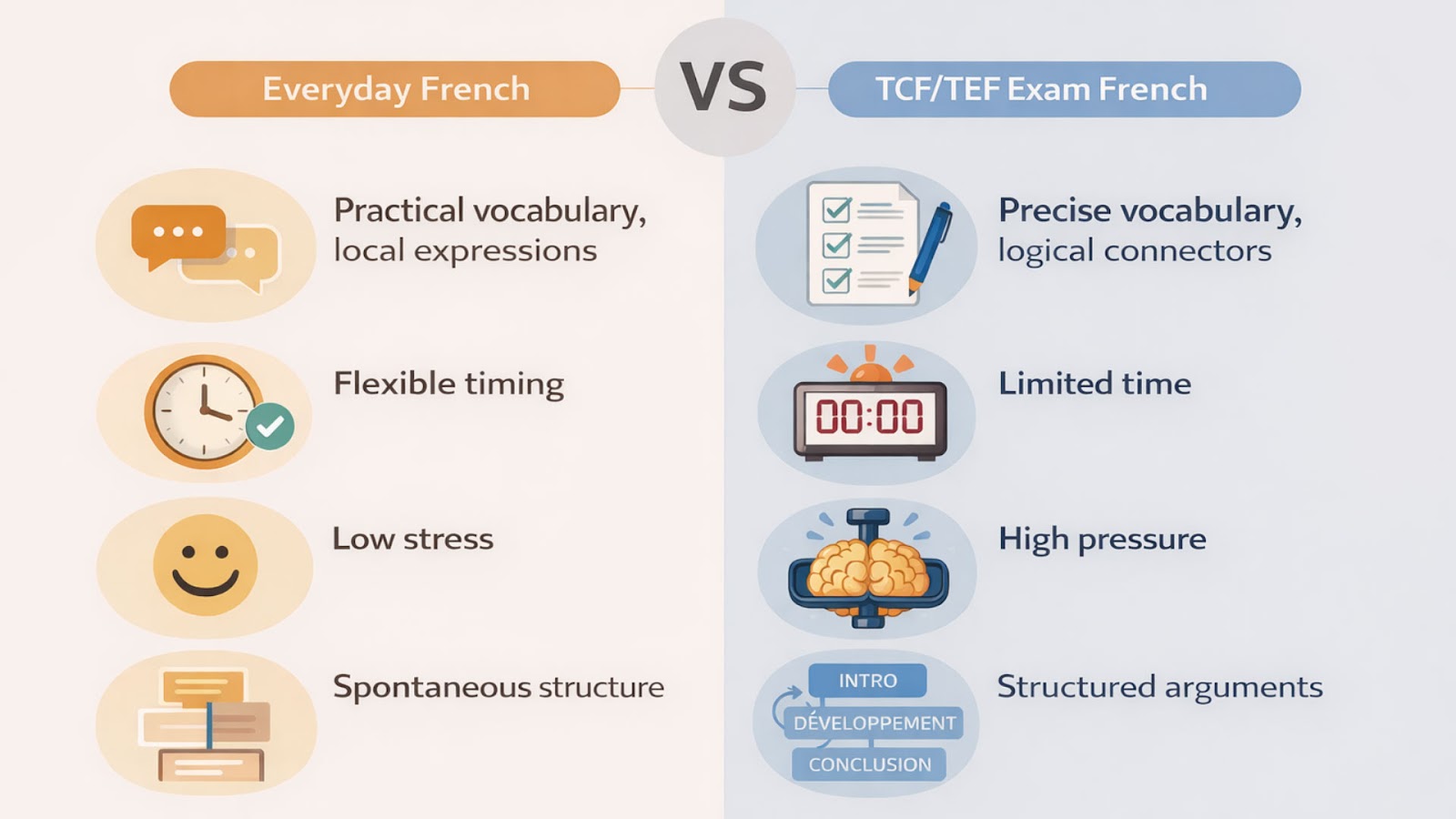
Everyday French vs. Exam TCF/TEF French: Key Differences
The Canadian government uses the NCLC (Niveaux de compétence linguistique canadiens) to evaluate your score. A "good" level of French for a coffee shop is not a "Level 7" (B2) or "Level 9" (C1) for immigration.
Official TEF/TCF Canada results always include your NCLC equivalence per skill, which is what IRCC and Quebec authorities actually use.
| Feature | Everyday Quebec French | TCF/TEF Exam French (B2-C1) |
| Vocabulary | Functional, sometimes repetitive, local idioms (char, job) | Academic, varied, precise, topic-appropriate, formal (véhicule, emploi) |
| Structure | Simple sentences, frequent "tu" | Subordination, passive voice, "vous" |
| Argumentation | Subjective, emotional | Logical, structured (Intro-Body-Conclusion) |
| Grammar | Generally correct in familiar situations | Controlled in complex, abstract discussion |
| Pace | Flexible, adapted to context | Strict time limits, no pauses or repeats on demand |
| Comprehension | Global meaning often sufficient | Precise detail and inference required |
| Interaction | Can ask for clarification | No clarification; one chance per question |
| Stress level | Variable, usually lower | High stakes, performance anxiety common |
| Error impact | Minor errors tolerated socially | Small errors can change level (e.g., B2 vs C1) |
| Organization | Spontaneous, less structured | Clear introduction, development, conclusion |
| Coherence | Understandable, occasional jumps | Logical flow with connectors and examples |
| Task fulfilment | Message usually understood | All parts of the task explicitly addressed |
Aligning Expectations for TCF/TEF Canada Scores
Another factor is misunderstanding TCF/TEF score interpretation and realistic requirements for target programs or immigration. Some expect C1 because they use French at work, while their exam performance matches solid B2.
This mismatch causes frustration, even when results are objectively strong. Conversely, candidates aiming for Quebec procedures requiring B2 or higher underestimate the precision, complexity, and consistency needed across all skills for that score.
Understanding precise descriptors (e.g., for B2: ability to argue, defend opinions, use connectors, explain advantages/disadvantages) helps adjust preparation and expectations. Skipping this step often leads to focusing on general French improvement rather than specific competencies evaluators assess.

Real-World Examples: TCF/TEF Underperformance Analysis
Case 1: Professional Engineer With Strong Workplace French, Low Oral Score
A mid-career engineer in Quebec used French daily with colleagues. He needed B2 oral on the TEF for a professional application. Confident, he did minimal exam-specific preparation, relying on everyday experience.
During the exam, role-play and argumentation tasks felt artificial. He answered briefly, used safe vocabulary, and hesitated developing opinions. Result: B1 oral, despite strong comprehension. After targeted practice—timed monologues, structured arguments, connectors—his second attempt showed clear progression, with longer, organized B2-aligned responses.
Case 2: International Student With C1 Comprehension, Uneven Written Performance
An international student preparing for university in Quebec had excellent listening and reading, frequently watching French news. She expected high TCF results without specific writing training.
Her written tasks were fluent but didn't fully address instructions. Texts lacked clear structure, and she rarely used discourse markers or advanced connectors. Result: B1/B2 writing, below her comprehension. After practicing targeted exam tasks, focusing on planning, structure, and connectors, her writing became coherent and aligned with higher-level expectations.
FAQ
1. Why do candidates fail the TCF/TEF despite a good level of French in daily life?
Because exams measure standardized performance under time pressure, with specific task types and criteria. Everyday communication skills do not automatically translate into exam strategies, time management, and task fulfilment.
2. Can stress affect my TEF scores if I'm already fluent?
Stress is often a major factor, especially when results link to immigration or employment. It can block access to normally available vocabulary and structures. However, stress usually interacts with lack of exam practice and unfamiliarity with the format.
3. Is it possible to fail only one section of the TCF/TEF with a good general level?
Yes. Many candidates have unbalanced profiles, e.g., strong listening/speaking but weaker writing, or vice-versa. Since procedures may require minimums in each skill, one weaker section can compromise the overall objective.
4. How can I know if my French is “exam-ready” for TCF/TEF?
A realistic diagnosis involves practicing full mock tasks for each section, under timed conditions. Compare performance to CEFR descriptors for your target level. Feedback on task fulfilment, structure, and complexity is more informative than general impressions.
5. How long does it take to fix these testing mistakes?
For many adult learners, several weeks to a few months of focused, exam-specific practice can significantly improve scores if their base French is strong. The key is targeted work on exam format, timing, and required skills for the desired level.
6. Is TCF Canada easier than TEF Canada?
Neither is "easier." They test the same levels. However, the speaking format differs: TEF has two role-plays, while TCF has three guided tasks (monologues). Choose based on whether you prefer "acting" or "presenting."
7. Can I use Quebec expressions (Québécismes) in the exam?
Use them sparingly. The exam is International French. While an examiner in Montreal will understand "C'est le fun," they are looking for "C'est intéressant" or "C'est enrichissant" to award higher points for vocabulary.
8. Does the Canadian government accept old results?
Results are valid for 2 years. Ensure your results are still valid at the time you submit your PR or citizenship application.
Ready to Bridge the Gap?
Don't let your daily fluency trick you into a low score. Secure your future in Canada with a diagnostic test that measures you against official examiner criteria, not just your ability to hold a conversation.
⚠️ Disclaimer
The information provided in this guide is for educational purposes. Exam formats and immigration requirements (IRCC/MIFI) are subject to change. Always consult official government websites (Canada.ca or Quebec.ca) for the most current regulations regarding language testing.