When you’re preparing for immigration, professional certification, or academic enrollment, choosing the right French exam becomes a key step.
Candidates often get confused: TEF and TEFAQ may look similar, but they serve different purposes and require different skills. Choosing the wrong one can cost you money and delay your application.
At CECFQ, our certified examiner-teachers help students prepare for both tests with targeted, practical training. This 2026 guide breaks down the differences to help you decide which exam fits your goals.
The Core Difference: Purpose and Recognition
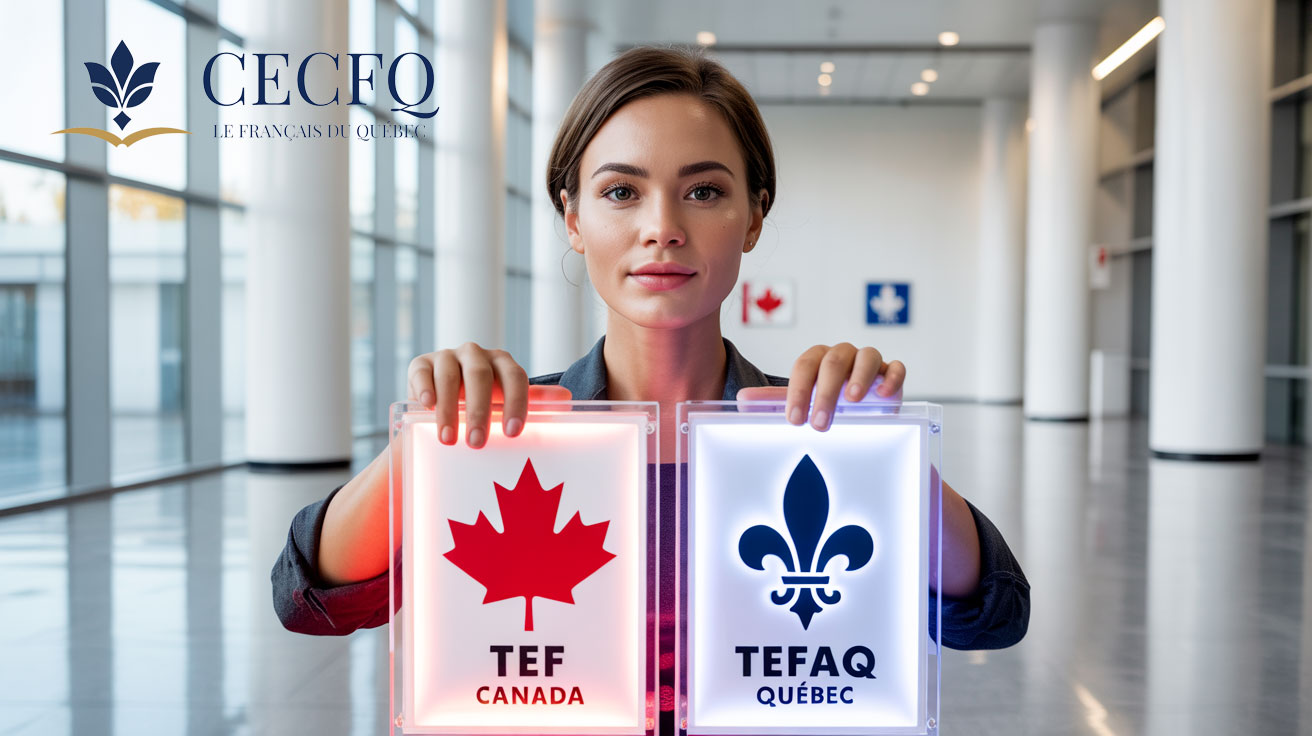
While both exams are created by the Chambre de commerce et d’industrie de Paris Île-de-France (CCI Paris IDF), they have distinct scopes.
- TEF / TEF Canada is required for federal immigration (Express Entry, PNP), citizenship, academic programs and certain professional pathways. IRCC-approved.
- TEFAQ is the version adapted specifically for Québec immigration (CSQ for QSWP/PEQ) and MIFI-aligned (aligns with the requirements of the provincial selection system)
Your choice depends on where you’re applying and which skills you want to showcase.
Quick choice:
- Federal/wide? TEF.
- Québec-only? TEFAQ.
1. TEF / TEF Canada (Federal & General)
TEF Canada is the mandatory version for Federal immigration programs (Express Entry, PNP).
- Required for: Canadian Citizenship, Federal Skilled Worker Program, Canadian Experience Class. IRCC-approved.
- Scope: It evaluates your general proficiency in a broad context.
- Key Feature: You must take all 4 modules for federal immigration.
2. TEFAQ (Quebec Specific)
TEFAQ (Test d’Évaluation de Français pour l’accès au Québec) is adapted specifically for the Quebec Ministry of Immigration (MIFI).
- Required for: CSQ (Certificat de sélection du Québec), PRTQ, and PEQ programs.
- Scope: It aligns with Quebec’s specific selection grid.
- Key Feature: It is modular. While Listening and Speaking are the priority, Reading and Writing can be added to boost your score.
Examiner Tip: If you are undecided between settling in Quebec or another province (like Ontario or BC), choose TEF Canada. It is recognized by Quebec (since 2022), but TEFAQ is not recognized by the Federal government. However TEFAQ is better for oral-heavy scoring.

Exam Structure & Modules
What TEF / TEF Canada Measures
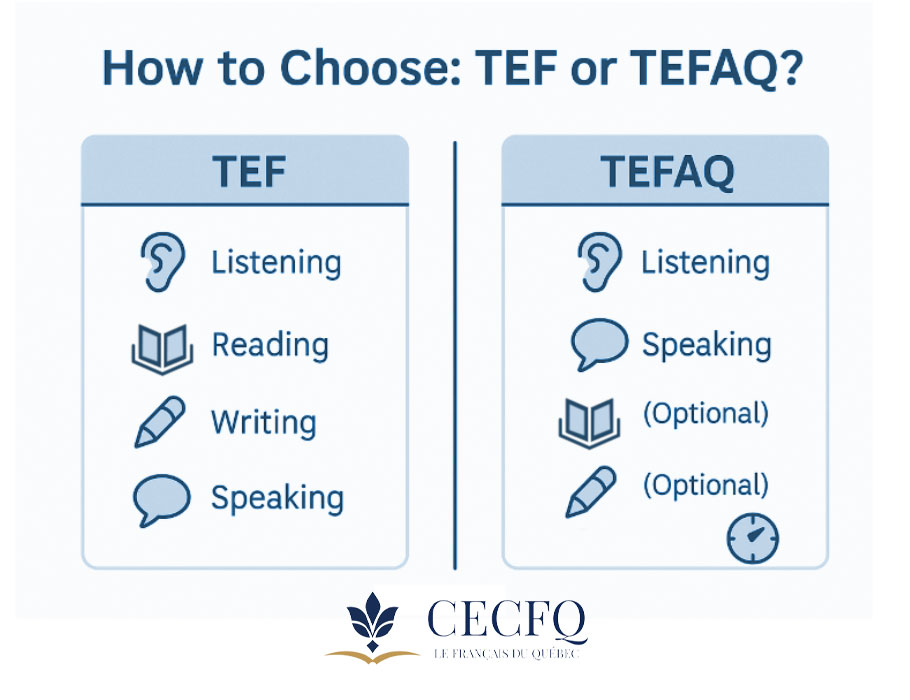
For federal immigration, you must complete all four sections on the same day:
- Listening (Compréhension de l’oral): 40 mins, 60 questions.
- Reading (Compréhension des écrits): 60 mins, 50 questions.
- Writing (Production écrite): 60 mins, 2 topics (Finish a story & Write a formal letter/argument).
- Speaking (Production orale): 15 mins, 2 topics (Gather information & Convince a friend).
These modules give a full picture of your language ability. Listening and reading include longer texts and recordings with detailed information. Writing requires structured paragraphs and clear arguments. Speaking involves role plays and guided discussions.
Because TEF covers all skills, it’s more comprehensive and often more demanding, but it opens doors to multiple federal and academic programs.
What TEFAQ Measures
TEFAQ is modular. For Quebec immigration, points are awarded primarily for oral skills, but written skills are increasingly important for a competitive score in the Arrima pool.
- Listening: 40 mins, 60 questions.
- Speaking: 15 mins, 2 topics.
- Reading (Optional but recommended): 60 mins.
- Writing (Optional but recommended): 60 mins.
The speaking tasks in TEFAQ are practical and fast-paced. You respond to everyday situations, express opinions in short exchanges and react quickly to prompts. Listening is based on short dialogues and announcements delivered at natural speed.
Format Differences
Although both exams come from the same institution, the testing experience is different.
- TEF offers longer texts, extended listening, and structured writing tasks.
- TEFAQ emphasizes quick comprehension and rapid responses.
TEF feels broader and more academic, focuses on balanced skills; TEFAQ feels more concentrated and focused on immediate communication.
Scoring and Expectations
Both exams follow the CEFR scale (A1 to C2). The way your score is used depends on the program:
- TEF evaluates each skill separately and gives a complete profile.
- TEFAQ gives most weight to listening and speaking, since those modules are mandatory for Québec.
If you’re a strong writer or reader, TEF may suit you better. If you’re more confident in conversation, TEFAQ can be a strategic choice.
Difficulty Level: Which is “Easier”?
The difficulty of each exam depends on your strengths.
- TEF is more demanding if your writing or reading skills need improvement.
- TEFAQ may feel easier overall, but the oral sections move quickly and require confidence under pressure.
A common myth is that TEFAQ is easier because it focuses on speaking. This is not always true.
- TEF Canada is “balanced.” If you are a strong reader/writer but nervous speaker, TEF allows your strong writing score to balance your profile (depending on the specific CLB requirement).
- TEFAQ is “fast-paced.” The listening section uses natural, rapid French dialogues. The speaking section requires immediate reactions and argumentation.
Learners who get nervous speaking often find TEFAQ more challenging despite the lower number of modules.
If you are a nervous speaker? Practice mocks – 94% CECFQ pass rate.

Who Typically Chooses Which Exam (2026 Immigration)
Scoring: Understanding NCLC vs. CEFR
Immigration authorities convert your exam score (A1–C2) into NCLC (Niveaux de compétence linguistique canadiens).
- Federal (Express Entry): You often need a “CLB 7” (roughly B2 level) for 50 CRS in all four skills to be eligible for certain points.
- Quebec: You gain points on a sliding scale. A score of B2 (Level 7) in Listening and Speaking provides the most significant boost.
Choose TEF Canada if:
- You need a certificate recognized across Canada.
- You want a full assessment of all four skills.
- You plan to use your results for multiple goals (immigration, studies, professional recognition).
- You prefer a balanced exam structure.
- You are a structured learner who writes well.
Choose TEFAQ if:
- You are 100% certain about settling in Quebec and are targeting Québec immigration (CSQ/PEQ).
- You want to focus mainly on oral skills.
- You prefer a shorter exam session.
- You want faster results with fewer modules.
- You are a confident speaker who struggle with writing.
How CECFQ Helps You Prepare
At CECFQ, all exam preparation is delivered by certified examiners who know how official evaluations work in practice. Our programs include:
- Diagnostic placement test (free)
- Personalized learning plan
- Targeted training for TEF or TEFAQ (target CLB 7+)
- Strategies for time management and common pitfalls
- Mock exams with 2026 updates with full correction
- Live online lessons (one-on-one or in mini-groups)
- Flexible scheduling and Québec-ready French practice
Our approach prepares you for real exam tasks, not generic textbook exercises.
Preparation Strategies (2026)
TEF Preparation
- Build reading stamina with articles and structured texts.
- Practice writing clear paragraphs with connectors and logical flow.
- Work regularly with long listening materials.
- Develop structured oral responses and organize your ideas quickly.
- Train under realistic timing through mock exams.
TEFAQ Preparation
- Focus heavily on listening and speaking.
- Practise short, rapid exchanges.
- Train with natural-speed recordings.
- Learn to respond quickly without long pauses.
- Add reading and writing only if needed for your immigration score.
Both: Timed mocks 2–3x/week.
Time, Cost and Practical Details (2026 Canada)
- TEF sessions take longer because they include four modules.
- TEFAQ is usually shorter if you take only listening and speaking.
- Both exams require advance registration (1–4 weeks ahead).
- Results are ready in 15 days (oral), 4–6 weeks (written). Retake after 30 days.
- Results are typically valid for two years.
- Prices vary by centre and number of modules taken (e.g., oral $145 CAD/module; full TEF ~$390)
Summary Table
| Feature | TEF | TEFAQ |
| Primary use | Federal immigration (Express Entry, PR) & citizenship, academic/professional | Québec immigration (Arrima/CSQ/PEQ) |
| Recognition | Recognized across Canada (including Quebec). | Recognized only by Quebec |
| Mandatory modules | 4: Listening, Speaking, Reading, Writing | 2 (Listening, Speaking) are core; Reading/Writing are optional but boost points. |
| Format | All taken in one session. | Modular (can take oral only). |
| Optional modules | None (for immigration) | Reading, Writing |
| Focus | Balanced + academic, all skills | Oral communication / Québec practical |
| Length/Cost | ~3 hrs / $300–400 CAD | 1.5–2.5 hrs / $200–300 CAD |
| Best for | Candidates keeping options open. Wide use, full profile | Candidates targeting Montreal/Quebec exclusively. Québec-specific needs |
| Validity | 2 Years | 2 Years |
FAQ
Do I need TEFAQ if I already passed TEF?
Not in every situation. Some Québec immigration programs may accept TEF results (since 2022), especially if your oral scores meet the required thresholds. However, TEFAQ is designed specifically for Québec and often fits the scoring structure more precisely. If you are applying through a Québec-based program, TEFAQ is usually the safer and more strategic choice. Check with MIFI.
Is TEFAQ easier because it has fewer modules?
Only in terms of structure. The exam is shorter, but the listening and speaking sections are intense and move quickly. You must understand naturally spoken French, react without hesitation, and express your opinion on the spot. For some candidates, this makes TEFAQ more challenging than TEF, despite having fewer components.
Can I take both exams?
Yes. Many applicants prepare for and take both tests for different purposes. TEFAQ helps with Québec immigration, while TEF is useful for broader opportunities such as federal immigration, academic programs, or professional requirements. Some learners take TEFAQ first to secure their Québec points and later complete TEF to keep more options open.
How long does preparation usually take?
The timeline depends on your starting level and the result you need.
- If you are at A2 aiming for B2 in oral skills, several months of structured training may be necessary (2–3 sessions/week).
- If you already have a B1 foundation, progress to the required level may be faster (1–2 months).
- Learners preparing for all four TEF modules typically need more time than those preparing only for TEFAQ oral components.
How often can I retake TEF or TEFAQ?
There is generally no long waiting period between attempts, but availability depends on exam centres. Because results are valid for two years, many learners plan their preparation carefully and retake the exam only if needed to improve specific modules.
How long do I have to wait to retake the exam?
For both exams, there is typically a mandatory waiting period of 30 days between two attempts of the same module.
Which exam gives more immigration points?
Neither exam gives points on its own. Points come from your scores. For Québec immigration, strong listening and speaking scores in TEFAQ often provide the highest benefit (TEFAQ oral B2 = 14/16 Québec). For federal immigration, balanced performance in all TEF modules leads to a stronger overall profile (TEF balanced = 50 CRS federal)
Does TEF include grammar questions directly?
TEF does not include a separate grammar section, but grammar is assessed indirectly through reading, writing and speaking tasks. Your accuracy, clarity and proper use of structures influence your score.
Do reading and writing help in TEFAQ?
Yes, even though they are optional. Some Québec immigration streams award additional points for these modules (about 2-6 points). Candidates looking to strengthen their profile often complete all four sections.
Is TEFAQ accepted outside Québec?
TEFAQ is designed mainly for Québec immigration and is not routinely used for federal applications, academic pathways, or professional certification. TEF is the more versatile exam for wider recognition.
Which exam should I choose if I am not sure where I will settle in Canada?
TEF is the safer option because it is recognized across Canada for a variety of purposes. If later you decide on Québec, TEFAQ remains an option.
DELF vs TEF/TEFAQ?
DELF is valid lifetime and recognised in certain procedures to document French level; TEF/TEFAQ – 2 years, and points-based for immigration and accepted by IRCC/PEQ.
Why Choose CECFQ
CECFQ is more than a French language school. It is a dedicated teaching and certification centre built around the needs of learners who aim to integrate, study or build their future in Québec. Our programs are designed to deliver both linguistic progress and exam-ready performance.
Why Prepare with Us?
Diagnostic Strategy: We start with a free placement test to determine if your current level matches your immigration target (B2, C1, etc.).
Official Examiners: Our teachers are accredited for TEF/TEFAQ. They will teach you the specific logic of the test (e.g., how to manage time in the Reading section, or which “connecteurs logiques” score high points in Writing).
Mock Exams (Examens Blancs): We simulate real exam conditions so you are not surprised by the speed of the audio or the pressure of the timer on test day.
Flexible Format: Choose between one-on-one coaching for intensive correction or mini-groups to practice speaking interaction.
Stop guessing and start passing.
Take your free level test today
Book your targeted lessons package with CECFQ