
Introduction
For many adults in Quebec, the TEF (Test d’évaluation de français) and TCF (Test de connaissance du français) are more than just exams. They determine access to immigration programs, study permits, and jobs.
While Reading and Listening are passive skills, Speaking (Expression Orale) and Writing (Expression Écrite) require you to create content under pressure. This is where most candidates lose points – not because of bad grammar, but because of poor structure.
The good news is these sections are highly predictable in terms of task types and skills assessed, even though topics themselves vary from session to session. Examiners follow clear criteria and recurrent task types. With targeted templates and focused practice, you can confidently structure your answers.
This guide provides the key criteria examiners use, reusable templates for your answers, and 8 actionable exercises to secure your B2 score in 2026.
1. Understanding TEF/TCF Speaking: Decoding the Examiner’s Grid
Examiners do not judge you on “perfection.” They judge you on communication. In 2026, most candidates aiming for Quebec programs typically need at least a B2 level in oral production. Many plateau at B1 due to short, vague, or unstructured answers.
To reach a solid B2 level (often corresponding to level 7 in many scoring grids), you must demonstrate:
- Task Achievement: Did you fully address the prompt and follow instructions?
- Structure: Can you link ideas logically? (Connecteurs logiques).
- Fluency: Can you speak without uncomfortable pauses?
- Pronunciation Clarity: Is your speech clear and easily understood?
- Vocabulary: Can you avoid repetition using synonyms?
- Interaction (TEF specific): Can you convince, negotiate, and react?
- Sustained Monologue (TCF specific): Can you speak continuously on a topic without prompting?
2. Speaking Strategies: Fluency & Interaction
For interactive oral tasks (especially TEF expression orale), examiners assess if you:
- respond quickly without long silences
- ask for clarification naturally
- react to suggestions and negotiate
The TEF “Interaction” Template (B1–B2)
In the TEF Task B (Role Play), you must interact with the examiner. Don’t just answer questions; drive the conversation.
Use this 4-Step Loop:
- Reaction: “D’accord, je vois ce que vous voulez dire…” (Okay, I see what you mean…)
- Position: “Personnellement, je pense que…” (Personally, I think that…)
- Nuance: “Cependant, il faut aussi considérer que…” (However, we must also consider…)
- Bounce Back: “Qu’en pensez-vous ?” (What do you think?)
Exercise idea: record a 2‑minute negotiation (choosing an activity, solving a problem) using this 4‑step pattern, then replay and count silences longer than 3 seconds.
The TCF “Monologue” Template
For TCF questions like “What do you think about remote work?”, use the Triangle Method:
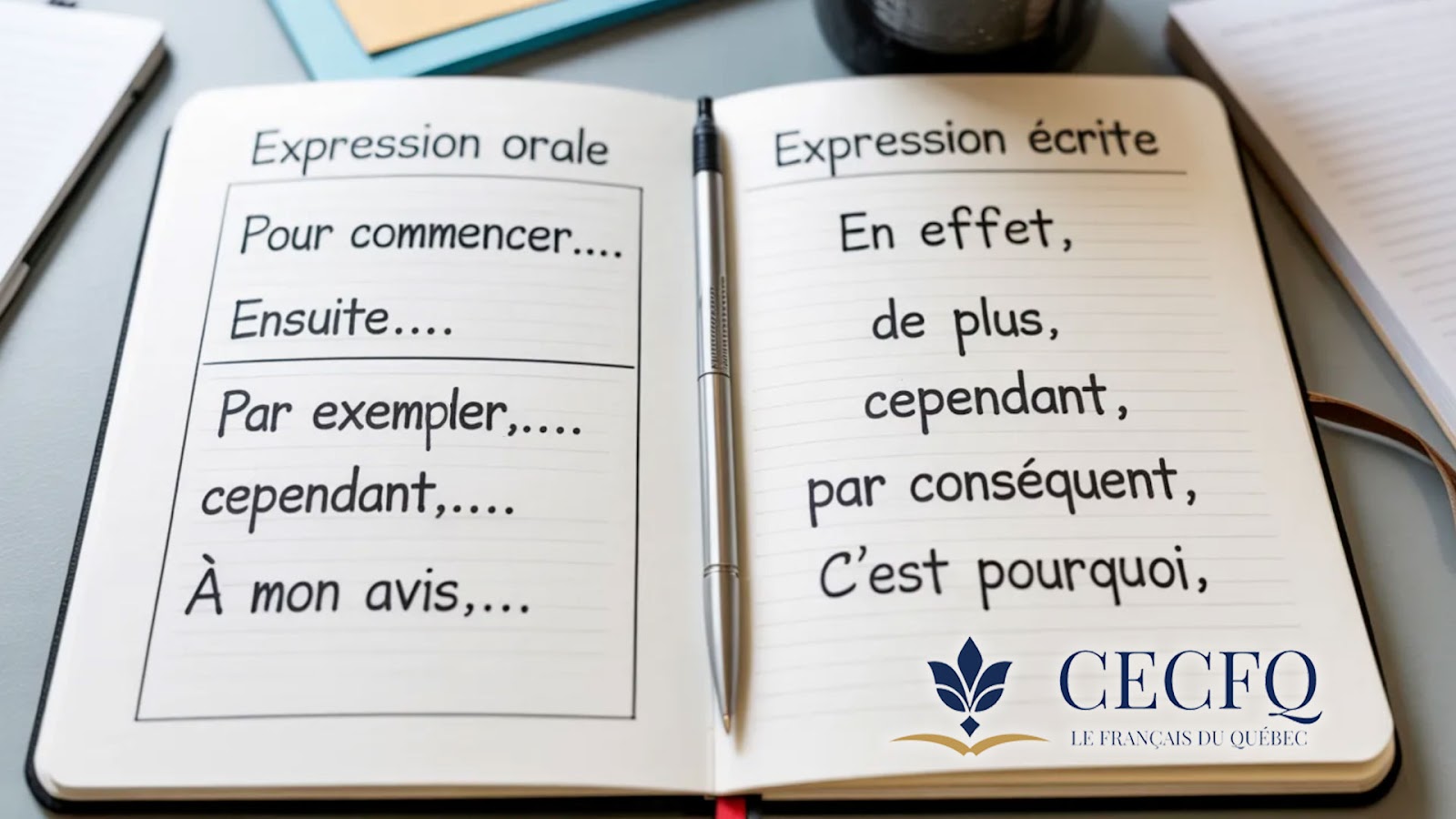
- Presentation: “Pour commencer, je vais présenter…”
- Explanation: “Ensuite, je voudrais expliquer…”
- Opinion: “Finalement, il me semble que…”
Expanding Lexical & Grammatical Range
To reach B2, you must move beyond basic verbs and memorized phrases. Examiners look for:
- connectors: “first, then, however, finally”
- modal structures: “it would be necessary that…, it would be better…”
- cause and consequence: “because of, thanks to, so, as a result”
Micro-template to upgrade a basic answer:
- Base: “I want to change jobs because I am tired.”
- B2 upgrade: “I want to change jobs because, after several years in the same position, I feel a certain professional fatigue and I would like to take on new challenges.”
Exercise: take 5 simple answers and rewrite each one with (1) a connector, (2) an abstract noun (e.g., “professional fatigue”), (3) one complex tense or structure.
3. Writing Strategies: Structure is King
TEF/TCF written expression evaluates your ability to write clear, coherent, and formal texts. For Quebec immigration candidates in 2026, achieving a B2 in writing is often the hardest challenge due to time constraints.
Examiner Criteria & Expectations
Examiners analyze: task respect (text type, length, tone), organization (paragraphing, connectors), lexical richness, grammar and spelling, and ability to argue or explain. A strong, reusable structure for letters, emails, and opinion texts can immediately increase your score.
Effective Structure Templates for TEF/TCF Letters & Emails
Common task: write a formal email/letter to complain, request information, or explain a situation.
Whether you are writing a complaint or a request, memorize this skeleton. It works for 80% of Task 2 assignments.
The B1-B2 Email Template:
- Greeting: “Monsieur, Madame,”
- The Hook (Context): “Je vous écris concernant…” (I am writing regarding…)
- The Problem: (2 short sentences explaining the issue)
- The Argument (with connectors): “En effet… / De plus… / C’est pourquoi…”
- The Solution: “Je vous prie de bien vouloir…” (I kindly ask you to…)
- Closing: “Dans l’attente de votre réponse, je vous prie d’agréer mes salutations distinguées.”
Exercise: write 120–150 words using this template about a real administrative difficulty (housing, transport, registration), then check: did you include at least 3 connectors and 1 clear request?

Strategies for Argumentative Writing in TEF/TCF
Opinion or argumentative tasks require a clear point of view with reasons and examples. Many candidates list ideas but neglect logical structure.
B2 opinion template:
- Introduction: reformulate the topic + position “The question of … raises many debates. In my opinion, …”
- Argument 1 + example “Firstly, … For example, …”
- Argument 2 + counter-argument or nuance “Next, … However, some people think that… Yet, …”
- Conclusion: summary + opening “In conclusion, … It therefore seems essential to…”
Exercise: choose a frequent TEF/TCF theme (remote work, social networks, public transport) and write 180–200 words using this 4‑part plan, timing yourself for 25 minutes.
4. TEF vs TCF: A Comparison of Speaking and Writing Focus
Understanding the difference can save you months of preparation.
| Aspect | TEF Canada / TEFaq | TCF Canada / TCF Québec |
| Speaking Format | Interactive: You talk with the examiner (Role Play, negotiation). | Monologue: You talk at the examiner (Q&A, guided tasks and questions). |
| Writing Tasks | News item completion + Argumentative text. | Email/Letter writing + Opinion essay. |
| Constraint | Requires social reactivity and improvisation.Timing is often tighter for speaking. | Requires strong logical structure and stamina.Timing is often tighter for longer writing task |
| What often blocks candidates | Lack of interactive phrases, hesitations | Weak structure, missing connectors |
| High‑impact preparation focus | Fluency drills + role‑play templates | Essay/letter frameworks + timed practice |
| Best For… | People who like conversation and acting. | People who prefer structured, academic presentation. |
5. Leveraging Answer Templates for TEF/TCF Practice & Reuse
Well‑designed templates do not make answers robotic; they free your brain to focus on content. The key is to memorize structures, not full texts, then adapt them to the specific TEF/TCF instruction.
Developing Reusable Oral Answer Patterns
For frequent questions like “Tell me about…” or “What do you think about…”, a 3‑step pattern works well:
- Presentation: “To start, I will present…”
- Details / explanations: “Then, I would like to explain…”
- Personal opinion / conclusion: “Finally, I think that…”
Exercise: choose 3 topics (work, studies, free time). For each, record a 1‑minute answer strictly following this 3‑step plan. Focus on clarity, not speed.
Implementing Reusable Written Micro-Templates
Micro‑templates are small pieces you can insert into almost any TEF/TCF writing task:
- To introduce a reason: “Because of…,”, “Given that…,”
- To compare: “Compared to…,”, “In comparison with…,”
- To express consequence: “As a result, …”, “Thus, …”
Exercise: take one past TEF/TCF topic and underline where you could insert 5 micro‑templates. Rewrite the text including them.
6. The 8 High-Impact Exercises for TEF/TCF Speaking & Writing Mastery
Don’t just “study French.” Train for the exam. These 8 exercises address the specific blockages adult learners face. They prepare candidates for TEF/TCF requirements for Quebec immigration, studies, and jobs.
1. 90‑second speaking pyramid
- Step 1: Speak 30 seconds on a simple topic.
- Step 2: Repeat and extend to 60 seconds with more details and connectors.
- Step 3: Extend to 90 seconds adding an opinion and example.
Goal: achieve fluency and automatic use of connectors without translation, build stamina and reduce “blanking out.”
2. Connector transformation drill (oral + written)
Create a list of 10 basic sentences. For each, say or write three versions:
- with « mais » (“but“)
- with « parce que » (“because“)
- with « donc » (“so“)
Then upgrade using higher‑level links: « Toutefois, étant donné cela, en conséquence » “however, given that, as a result”.
3. 3‑paragraph email sprint
In 20 minutes, write a 130–150 word email with exactly 3 paragraphs:
- Context
- Problem + consequences
- Request + polite closing
Check: task respected, tone appropriate, at least 4 connectors, clear final request.
Goal: Speed and organization.
4. Role‑play with escalation
Practice a TEF‑style conversation:
- Neutral request
- Refusal or problem from the other person
- Polite insistence + compromise
Use phrases like: “I understand, however…, Would it be possible to…, What do you propose as a solution?”
5. Timed outline only (writing)
Before writing full texts, spend 10 minutes creating just the plan:
- Intro: 1 sentence (idea)
- 2–3 main arguments (keywords)
- Conclusion: 1 key message
This trains you to structure under time pressure without obsessing over perfection.
6. Dictation to paragraph (writing accuracy)
Listen (or read) to a short B2‑level text on a frequent TEF/TCF topic. Then, without looking, write a 120‑word paragraph on the same topic, trying to reuse at least 5 expressions you remember.
This improves spelling, syntax, and lexical variety.
7. “Repair strategy” drill (speaking)
Practice correcting yourself naturally:
- “Sorry, I’ll rephrase…”
- “What I mean is…”
- “To be more precise…”
Record 5 one‑minute answers where you force yourself to correct at least one element each time.
Why: Examiners love self-correction; it shows control.
8. “Exam Sandwich” Simulation
Once a week, do a full simulation:
- Bread: Warm‑up – 5 minutes of free speaking on daily topics.
- Meat: Strict TEF/TCF timing for one speaking and one writing task.
- Bread: 10 min analysis of your errors – listen to your audio or reread your text, identify 3 vocabulary gaps and 3 grammar errors, and rewrite just one paragraph.
This connects strategy, performance, and correction in a single session.
7. Real Success Stories
Case 1 – Skilled worker needing CLB 7 equivalent
A mid‑career engineer preparing for TEF Canada achieved B2 in listening and reading, but remained at B1 in speaking. His answers were short and overly technical. By using a simple 3‑part oral template (introduction – explanation – example) and weekly 90‑second speaking pyramids, he learned to structure clear explanations. His subsequent TEF oral score met the requirements for Quebec immigration programs, and candidates can confirm which tests are accepted for Canadian immigration here.
Case 2 – International student struggling with writing
An international student needed B2 in TCF Québec writing for university admission. She wrote fluently but disorganized texts, often missing the explicit request or conclusion. Through repeated practice of 3‑paragraph email sprints, argumentative 4‑part plans, and timed outline drills, her scripts became clearer and better targeted. On exam day, she achieved the required writing level.
FAQ
1. How are TEF/TCF speaking scores calculated for immigration to Quebec?
Scores are linked to CEFR levels (A1–C2) and converted into equivalences for Quebec and federal programs. Examiners use standardized grids focusing on task completion, fluency, vocabulary, grammar, pronunciation, and interaction (for TEF).
2. How long should my answers be in TEF/TCF speaking?
There is no word count. For a B2 level, you generally need 60–90 seconds for a developed response. This includes examples and connectors, delivered without long silences.
3. What are the most common TEF/TCF writing mistakes?
Typical problems include: ignoring instructions, using inappropriate formality, missing clear paragraphs, poor connector use, and texts too short for the expected level.
4. Can I memorize texts for TEF/TCF speaking and writing?
Memorizing full texts is risky; examiners can detect it, and it may not fit the task. It is safer to memorize structures, connectors, and templates that you adapt to the specific question.
5. How much time should I spend preparing speaking vs writing?
For balanced results, many adult candidates preparing for Quebec requirements benefit from splitting production practice roughly 50/50. They often dedicate slightly more time to the skill they find harder (often writing for academic goals, speaking for workplace or immigration interviews).
6. Which is easier: TEF or TCF?
Neither is “easier.” If you are shy, TCF might be better (less acting). If you are chatty, TEF is often more natural.
Ready to get your B2?
Don’t guess your score. Book a free diagnostic test at our school and get the personalized review by TEF/TCF experts who will map your current level and design a custom speaking and writing practice routine that works for you.