

Introduction
French usage in Quebec differs significantly from the “standard” textbook French taught in Europe or Anglophone schools. Distinct Quebec styles apply to pronunciation, vocabulary, and workplace etiquette.
For A2–B2 learners, these differences often cause stress in professional contexts like job interviews, government interactions or daily operations. You might understand grammar rules, but freeze when a colleague says, “T’as-tu fini ta job?”
This guide provides practical pronunciation tips, key vocabulary, and ready-to-use workplace communication strategies. Our goal is not to give you a “perfect Québécois” accent, but to help you communicate clearly and professionally in 2026.
It offers expressions directly applicable to work, customer service, and daily professional communication, based on real situations faced by adult learners in Quebec.
Essential Quebec French Pronunciation for A2-B2 Learners
Pronunciation presents a common initial hurdle for newcomers in Quebec.
Ministry of Immigration data (2026) shows nearly 50% of new arrivals struggle to understand everyday spoken French during their first year, even with standard French studies.
A2–B2 learners should prioritize recognition (understanding what you hear) over production (trying to sound local). Stick to a neutral accent, but learn to decode these sounds.
Develop a clear, neutral pronunciation easily understood by Québécois speakers. The following variations are consistently heard in workplace, phone, and service contexts.
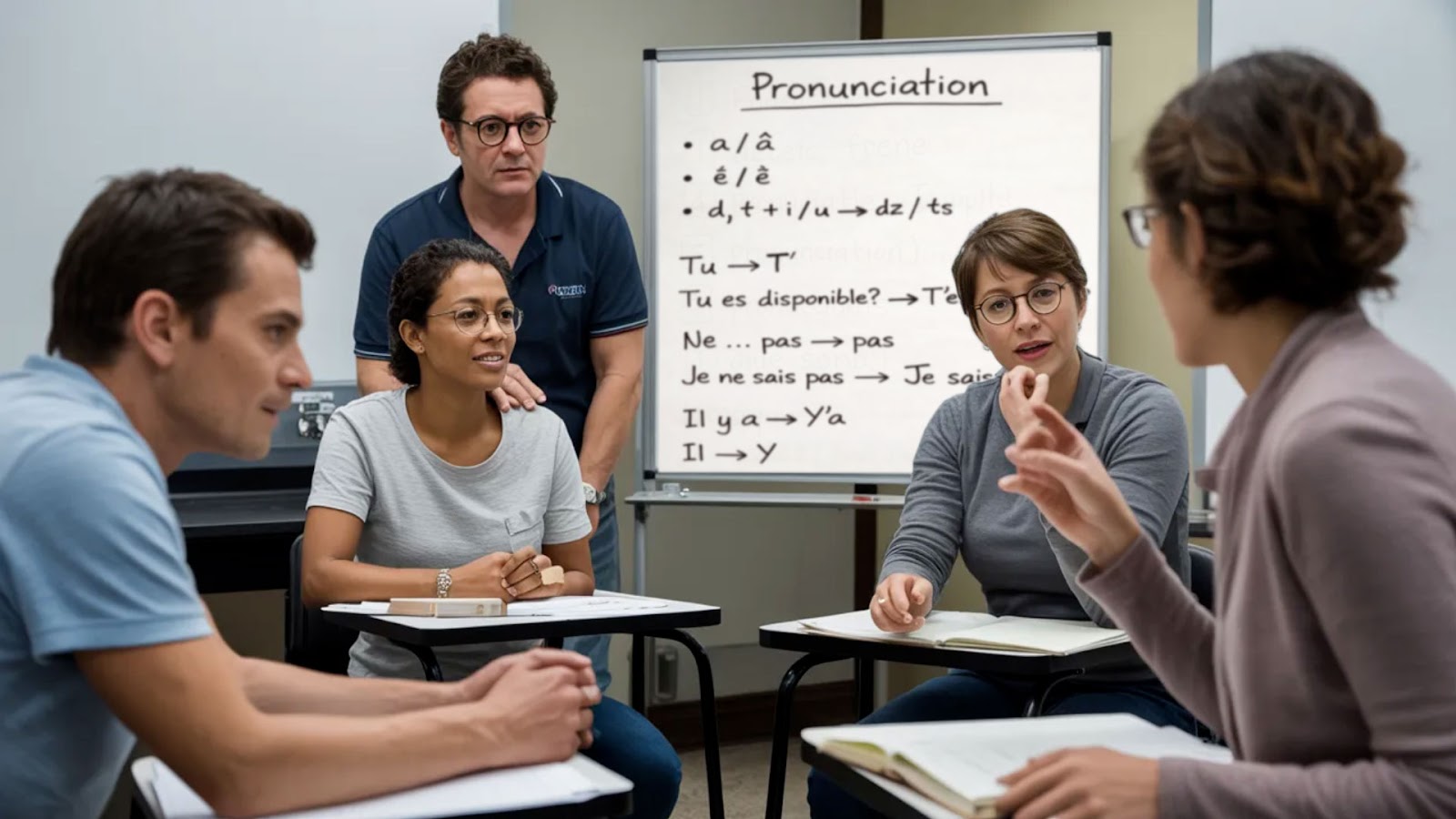
Common “Shortcuts” : Informal Quebec French Sound Reductions
In everyday and workplace conversation, you will often hear:
“Tu” becomes “T’”
- Standard: “Tu es disponible?”
- Quebec Spoken: “T’es disponible?”
“Il y a” becomes “Y’a”
- Standard: “Il y a un problème.”
- Quebec Spoken: “Y’a un problème.”
“Il” (he/it) becomes “Y”
- Standard: “Il peut venir.”
- Quebec Spoken: “Y peut venir.”
“Ne … pas” becomes just “pas”
- Standard: “Je ne sais pas”
- Quebec Spoken: “Je sais pas”
A2–B2 learners need to understand these reductions, not necessarily use them.
In professional emails or when speaking to a superior, always use the full forms (“Tu es”, “Il y a”).
Key Vowel and Consonant Tendencies in Quebec French
Some typical tendencies in Québec French:
• “â” / “a” more open
“tâche”, “pâte”, “salle” can sound more open than in European French.
• “é” and “è” contrast strongly
“geler” vs “gelait”, “été” vs “était”.
• D and T before “u” and “i” may sound like “dz” and “ts” in casual speech:
“tu” → “tsu”, “tu dis” → “tsu dzis”.
Don’t worry about mimicking this perfectly, but be aware of it so you recognize the words when you hear them.
For workplace clarity, use a slower, neutral pronunciation. Understanding these patterns, however, aids comprehension when colleagues speak quickly or informally.
Crucial Quebec French Vocabulary for the Workplace
Using the right word shows you are integrated. Quebec uses specific terminology, often protected by the OQLF (Office québécois de la langue française), which differs from France.
Vocabulary often challenges A2–B2 learners, particularly with Quebec-specific “office” and “service” French. Once mastered, these common Quebec words are heard universally.
Recent labor market reports (2026) indicate that basic Quebec French workplace vocabulary aids new employee integration more than grammar accuracy.
For adult learners, prioritizing high-frequency words quickly boosts confidence.
Comparison of neutral vs typical Québec French expressions
Some common terms in Quebec that are different from many textbooks:
| Situation | Standard / Textbook French | Frequent Quebec usage |
| Courriel (Mandatory in admin) | ||
| Mobile Phone | Téléphone portable | Cellulaire (or "Cell") |
| Job / Position | Poste / Travail | Emploi / Job / Poste |
| Car | Voiture | Auto (Standard) / Char (Informal) |
| Shopping | Faire du shopping / des courses | Magasiner |
| You are welcome | De rien / je vous en prie | Bienvenue / Ça fait plaisir |
| It’s OK / no problem | Pas de problème | pas de trouble / pas de souci (informal) |
| Sponsorship | Parrainage | Commandite |
Example workplace phrases:
- “Je vais vous envoyer un courriel cet après‑midi.”
- “On se parle au cellulaire si jamais il y a un problème.”
- “As‑tu trouvé un nouvel emploi?”
Writing Effective Workplace Emails
Professional writing in Quebec adheres to clear, polite standards. A2–B2 learners can write concise, efficient emails that colleagues and employers will respect.
Tu vs. Vous: Many Quebec workplaces use “tu” internally immediately. However, always use “vous” for clients, external partners, or superiors until invited to use “tu.”
Standard Structure for Professional Emails in Quebec
Do not translate from English phrases. Typical structure you can copy:
- Object / Subject: Keep it short and clear. Objet : Confirmation de la réunion du 15 mars
- Greeting: Formal: Madame, / Monsieur, / Madame, Monsieur, / Bonjour Monsieur, / Bonjour Madame, Semi‑formal (Colleague): “Bonjour Marie,”
- Opening line: Je vous écris concernant… (I am writing regarding…) Suite à notre conversation téléphonique… (Following our phone conversation…)
- The Request/Body: 1–3 short paragraphs, clear and direct. Est-ce que vous pourriez confirmer… (Could you please confirm…) Veuillez trouver ci-joint… (Please find attached…)
- Closing line: Merci de votre temps. / Merci de votre aide. (Thank you for your time / Thank you for your help.) N’hésitez pas à me contacter si vous avez des questions. (Don’t hesitate to contact me…)
- Sign‑off: Cordialement, / Salutations / Bien à vous, / Bonne journée,
- Signature: name, position, organisation, contact.

Mastering Phone Communication
Phone calls remove visual cues, making them stressful, particularly with a new accent. Yet, most administrative and workplace communication in Quebec, including appointments, HR, and government services, occurs via phone.
At A2–B2, manage calls by using set phrases for opening, clarifying, requesting repetition, and closing. The key is to memorize your “script” so you don’t have to think about grammar in the moment.
Essential Phone Phrases for Quebec Workplaces
Answering the Phone
- “Bonjour, [Nom de l’entreprise], [Votre nom] à l’appareil.”
- (Hello, [Company], [Name] speaking.)
- “Bonjour, comment je peux vous aider?”
- (Hello, how can I help you?)
If You Don’t Understand
- “Excusez-moi, je n’ai pas bien compris.”
- (I’m sorry, I didn’t quite understand.)
- “Est-ce que vous pouvez répéter plus lentement, s’il vous plaît?”
- (Could you please repeat more slowly?)
- “Est-ce que vous pouvez épeler votre nom?”
- (Could you please spell your name?)
Managing the Call
- “Un instant, s’il vous plaît, je vous mets en attente.”
- (One moment please, I’m putting you on hold.)
- “Je vous transfère à ma collègue.”
- (I’m transferring you to my colleague.)
- “Je vais vérifier les informations et je vous répondrai dans un instant.”
- (I’ll check the information and get back to you in a moment.)
- (I’ll check the information and get back to you in a moment.)
Ending the call:
- “Merci beaucoup pour votre appel.”
- (Thank you very much for your call.)
- “Bonne journée, au revoir.”
- (Have a good day, goodbye.)
- (Have a good day, goodbye.)
Navigating Service Interactions
Many adult learners work in customer service, health, retail, or administration. Mastering Quebec French service formulas is essential for these roles. Politeness in Quebec is typically egalitarian and efficient.
Even at A2, professional service is achievable with memorized expressions. At B1–B2, you can introduce nuance, apologize, and resolve minor issues.
Practical Quebec French Service Phrases
Welcoming a Client
- Bonjour! Avez-vous un rendez-vous?
- (Hello! Do you have an appointment?)
- Puis-je avoir votre nom, s’il vous plaît?
- (May I have your name, please?)
- Bonjour, comment puis-je vous aider ?
- (Hello, how can I help you?)
- (Hello, how can I help you?)
Checking information:
- Pouvez-vous me montrer une pièce d’identité ?
- (Can you show me a piece of identification?)
- Je vais vérifier cela dans le système, un instant s’il vous plaît.
- (I’ll check that in the system, one moment.)
- Je vous recontacterai dans quelques minutes avec les informations.
- (I’ll get back to you in a few minutes with the information.)
- (I’ll get back to you in a few minutes with the information.)
Dealing with problems:
- Je comprends la situation.
- (I understand the situation.)
- Désolé pour l’erreur / le délai.
- (Sorry for the error / the delay.)
- Voici ce que je peux faire pour vous aider.
- (Here’s what I can do to help you.)
Ending the interaction:
- Merci, bonne journée.
- (Thank you, have a good day.)
- Merci de votre visite.
- (Thank you for your visit.)
- Au revoir, à la prochaine.
- (Goodbye, see you next time.)

Real-World Success: From Theory to Practice
Case 1 – Immigrant professional in customer service (A2→B1)
A newcomer with A2 French started a customer service job in a Montreal retail store. She understood textbook French but felt lost with Québec pronunciation and client questions. She focused on three areas: common Québec vocabulary (“char”, “courriel”, “magasiner”), standard service formulas (“Hello, how can I help you?”), and listening to frequent reduced forms (“y’a”, “t’es”). She focused on learning the service scripts above. Instead of translating “How can I help you?” in her head, she memorized “Comment je peux vous aider?” as a single block of sound. After three months of targeted practice, she could handle most interactions without switching to English and reported feeling more confident with local clients.
Case 2 – International employee in an office (B1→B2)
An international IT specialist with B1 French worked in a Quebec tech company. His biggest problems were professional emails and phone calls in French with francophone clients. By standardizing his email structure (clear subject, short paragraphs, polite closing) and memorizing key phone expressions (“I’ll transfer you”, “I’ll check the information”), he reduced misunderstandings and stopped avoiding French calls. Within six months, colleagues began including him naturally in French-only meetings.
FAQ
1. What are the main differences between Québec French pronunciation and standard French for A2–B2 learners?
You will notice more open vowels, stronger contrast between “é” and “è”, and informal reductions like “t’es”, “y’a”, and “je sais pas”. Understanding these patterns is more important than reproducing them perfectly.
2. Which Québec French vocabulary is most important for workplace communication?
Focus on frequent terms like “courriel”, “cellulaire”, “emploi”, “magasiner”, and informal words such as “char” that you will hear from colleagues and clients, even if you answer with more neutral French.
3. How can I write professional emails in Québec French at B1 level?
Use a clear structure: subject, greeting, 1–3 short paragraphs, polite closing, and signature. Choose formulas like “I am writing to you regarding…”, “Thank you for your time”, and “Sincerely”.
4. How do I manage a phone call in Québec French if I do not understand everything?
Stay calm and use standard phrases: “I didn’t quite understand”, “Could you repeat more slowly?”, and “Could you spell that, please?”. Repeating key information aloud also helps confirm details.
5. What expressions are essential for service jobs in Quebec for A2–B2 levels?
Memorize a small set: “Hello, how can I help you?”, “I’ll check that in the system”, “I’m sorry for the error”, “Here’s what I can do to help you”, and “Thank you, have a good day”.
6. Should I try to imitate the Quebec accent?
No. As an A2-B2 learner, focus on a neutral, clear pronunciation. Locals appreciate clarity over a fake accent. However, you must understand the Quebec accent (shortcuts like t’es, y’a) to follow conversations.
7. Is it rude to use “Tu” at work?
In Quebec, it is very common, even with bosses. However, the golden rule is: Start with “Vous”. Wait for the other person to say “On peut se tutoyer” (We can use ‘tu’).
8. What if I make a mistake on the phone?
Don’t panic. Use the “repair phrase”: “Pardon, je reformule…” (Sorry, I’ll rephrase). It shows you are in control.
Ready to boost your Professional French?
Stop stressing about grammar and start communicating. Contact CECFQ today for a specialized Business French assessment.
For learners looking for structured learning options in Quebec, official resources to learn French are available here.