

Many adult learners memorize verbs and vocabulary, postponing pronunciation. Months later, native speakers still ask “Pardon?”, making conversations stressful.
Starting French pronunciation from A1 changes this. It builds clear speech habits, accelerates listening skills, and prevents hard-to-correct errors.
By 2026, French-language expectations continue to rise for Quebec immigration, employment, and studies. Early pronunciation is now a strategic choice, impacting test scores, workplace communication, and daily life.
Mastering French Pronunciation from Day One (A1)
Pronunciation is fundamental to French oral communication, not an extra skill. Research consistently shows that early phonological training improves both speaking and listening outcomes.
A 2026 survey of adult French learners in Quebec found that A1 pronunciation practice doubled confidence in conversations after one year. They also reported fewer misunderstandings with colleagues and public service staff.
Integrating French pronunciation from day one links sound and meaning. Learners stop translating written forms and recognize common words in real speech, even with a Quebec accent or fast delivery.
At CECFQ, pronunciation work is integrated from A1 in all general French courses, so learners build clear, exam‑ready habits from day one.

Key French Pronunciation Elements for Beginners
For beginners, pronunciation can seem daunting: silent letters, nasal vowels, liaison, rhythm. The key is to simplify and focus on high-impact patterns.
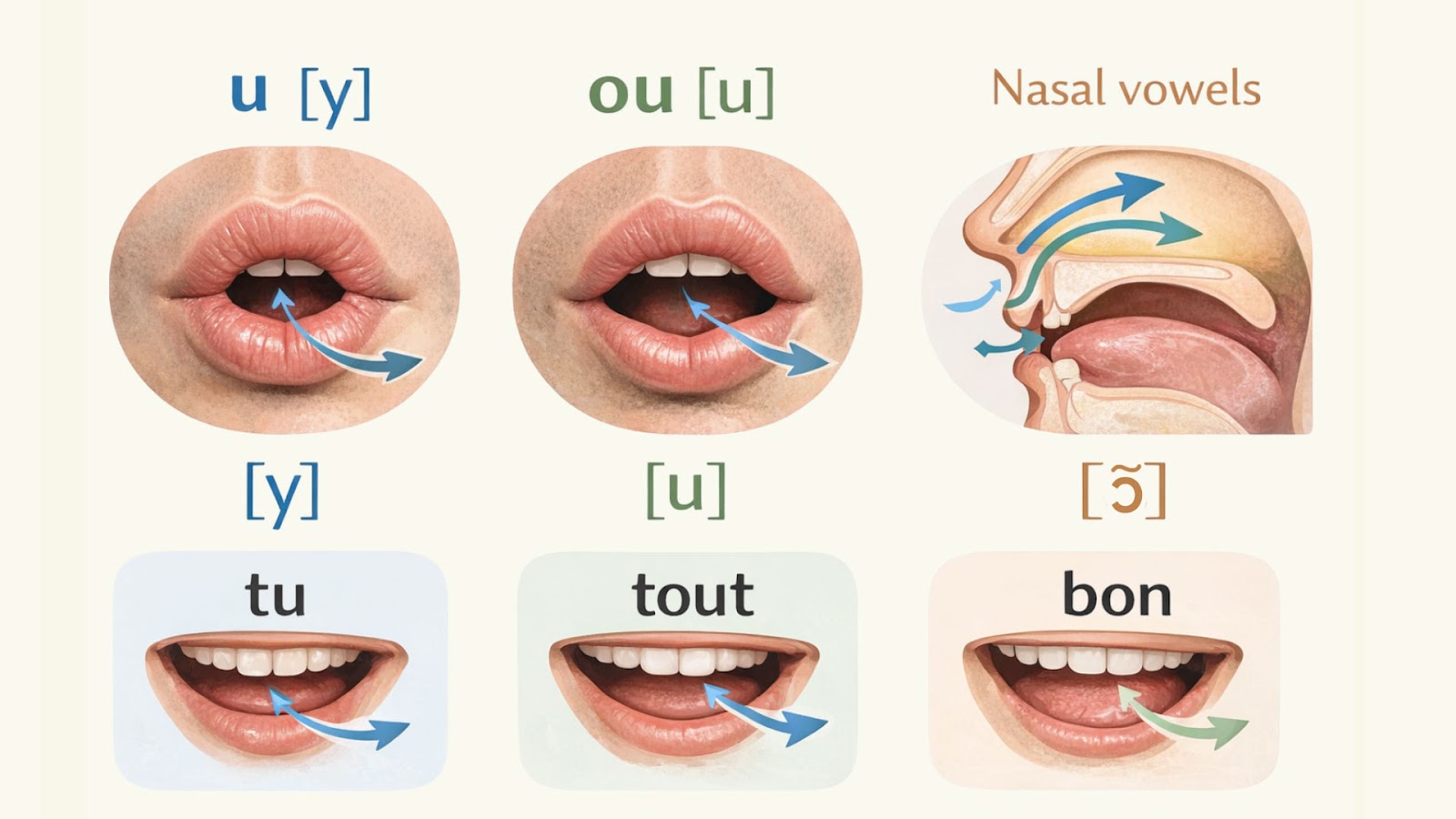
At A1, this involves distinguishing minimal pairs like “tu / tout” and mastering the French “u” and “r.” Hearing differences between nasal vowels like “on / an” is also crucial. These early distinctions prevent confusion in essential words related to time, place, and identity.
Beginners who repeat natural examples from week one create mental templates for correct French sounds. This reduces the tendency to read French using first-language pronunciation rules.
Developing a Clear and Understandable French Accent
Accent is often seen as cosmetic, but for adult learners, intelligibility is key. The goal is clear speech, easy to follow in authentic situations, not accent eradication.
From A1, recording yourself, comparing to native models, and correcting one or two sounds is effective. This leads to noticeably more fluid and accurate speech within months.
Early work on prosody (rhythm, word stress, intonation) also matters. It makes learners sound more natural, reduces speaking anxiety, and aids listening by recognizing typical French “melodies.”
| Approach to Pronunciation | Typical Result After 6-12 Months | Long-Term Impact on French Learning |
| Start at A1, every week | Clearer speech, better listening, easier conversations | Strong base for B1-B2, fewer fossilized errors |
| Start at B1 or later | Noticeable accent, frequent misunderstandings | Harder correction, slower progress in oral tasks |
| No structured practice | Hesitation, avoidance of speaking | Lower confidence, weaker exam performance |
How Early Pronunciation Boosts French Listening Skills
A key benefit of early pronunciation work is its impact on listening. Sounds you can produce clearly are usually easier to recognize quickly in natural speech.
Many A2-B1 learners in Quebec "know words" on paper but struggle with normal speaking speed. The issue is often unfamiliarity with how words are pronounced in continuous speech, not vocabulary.

Systematically practicing French sound patterns, liaisons, reductions, and linking from A1 builds a mental "map" of spoken French. This helps with:
- Understanding announcements, appointments, and administrative information.
- Following instructions at work or during training.
- Recognizing familiar words in fast speech without subtitles.
By the time learners prepare for exams like TEF, TEFAQ, TCF, DELF, or DALF, this long-term investment pays off. Listening sections feel more accessible due to a familiar sound system.
Practical French Sounds and Phonetics for A1 Learners
At A1, phonetics should be practical, tied to frequent words. Learners benefit from explicit comparison with their first language to adjust articulatory habits.
For instance, explaining that French “u” [y] involves rounded lips and an English “ee” [i] tongue position provides a concrete target. Short, daily practice is more effective than occasional long sessions.
Focused exercises gradually create automaticity. Learners stop consciously thinking about tongue or lip placement, instead focusing on meaning and interaction.
Enhancing French Oral Comprehension with Early Practice
Oral comprehension often frustrates adults most. However, early pronunciation practice yields significant dividends here.
Knowing how French reduces sounds in common expressions (“je ne sais pas” → “ch’ais pas”) reduces surprise from colloquial speech. Learners begin to perceive continuous speech as predictable patterns, not random noise.
Integrating targeted listening with shadowing (immediate repetition after a speaker) from A1 links ear and mouth. This approach is especially useful for learners preparing for standardized exam oral interaction tasks.
Building French Speaking Confidence from A1
Pronunciation and confidence are deeply connected. Many adults avoid speaking due to fear of not being understood or a "strong" accent.
Starting pronunciation at A1 changes this. Measurable improvement in intelligibility makes learners more willing to speak in real contexts: at work, in shops, with neighbors, or at school.
In Quebec, where daily interactions require French (appointments, daycare, administration), this confidence directly impacts integration and autonomy.
Effective French Communication in Daily Life
Clear pronunciation streamlines everyday communication. It reduces the need for repetition, spelling names, or language switching.
Correctly distinguishing similar-sounding words in addresses, dates, or job titles avoids frustrating misunderstandings. This fosters a sense of belonging and competence in a French-speaking environment.
In workplaces, comprehensible A1 pronunciation enables earlier participation in meetings, asking questions, and responding to instructions without constant clarification.
Achieving French Fluency at A1-A2: The Pronunciation Edge
Fluency involves producing smooth word sequences with consistent rhythm and linking. Early pronunciation practice trains these elements specifically.
At A1-A2, activities like repeating fixed expressions, practicing common question patterns, and using simple conversation scripts with rhythm improve fluency more than rote memorization.

By focusing on a small set of high-frequency structures and pronouncing them accurately, learners gain "ready-to-use" language chunks. These chunks can be expanded later at B1-B2 without rebuilding the sound system.
| Focus at A1-A2 | Short-Term Experience | Effect on Future Fluency |
| Mainly grammar & writing | Good test scores, weak speaking | Hesitation, difficulty with real conversations |
| Balanced with pronunciation | Steady oral progress, fewer blocks | More natural speech, easier interaction tasks |
| Only “survival phrases” | Memorized responses, fragile skills | Hard to generalize to new situations |
Early Pronunciation for French Exam Preparation Success
Many adult learners target French exams (TEF/TEFAQ, TCF, DELF/DALF) for Quebec immigration, employment, or studies. These exams include listening and speaking, where pronunciation indirectly influences scores.
Starting pronunciation at A1 reduces pressure during B1-B2 exam preparation. Learners can focus on exam strategy and task formats instead of changing ingrained habits.
In oral expression tasks, clear, understandable pronunciation lets examiners focus on content, structure, and vocabulary. It minimizes comprehension issues that can lower scores, even with sufficient grammar and vocabulary.
Optimizing French Oral Exam Performance
Exam rubrics for speaking often explicitly mention pronunciation, intonation, and fluency. While a foreign accent is acceptable, consistent mispronunciation affecting intelligibility can limit scores.
Practicing pronunciation from A1 builds muscle memory that supports:
- Stable rhythm in monologues and role-plays.
- Intonation patterns signaling questions, opinions, and arguments.
- Accurate pronunciation of key lexical fields (work, studies, administration).
By B1-B2, early starters can focus on organizing ideas and using connectors, confident their pronunciation will not hinder their message.
Facilitating French Integration in Quebec
In Quebec, language tests are often key for immigration, naturalization, and access to professional or educational paths. Beyond formal tests, daily oral communication is central to integration.
From day one, practicing pronunciation relevant to local contexts (service names, institutions, professions, expressions) helps learners navigate public services, workplaces, and education.
Over time, clear pronunciation fosters more equal, reciprocal interactions, reducing the need for others to adapt or switch languages. This promotes newcomer autonomy and smoother communication for colleagues, employers, and institutions.
You can navigate public services and education through the official Quebec Francisation programs.
Real-Life Success Stories: Early French Pronunciation in Quebec
Case 1: A1 learner preparing for future TEFAQ
A new professional in Quebec began French at a complete beginner level, aiming for the TEFAQ for immigration. He initially wanted to skip pronunciation and focus on vocabulary.
The training integrated short pronunciation routines from the first lesson. These included French vowels, minimal pairs, and slow shadowing with simple workplace dialogues. Within six months, his speech clarified, and he participated in basic colleague conversations.
When he reached B1-B2 and started formal TEFAQ preparation, he avoided intensive corrective phonetics; he aligned his practice with the official TEF/TEFAQ format and expectations. Exam sessions focused on structuring answers and developing arguments. He achieved the required oral scores without last-minute pronunciation crises.
Case 2: A1 immigrant parent aiming to communicate with school staff
A newly arrived parent in Quebec primarily needed French to communicate with school and daycare staff. At A1, she struggled to understand voicemails and explanations, despite knowing the vocabulary.
Lessons systematically linked pronunciation and listening. She practiced school-related lexical sets, focusing on stress and liaison, then listened to authentic school recordings. She learned to produce and recognize typical phrases used in meetings and messages.
Within months, she reported fewer misunderstandings at appointments. She felt comfortable attending parent-teacher meetings in French. Clearer pronunciation also gave her confidence to ask follow-up questions and clarify information without language switching.
FAQ
1. Why is pronunciation so important at the beginner level?
It builds correct sound habits early, improving both speaking and listening. This prevents fossilized errors and simplifies real-life communication and exam preparation later on.
2. Can I improve my French pronunciation if I already started without focusing on it?
Yes, but it generally requires more time and effort. Starting systematic pronunciation practice earlier makes changing habits and developing a clear, intelligible accent easier.
3. How does early pronunciation work help with French listening skills?
Sounds you can produce clearly are easier to recognize in fast, natural speech. Training vowels, consonants, rhythm, and liaison from A1 creates a mental map that supports oral comprehension.
4. Do I need perfect French pronunciation to pass exams like TEF, TEFAQ, or DELF?
No, but your pronunciation must be clear enough for understanding. Early practice ensures examiners can focus on your ideas, vocabulary, and structure, rather than struggling to understand you.
5. What are the most important French pronunciation elements to learn at A1?
Focus on core vowel contrasts (especially “u,” “ou,” and nasal vowels), the French “r,” basic liaison rules, and simple rhythm and intonation patterns. Mastering these early significantly impacts overall communication.
Ready to master your French pronunciation for Quebec success?
Book a free consultation to discuss your goals, exam plans, and daily communication challenges, and get a tailored roadmap for integrating pronunciation from A1 into your learning.
Disclaimer: While early pronunciation practice significantly improves language acquisition and listening comprehension, individual progress may vary based on native language phonology, hearing sensitivity, and the frequency of practice. The timelines and results mentioned in the case studies reflect typical dedicated learners but are not guaranteed outcomes for every student.