
Choosing a French course seems straightforward, but identifying your correct level is crucial. Choosing the right French course depends not only on how long you have studied, but on what you can actually do in French today.
Whether your goal is daily life in Quebec, professional growth, university study, or an exam, matching your current level to your target level is essential. This guide helps you pinpoint your level, compare course types, and select a suitable program in 2026.
Understanding French Course Levels: A1-C1
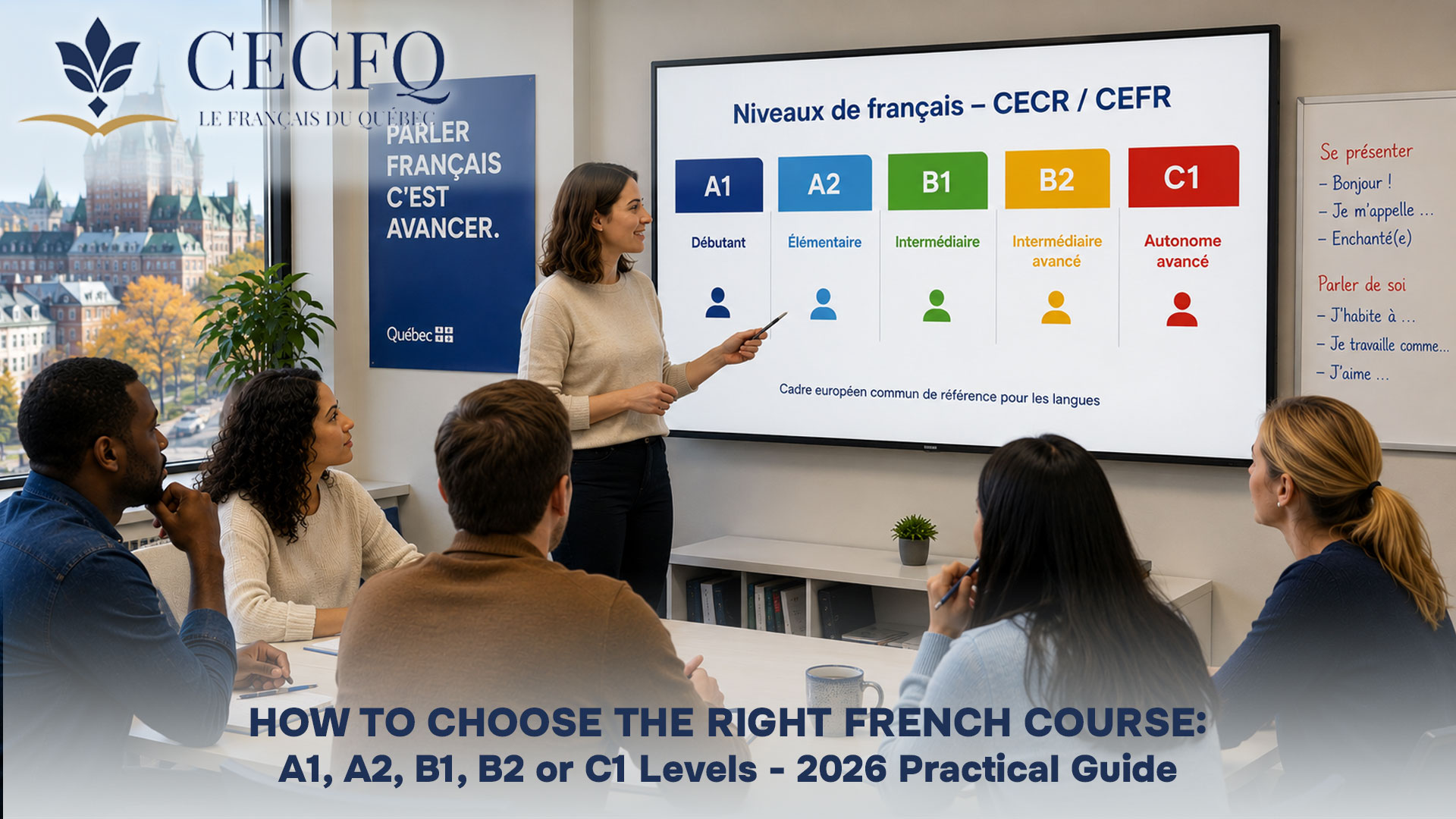
The Common European Framework of Reference for Languages (CEFR) scale is your best starting point: A1, A2, B1, B2, and C1. This framework is standard in language schools, exam preparation, workplace training, and immigration language assessments. In 2026, many adult French programs use CEFR descriptors for placement and progression. Simply labeling yourself as “beginner” or “intermediate” is often too vague for effective course selection.
A1 & A2 (Beginner):
A1 is for absolute beginners or those who know only isolated words. You can introduce yourself and handle very brief interactions. A2 offers more functionality, allowing you to discuss routine topics like work, housing, and shopping using simple sentences.
B1 & B2 (Intermediate):
B1 learners can manage everyday conversations more independently, describe experiences, and handle common administrative tasks. B2 signifies a significant step: learners interact more fluently, support their opinions, and operate comfortably in professional or academic settings.
| Level | What you can usually do | Best course focus |
| A1 | Use basic words, greetings, simple questions | Foundations, pronunciation, survival French |
| A2 | Handle routine daily tasks | Practical communication, grammar building |
| B1 | Manage independent everyday communication | Conversation, writing, real-life tasks |
| B2 | Discuss ideas clearly and work in French | Advanced speaking, accuracy, professional French |
| C1 | Understand nuance and communicate flexibly | Precision, argumentation, specialized language |
How CEFR French Levels Impact Course Choice
Understanding CEFR levels helps you avoid picking a course based solely on its title rather than your actual ability. A course should align with what you can do now and what you need to achieve next.
For instance, someone who reads simple messages but struggles to speak might not be ready for a fast-paced B1 conversation class. Another learner with strong grammar might need an A2 or B1 oral communication course if speaking skills lag.
Self-Assessment Checklist for French Level
Before enrolling, ask yourself these four questions:
- Can I understand spoken French in common daily situations?
- Can I respond in French without switching languages?
- Can I read practical documents like emails, forms, or notices?
- Can I write short messages with reasonable clarity?
If you answer “not yet” to most A2-level tasks, an A1 course is often the best starting point. If you manage daily life tasks but find complex discussions challenging, B1 might be more suitable than B2.
The Importance of an Official Placement Test
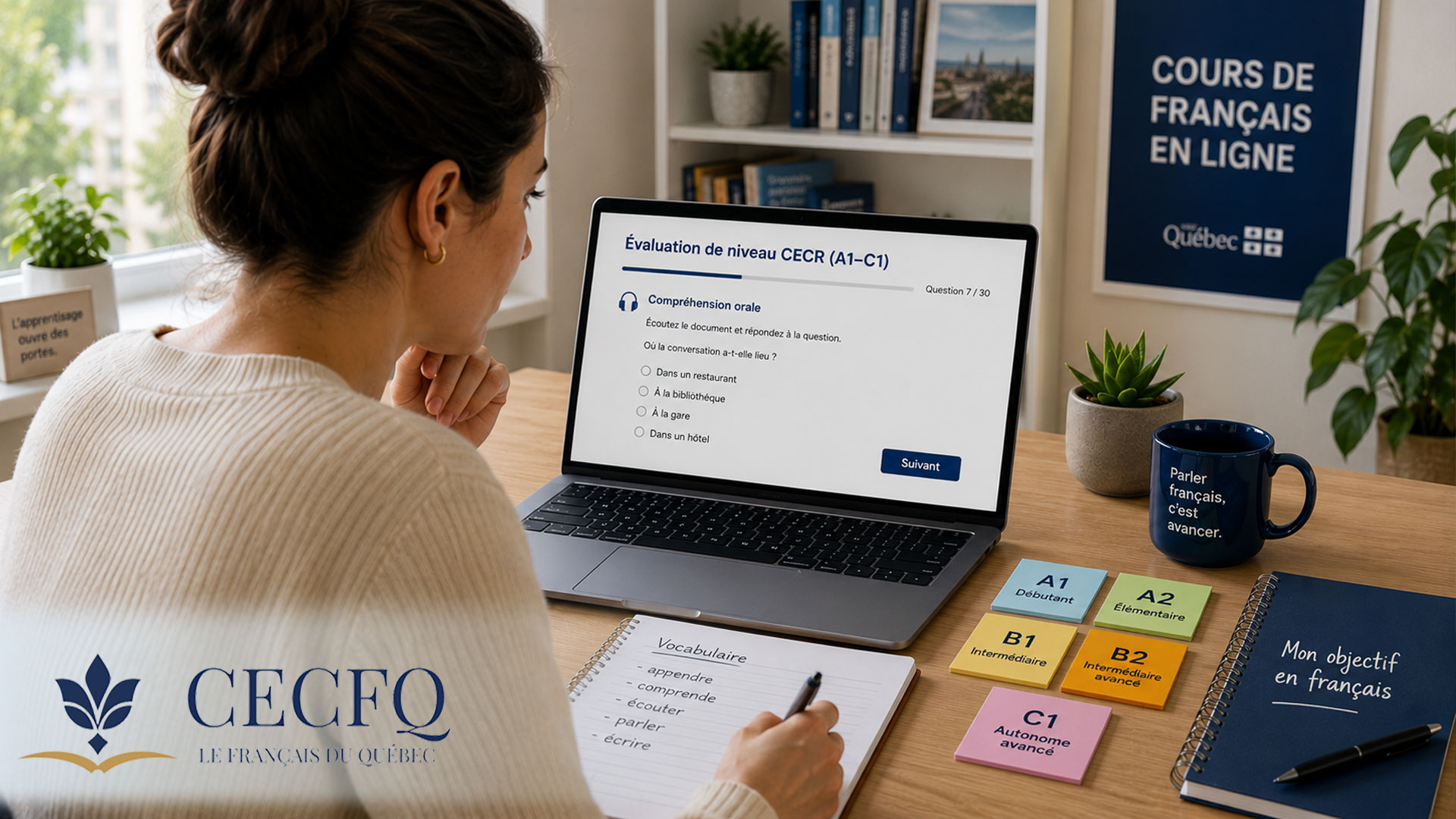
A placement test offers a more accurate assessment than self-perception alone. This is especially helpful for adults who studied French in the past, use it at work, or understand more than they can express.
Effective placement tests typically assess grammar, listening, speaking, and sometimes writing. A brief oral interview is often one of the most useful ways to differentiate between A2 and B1, or B1 and B2, minimizing the risk of joining a class with an unsuitable pace or content.

Matching French Proficiency Levels to Your Goals
French proficiency levels should connect to your objectives, not just your comfort zone. Someone preparing for life in Quebec may need a different course than one preparing for the DELF B2 or TCF Canada exam.
If your goal is daily integration, select a course emphasizing comprehension, speaking, and practical vocabulary. For professional advancement, choose a program that covers meetings, emails, presentations, and workplace scenarios.
French for Quebec Daily Life and Work
For newcomers and residents in Quebec, A1 and A2 courses are often most beneficial for daily integration. They cover transport, shopping, school communication, medical appointments, and basic administrative exchanges.
B1 becomes essential for greater autonomy. At this stage, learners can explain issues, ask follow-up questions, and participate more actively in community and work settings.
French for Exams and Formal Requirements
If French is needed for an exam, the course must match the test format and CEFR level. A general B2 course might improve your French, but a B2 exam prep course will also cover timing, task types, and evaluation criteria.
This applies to exams like DELF, DALF, TCF, and TEF/TEFAQ. The right course will specify if it focuses on overall language improvement, exam strategy, or both.
| Goal | Recommended starting point | Best course type |
| Daily life in Quebec | A1-A2 for most beginners | Practical communication course |
| Workplace integration | A2-B2 depending on role | Professional French course |
| Immigration or language proof | Based on required score | Test preparation + level support |
| University or advanced study | B2-C1 in many cases | Academic French or advanced skills |
Using a French Placement Test Effectively A placement test is most useful when it confirms both your current level and the pace you need. It is especially helpful for adults with uneven skills, such as strong reading but weaker speaking, or the reverse.
Signs it might be too easy:
You understand almost all instructions, complete tasks effortlessly, and rarely feel challenged. This often happens to learners who underestimate their abilities or lack speaking confidence despite a solid grammatical base.
Signs it might be too hard:
You frequently miss instructions, rely heavily on translation, or feel overwhelmed and stressed during participation. While some challenge is necessary for growth, constant confusion indicates a mismatch. A course that is too difficult can damage your confidence and leave foundational gaps. Moving down one level often accelerates your long-term progress.

Learning French Online & Class Formats
Accurate level matching is even more critical for adults learning French online. In virtual classes, pace, participation, and independent practice hinge on precise placement.
The best online option isn't necessarily the most advanced one. It's the course that provides sufficient challenge for growth while enabling consistent understanding, speaking, and task completion.
Group vs. Individual French Classes
Group classes suit learners with a clearly defined level who desire peer interaction. They are especially useful for speaking practice, listening diversity, and structured progression within a CEFR band.
Individual lessons are beneficial for uneven skill profiles or highly specific objectives. You might have B1 speaking but A2 writing, or need French for fields like healthcare, engineering, administration, or interview preparation.
How Many Hours Are Needed to Learn French?
Required hours vary by individual, but advancing between CEFR bands typically demands sustained practice over months, not weeks. Many adult programs estimate roughly 100 to 200 guided learning hours per level, but the actual timeline depends on your starting point, practice frequency, and exposure outside class. A realistic timeline helps you choose a course intensity that you can sustain consistently.

2 Real Cases: Finding the Right Fit
Case 1: Overestimating Past Knowledge
A newcomer to Quebec, assuming a B1 level from past classroom French, was evaluated. Oral assessment revealed their routine speaking was closer to A2. They began with an A2 practical communication course, building fluency in daily interactions before moving to B1 with greater confidence and faster progress.
Case 2: The Uneven Skill Profile (C1 Reading, B1 Speaking)
An international professional needing French for workplace meetings aimed for a C1 course. Placement review showed strong reading/listening but B1-B2 speaking. A targeted B2 professional communication course proved more suitable, improving their participation in discussions before further advancement.
FAQ
How do I know if I am A1 or A2 in French?
If you primarily use memorized phrases and very basic questions, you are likely A1. If you can manage routine daily situations with simple sentences, you are more likely A2.
Should I choose B1 or B2 French?
Choose B1 if you still require support for independent daily communication. Select B2 if you can discuss familiar and abstract topics fluently and aim to work or study more comfortably in French.
Is a French placement test necessary before choosing a course?
Yes, in most cases. It confirms your actual level in speaking, listening, reading, and writing, especially if your skills are uneven.
What French level is best for work in Quebec?
It varies by role. Many jobs become accessible from B1 upwards, while B2 often enhances comfort in meetings, writing, and professional interactions.
Can I study French online from A1 to C1?
Yes. Online study is viable at every CEFR stage, provided the course level, format, and learning objectives align with your specific needs.
Ready to Find Your Ideal French Course in Quebec?
Don't waste time and money guessing your CEFR level. At CECFQ, we help adult learners pinpoint their exact proficiency through a comprehensive level assessment before they start.
Whether you need survival French for daily life, professional communication for your career, or targeted preparation for official exams, we have the right class for you.
Take our official Placement Test or book a free pedagogical consultation today, and let us map out the fastest route to your fluency goals.
Disclaimer: The CEFR level descriptions provided in this guide reflect general language capabilities and typical 2026 course structures. Specific language requirements for immigration, professional orders, or university admissions in Quebec may vary. Always verify the required proficiency level directly with the relevant official institution before enrolling in a course.