
In this article
“What French level am I?” is a question with two different answers, depending on who’s asking. The short version: a level test tells you where to start — which course, which group, roughly which CEFR band you’re in. An official exam like DELF, TEF, or TCF tells everyone else — a university, an employer, an immigration officer — where you stand, with a score they can verify.
These two things get mixed up constantly, and the mix-up is expensive. Someone takes a five-minute online quiz, gets told “you’re B2,” and repeats that number on a job application or an immigration form, where a self-declared level carries no weight. Before you sign up for anything, it helps to know what you’re actually measuring, and why the tool matters as much as the result.

What CEFR Levels Actually Mean
The Common European Framework of Reference for Languages (CEFR) is the scale almost every French course and language exam refers back to. It runs from A1 to C2 and describes what you can actually do in the language — not how many verbs you’ve memorized.
The quickest self-check is to find the highest description that’s true of you on a normal day, not on your best day. The summaries below are based on the interpretation grid published by Le français des affaires, which runs the TEF.
| Level | What you can do |
| A1 | Understand common sayings and very simple announcements; introduce yourself and someone else; answer simple questions about your age, language and where you live |
| A2 | Understand single sentences and frequent expressions; hold a simple conversation about familiar topics such as work, friends or hobbies |
| B1 | Follow the main points when the language is standard; produce simple, coherent speech on familiar topics; give your point of view briefly; handle most situations while travelling |
| B2 | Understand the main points of a complex text; communicate with spontaneity and ease; express an opinion on a current topic and weigh pros and cons; report what someone else said |
| C1 | Understand long texts with implicit meaning; express yourself fluently and flexibly in social, professional or academic life; discuss and write about complex topics in a clearly structured way |
| C2 | Understand everything you read and hear without effort; synthesize different sources; express yourself spontaneously and precisely, including fine nuances |
Two things this table won’t tell you. First, most people don’t sit at one level across all four skills — see below. Second, the level you need is usually stated in NCLC (the Canadian scale IRCC uses), not CEFR, and the two scales are not interchangeable.
If you’re weighing which course fits the level you land on, our guide to choosing a course by level covers that side in detail; this article stays on the question of where you stand now.
Level Test vs. Official Exam: Not the Same Tool
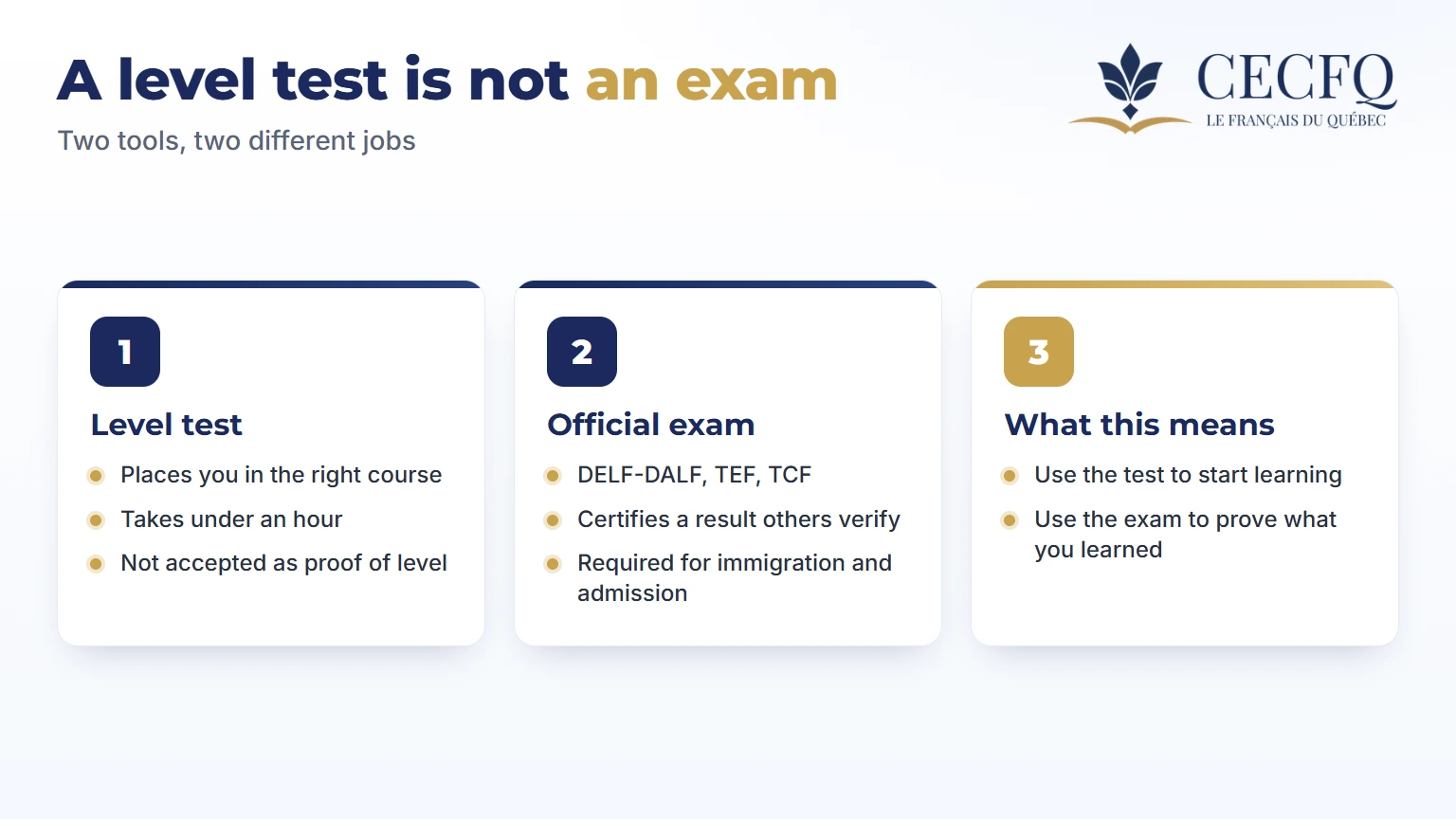
Both tools report their result on the same CEFR scale — the Council of Europe’s self-assessment grid sets out what each level means — and that shared vocabulary is exactly why they get confused. Everything else about them differs.
| Criterion | Level test | Official exam (DELF/DALF, TEF, TCF) |
| Purpose | Places you in the right course or group | Certifies your level for outside use |
| Typical length | 30–60 minutes | Several hours, sometimes across sessions |
| Skills usually checked | Listening, reading, grammar, vocabulary | All four: listening, reading, writing, speaking |
| What you get | A level estimate and a course recommendation | An official score or certificate |
| Accepted by immigration, employers, universities | No | Yes, where that specific exam is listed as accepted |
What Level Do You Actually Need?
Most goals attach to a specific required score rather than a general sense of “pretty good French,” and the number is rarely stated in the scale you’re thinking in. Before booking anything, it’s worth knowing what your actual target requires.
| Your goal | Minimum required | Scale used |
| Express Entry — Canadian Experience Class, TEER 0–1 | NCLC 7 in all four skills | NCLC |
| Express Entry — Canadian Experience Class, TEER 2–3 | NCLC 5 in all four skills | NCLC |
| Express Entry — Federal Skilled Worker Program (TEER 0–3 jobs) | NCLC 7 in all four skills, in your first official language | NCLC |
| Express Entry — French bonus points and French-language proficiency invitation rounds | NCLC 7+ in French, all four skills: 25 or 50 extra CRS (Comprehensive Ranking System) points (depending on your English level) and eligibility for French-category rounds | NCLC |
| Canadian citizenship, ages 18–54 | NCLC 4, speaking and listening only | NCLC |
| Quebec PSTQ, Stream 1 (highly qualified and specialized skills) | Oral 7+, written 5+ | Quebec scale (échelle québécoise) |
| Quebec PSTQ, Stream 2 (intermediate and manual skills) | Oral 5+ | Quebec scale |
| University programs in Quebec that carry a French-language requirement — for example some health programs at McGill and, more broadly, at Université de Montréal | Often B2; set by the university, and sometimes by the individual program | CEFR |
Read that table with two caveats. First, the federal rows can be met in either official language — the figures shown are the French equivalents, on the NCLC scale (Niveaux de compétence linguistique canadiens, the French counterpart of the Canadian Language Benchmarks, or CLB).
Second, TEER refers to the skill category of your job in Canada’s occupation classification, which is why the same program can ask different levels of different applicants. For many French-speaking candidates, the NCLC 7 line is the one that matters most: the same result that earns the bonus points is what makes you eligible for Express Entry’s French-language proficiency category.
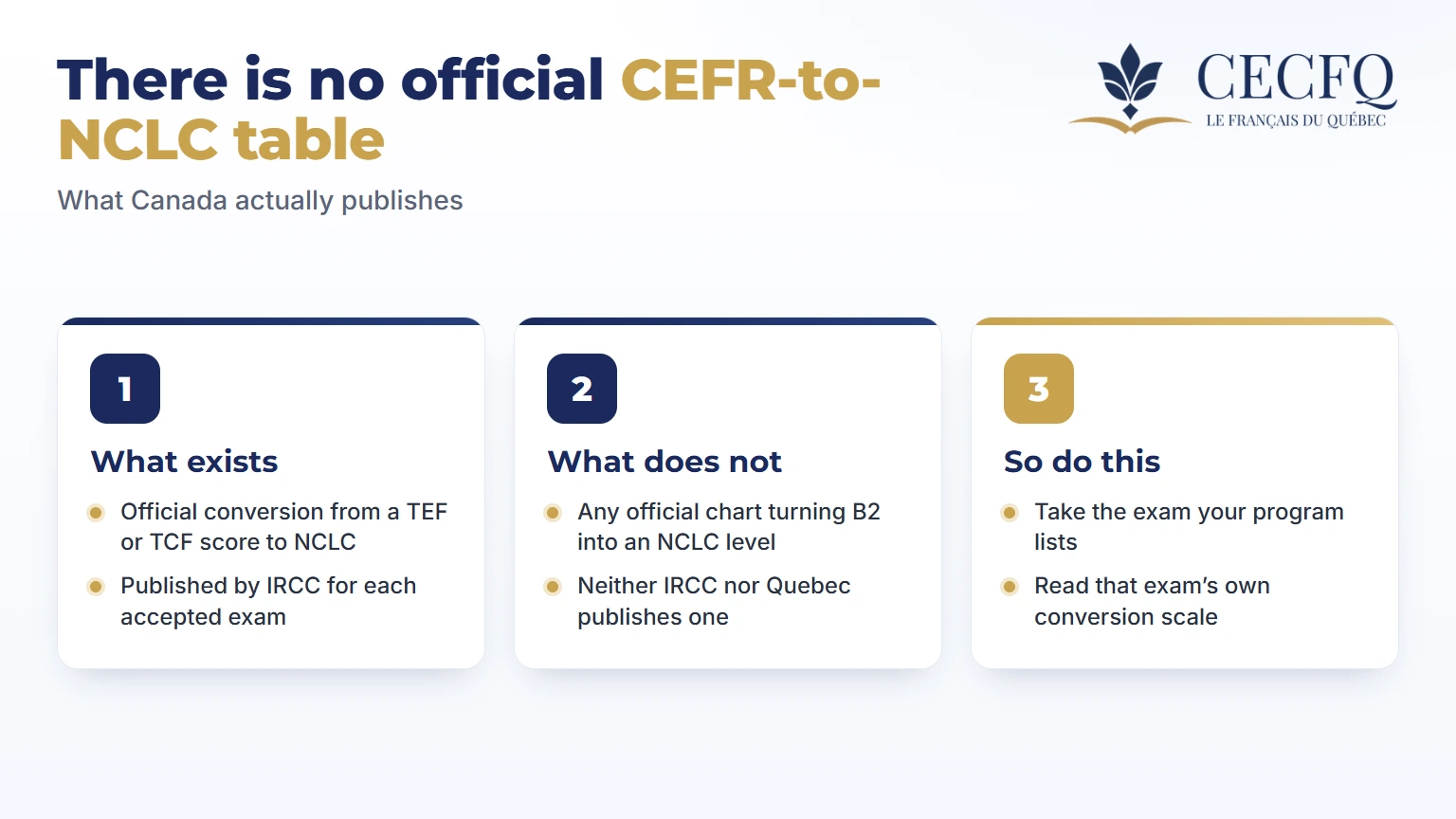
The mixed scales in that table aren’t sloppiness — they reflect how each authority actually writes its rules, and they lead to a point worth stating plainly. There is no official conversion table between CEFR and NCLC. IRCC only publishes how a specific exam result (a TEF or TCF score) converts to NCLC, not a general CEFR-to-NCLC equivalency. Quebec doesn’t fill that gap either: it works on its own provincial scale rather than NCLC. A clean “B2 = NCLC 7” chart presents something that doesn’t officially exist. The reliable path is to take the exam your goal actually requires and read that exam’s own conversion scale.
What Self-Assessment Can and Can’t Tell You
Most learners aren’t neutral judges of their own level. A study of how second-language English speakers judge their own speech observes a pattern worth knowing about, and teachers see the same thing in French: those at lower levels tend to overestimate themselves, while more advanced learners tend to underestimate. A plausible reason for the second half of that: the more French you have, the more clearly you hear what you’re still getting wrong. Either way, the problem isn’t honesty — it’s the absence of an outside reference point, which is what a level test provides.
How Long Does the Next Level Take?
People also want a number for how long the next level takes, and there isn’t a solid one for French. The widely cited figure of roughly 200 guided learning hours per level comes from Cambridge English and describes English; no equivalent official figure exists for French. Treat any hour count you see as a loose planning reference, since pace depends on your starting point, prior language experience, and how consistently you practice.
Check Each Skill Separately, Not Just “My Level”
A single number like “I’m B1” can hide a lot. It’s common to read comfortably at B2 while speaking closer to A2, especially for people who learned French mostly through reading, subtitles, or work documents rather than conversation.
That gap matters practically. Express Entry sets a minimum per skill across all four, and Quebec’s PSTQ does the same for its own oral and written scores — so a strong reading result won’t offset a weak speaking one. Citizenship works differently again: only speaking and listening are assessed. And the exams themselves don’t all behave the same way — TEF and TCF convert each skill to its own level, while DELF is compensatory, with an overall pass mark and a minimum per section. Which exam you take changes how much a weak skill actually costs you.
Before assuming a single label describes you, it’s worth asking, skill by skill: can you follow a fast radio segment without subtitles (listening)? Read a news article without stopping for every third word (reading)? Write a few paragraphs with correct structure (writing)? Hold a five-minute conversation on an unfamiliar topic (speaking)? Wherever the answer changes, your real level probably changes too.

How CECFQ’s Level Test Works
CECFQ offers two versions of a level test, and it’s worth knowing what each one covers before you pick.
| Criterion | Placement test | Ev@lang |
| Price | CAD $20 | CAD $30 |
| Range covered | A1–B2 | A1–C2 |
| Length | 30–45 minutes | Up to 35 minutes |
| How it works | Online test, followed by personalized course recommendations | Adaptive: question difficulty adjusts to your answers |
| Result | Your level plus course recommendations, by email | CEFR level immediately |
| Best when | You want to be placed in the right group | You want a fuller picture, including the C levels |
Both are taken online, from a computer, tablet, or phone, and the second was developed by France Éducation international — the same organization behind the DELF-DALF and TCF exams. The CAD $20 placement-test fee comes back to you as a promo code toward a course, sent by email right after you buy the test.
One limit applies to both, and it’s the important one: neither issues an official certificate. Ev@lang, the more detailed of the two, is built around listening, reading, grammar and vocabulary — so neither test tells you how well you speak, which is exactly the skill learners tend to misjudge. If speaking is the gap you already suspect, that’s the skill to work on with a teacher before booking any official exam. The result is there to place you in the right course, not to serve as proof of level for an application. If you’re a complete beginner, you can skip the test entirely and register directly for an A1.1 course.
Related reading: once you know your target, which French exam Canada actually requires; and if the test places you at the start of the scale, how to pass DELF A1–A2 as a beginner.
2 Real Cases:
Case 1 — a level assumed, never checked. A prospective immigrant assumed her intermediate online course made her “B2-ready” and booked a TEF Canada exam without testing first. Her reading score was strong, but her speaking result came in a full band lower, missing the NCLC 7 threshold she needed for Express Entry bonus points. An online level test wouldn’t have caught this — it doesn’t assess speaking — but having a teacher hear her speak months before booking would have flagged the gap, with time to work on it.
Case 2 — strong at reading, no official proof. A university applicant had read French academic articles comfortably for years and described himself as C1 on an admission file for a program requiring B2. The school asked for an official score instead, since a self-declared level isn’t verifiable. He ended up booking a DELF B2 exam close to the deadline — workable, but far more stressful than starting the official process early.
FAQ
1. How long is a level test result good for?
There’s no formal expiry, but treat it as a snapshot: after a few months of study — or a few months without any — it stops describing you. Retesting before enrolling again is cheaper than sitting in the wrong group for a term.
2. What’s the difference between DELF, TEF, and TCF?
DELF and DALF certify a fixed CEFR level (A1–B2 for DELF, C1–C2 for DALF). TEF and TCF instead produce a score that’s then converted to a level, and they’re the only two French exams accepted for Express Entry. Quebec’s PSTQ accepts DELF and DALF alongside them, and so does citizenship — though for citizenship, DELF counts only from B1 up. See which French exam Canada requires for a full comparison.
3. I’m already living in Quebec. Is there a public option?
Yes — Francisation Québec, the provincial French-language service open to people aged 16 and over living in or moving to Quebec, runs its own courses and its own placement process, and it works on the Quebec scale rather than CEFR. Worth checking your eligibility there before paying for anything privately; the two systems describe levels differently, so don’t assume a level from one transfers cleanly to the other.
4. What if the test places me lower than I expected?
It often means one of the areas an online test actually measures — listening, reading, or grammar and vocabulary — is weaker than you assumed, rather than your French being weaker across the board. Speaking isn’t part of the result at all, so check it separately with a teacher. Starting a level below where you imagined yourself is far cheaper than sitting an official exam and discovering the same thing from a result you paid several hundred dollars for.
5. How long does an official exam result stay valid?
For Express Entry and other economic immigration programs, language test results must be less than two years old when you apply, so timing matters: sitting an exam long before you’re ready to submit can mean paying for it twice. Check the current rule for your specific program before booking.
Disclaimer: This article is for general information only and does not constitute immigration advice. Exam formats, accepted tests, and level requirements for immigration, citizenship, and university programs change over time and vary by program. For current, binding requirements, consult the exam operator directly (DELF-DALF, TEF Canada, or TCF Canada) and the relevant immigration authority (IRCC or the Government of Quebec).
Ready to find out where you actually stand? Take your French level test and you’ll get a course recommendation built around your real starting point instead of a guess — and the CAD $20 test fee comes back to you as a promo code toward your course.
Email: info@cecfq.ca
Website: cecfq.ca
Address: 50 Rue Saint-Charles O, local 100, Longueuil, QC J4H 1C6
Hours: Mon–Fri 9:00 a.m.–6:00 p.m., Sat 9:00 a.m.–2:00 p.m.