
In this article
- Why Understanding French Doesn’t Automatically Make You Speak It
- Why Interaction Beats One-Way Practice
- What Makes Practice Stick
- How Much Practice Does It Take?
- Comparing Formats for Online French Speaking Practice
- Does Quebec French Change How You Should Practice?
- Speaking Practice Isn’t Just About Real Life — It’s Also on the Exam
- Building a Regular Speaking Habit
- How CECFQ’s Conversation Workshops Fit In
- Frequently Asked Questions
- Ready to Start Talking?
You can read a French newspaper, follow a podcast, and understand a fast conversation between two people at the next table. Then someone turns to you with a direct question, and the words don’t come. That gap between understanding French and speaking it is one of the most common obstacles in language learning — and one of the most misunderstood.
That gap isn’t a sign that you haven’t studied enough grammar or vocabulary. Comprehension and production are separate skills, built through different kinds of practice, and one doesn’t automatically turn into the other. This guide compares the main formats for online French speaking practice — group classes, private lessons, language exchange, AI conversation, and solo practice — so you can pick the one that closes your gap, not just adds more input.

Why Understanding French Doesn’t Automatically Make You Speak It
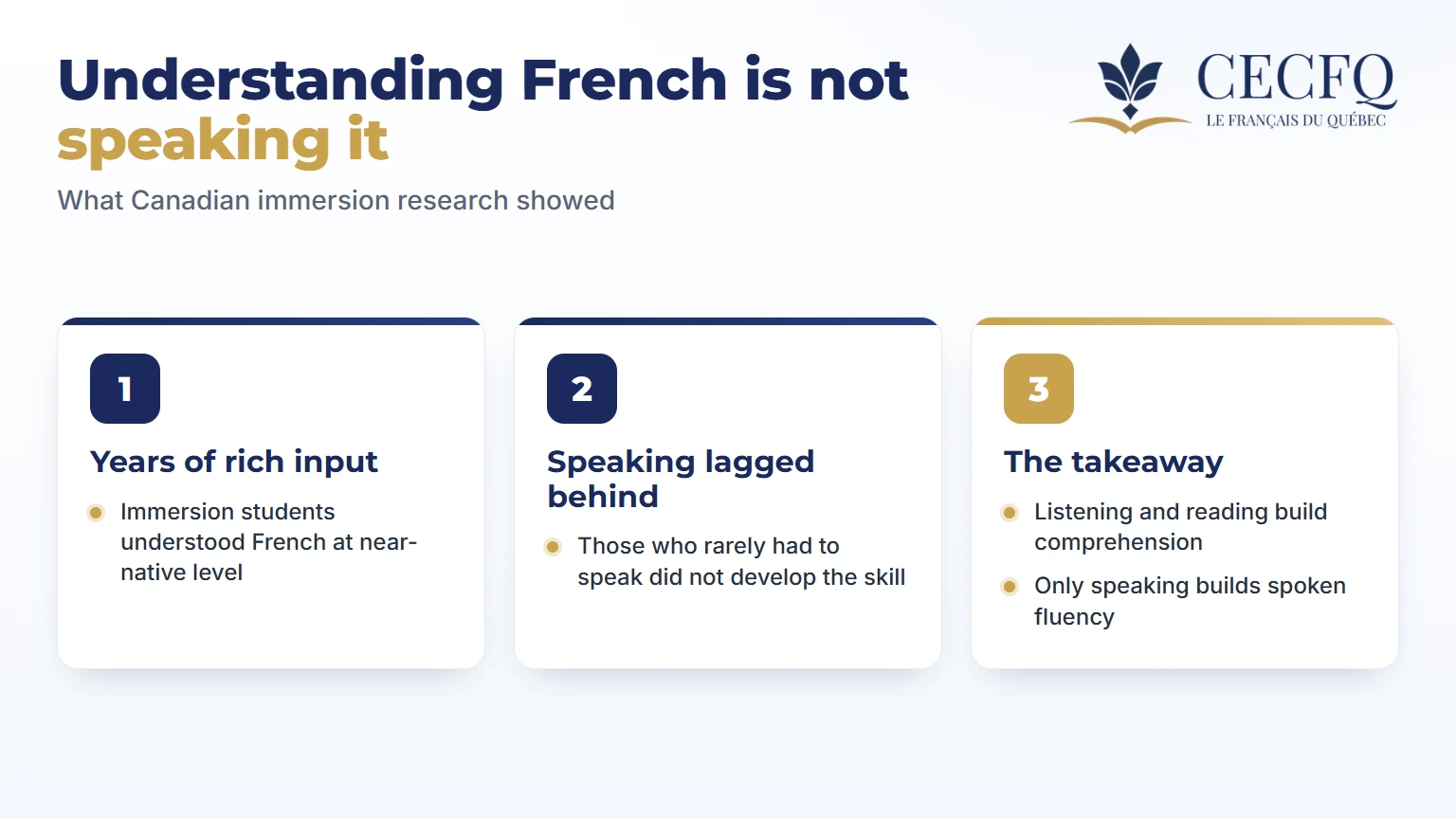
The clearest evidence for this comes from Canada itself. Researcher Merrill Swain studied French immersion programs in Canadian schools, where students received years of rich, comprehensible input — lessons, readings, and conversation almost entirely in French. Many of them developed strong comprehension of spoken and written French.
Yet their own speaking and writing lagged noticeably behind. According to Swain’s output hypothesis, comprehensible input gets a learner only so far; producing language is what forces you to notice gaps, test structures, and fix errors in real time. Immersion students who rarely had to speak simply didn’t develop that skill, no matter how much French they absorbed.
The lesson for adult learners practicing online is the same one those classrooms taught researchers decades ago: listening and reading build comprehension, and comprehension is necessary — but speaking is what builds speaking. For why realistic, scenario-based practice works so well in a Quebec context, see our guide to accelerating French through realistic speaking practice; this article picks up from there and focuses on which format to use.
Why Interaction Beats One-Way Practice
Passive exposure and active practice aren’t the only distinction that matters. Real conversation also involves negotiation of meaning — being asked to clarify, rephrasing something that didn’t land, catching yourself mid-sentence and correcting course. That back-and-forth does more for language development than talking at a screen or a script.
ACTFL, the main US professional body for language teaching, makes the same point in its guidance for instructors: effective learning requires “significant levels of meaningful communication and interactive feedback” in the target language, not just exposure to it. Using French isn’t enough on its own — learners need real interaction, with someone responding to what they actually say.
What Makes Practice Stick
Two things make practice hold. The first is retrieval: pulling a word out of memory yourself, rather than recognizing it when you see it again. The second is spacing — a review of spaced learning in language teaching notes that study sessions spread out over time often produce better learning than cramming everything into one. A five-minute conversation, where you have to produce vocabulary on the spot, does both at once; rereading a list of verbs does neither.
Apps aren’t the enemy here, and it’s worth being accurate about them. A Michigan State study followed 85 students using a language app for 12 weeks: 54 of them finished the 12 weeks, and 59% of those gained at least one sub-level on a spoken evaluation interview — so on speaking, not only on grammar and vocabulary. Where apps run out of road is further along: they can’t react to what you said, ask you to clarify, or tell you that a technically correct sentence sounds odd. That’s the part a conversation supplies, and it matters more the closer you get to real fluency.
How Much Practice Does It Take?
Estimates for how many hours it takes to move between levels vary depending on who’s measuring. Commonly cited guided-learning-hours figures from Cambridge English — roughly 350–400 cumulative hours to reach B1 on the CEFR scale — describe English-language courses; they’re used as a rough CEFR-wide reference rather than a measurement of French, and they assume classroom study rather than casual daily practice.
The U.S. Foreign Service Institute, which trains diplomats, places French in its easiest category for English speakers and estimates about 30 weeks of full-time, intensive training — roughly 690 hours in class, plus self-study — to reach general professional proficiency in speaking and listening, a level well past everyday conversational fluency.
These two references measure different things: guided classroom hours versus full-time immersive training. Neither converts cleanly into “weeks until I can talk to my in-laws.” Use them as compass points, not a countdown — your own pace depends on your starting level, how often you speak, and the quality of feedback you get along the way.
Comparing Formats for Online French Speaking Practice
Once you accept that speaking has to be practiced deliberately, the real question is which format fits you — group class, private lesson, tandem exchange, AI chat, or solo practice. Each trades off structure, feedback, and real interaction differently, and the right choice depends on what you’re missing most. If you’re weighing structured group sessions against one-on-one coaching specifically, our comparison of private lessons vs. group classes breaks down which fits different goals.
| Format | Cost | What it gives you | What it doesn’t give you | Often suits |
| Group conversation class | Paid | Structured prompts, teacher feedback, interaction with peers at a similar level | Fixed schedule, pace set by the group, less individual talk time; a dominant participant can absorb the airtime | Learners who want structure, accountability, and regular feedback |
| Private lessons | Paid, highest per hour | Maximum speaking time, feedback aimed at your specific errors and goals | No peer interaction, no exposure to other accents and speaking styles | A specific goal (exam, job interview) or a level no group matches |
| Language exchange (tandem) | Free | Authentic conversation with a native speaker, cultural context | No curriculum, no guaranteed correction, uneven levels between partners | Learners past the beginner stage who want informal practice |
| AI conversation practice | Free or low-cost | Available any time, no social pressure, endless patience for repetition | Weaker at judging register, tone, and natural phrasing; no feedback plan across sessions | Warming up or low-stakes repetition between lessons |
| Solo practice out loud | Free | Builds the daily habit of producing French | No interaction and no correction; you can’t hear your own errors in the moment | A daily add-on to another format, not a replacement for one |
Two practical notes the table can’t hold. First, group size decides how much of the session is actually yours: in a circle of four to six, everyone speaks several times; in a class of fifteen, some people leave without having said a sentence. Ask the number before you pay, not the format name.
Second, know when to switch. If you’ve stopped being corrected — because your partner is too polite, the group is too big, or the chatbot doesn’t notice — the format has stopped working, whatever it costs. And if you can hold a conversation but freeze with unfamiliar speakers, the fix isn’t more hours with the same person; it’s more people.
If you’re trying the free formats, exchange apps such as Tandem or HelloTalk match you with French speakers learning your language, and most general AI assistants now offer a voice mode you can set to French. Tell your partner — human or AI — up front that you want corrections; neither will reliably give them unasked.
Match the format to the problem you have
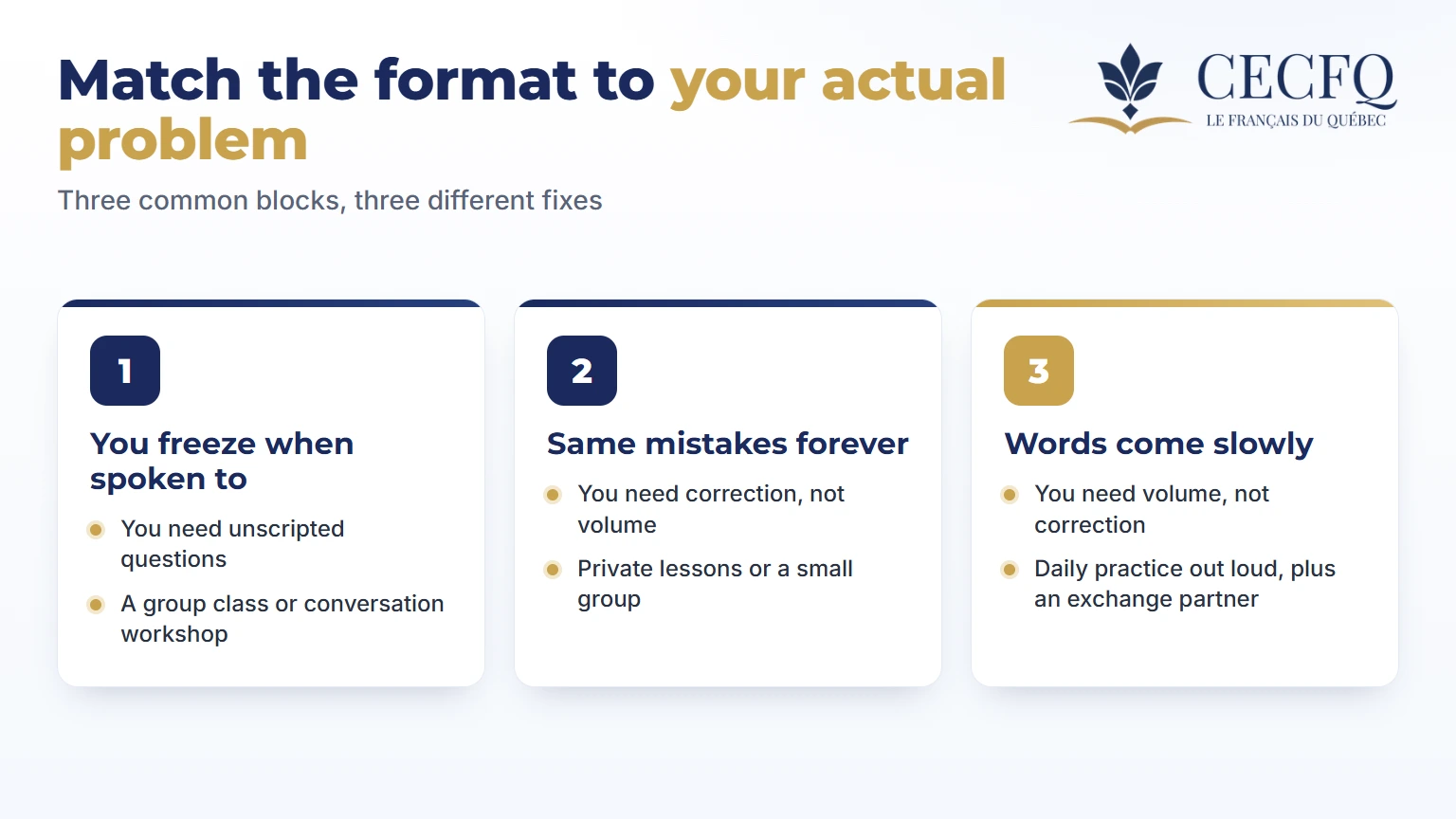
Most people don’t need every format. They need the one that fixes what’s blocking them:
- You freeze when someone speaks to you first. Start with a group class or lessons, where being addressed unexpectedly is built into the session — that’s the exact reflex you’re missing.
- You speak fine but make the same mistakes forever. You need correction, not volume: private lessons, or a class small enough that the teacher hears you every session.
- You have the words but they come out slowly. You need volume, not correction: daily solo practice and an exchange partner will do more than another grammar course.
- You understand Parisian French but not your colleagues in Montreal. Prioritize practice with Quebec speakers over any particular format.
- You’re preparing an exam’s oral section. Practice under exam conditions with someone who knows the criteria; general conversation rarely rehearses the constraints.
- You’ve just arrived in Quebec. Check whether you qualify for the free French courses offered by the Government of Québec before paying for anything privately.
One caution about AI practice specifically, since it’s the format changing fastest. Ask a chatbot whether a sentence is correct and you’ll get an answer; ask whether it’s what someone in Montreal would actually say, and the ground gets shakier. That distinction — correct versus idiomatic in this place — is where a teacher’s feedback still differs from an instant correction.
A related limit shows up in the research. A 2026 study with English learners found that immediate chatbot correction did not produce significantly stronger learning gains than delayed correction, although learners perceived it more positively. Feeling helpful and being more effective are not always the same thing.
Does Quebec French Change How You Should Practice?
French from France and Quebec French are the same language, but they don’t always sound the same. Quebec French keeps some vowel distinctions that have disappeared from standard Parisian French, and consonants like t and d often become [ts] and [dz] before i and the French u sound /y/ — so tirer can sound closer to “tsiré” and du closer to “dzu”. Vocabulary shifts too: a dépanneur is a corner store, stationnement is parking, and magasiner means to shop.
Neither variety is inherently more correct than the other. What matters is context: formal written French follows shared standards, while pronunciation, vocabulary and everyday usage vary by region. What it does mean is practical: if you’re planning to live, work, or take an exam in Quebec, practicing with Quebec French speakers and Quebec vocabulary prepares you for what you’ll actually hear at work or at the dépanneur, not just what a textbook or a Paris-based podcast trains you for.
Pronunciation habits set early often prove harder to correct later — we cover why in our guide to French pronunciation starting at level A1. The province’s own language programs follow the same logic: the French they teach is the French spoken here.
Speaking Practice Isn’t Just About Real Life — It’s Also on the Exam
If you’re preparing for TEF or TCF, speaking practice isn’t optional the way it can feel when you’re just building general fluency. It’s a scored section with its own criteria: fluency, pronunciation, vocabulary, grammar, and your ability to actually interact — ask questions, respond to something unexpected, keep a conversation moving instead of reciting a memorized answer.
On the TCF, the speaking test is a 12-minute face-to-face exchange with an examiner — three tasks, with only two minutes of preparation in total, so for most of it you hear the prompt and respond. That format rewards exactly the kind of practice covered here — real-time production under mild pressure, not a script rehearsed in a mirror. Comprehension gets you through the reading and listening sections; regular speaking practice is what prepares you for the oral one.
Building a Regular Speaking Habit
Frequency tends to matter more than the length of any single session: short daily speaking practice keeps production active in a way that one long weekly session usually doesn’t — the same spacing effect described above.
A few habits worth building into any format you choose:
- Talk out loud in French daily, even alone — narrate a task, describe your day, answer a question you imagine someone asking you.
- Record yourself occasionally and listen back. Hearing your own hesitations at a remove is a partial substitute for feedback — not a replacement for it, but better than nothing between sessions.
- Work on one weak point at a time — a specific verb tense, a sound, a habit of switching to English mid-thought — instead of trying to fix everything at once.
- Ask for feedback that’s specific. “Was that understandable?” tells you less than feedback pointed at one concrete pattern you can actually fix.

How CECFQ’s Conversation Workshops Fit In
One thing to settle first: CECFQ’s conversation workshops are built for intermediate and advanced learners (B1–B2 and C1–C2) and for candidates preparing an exam’s oral section — not for complete beginners. If you’re starting from zero, a general French course builds the base first, and a conversation workshop becomes useful once you have enough French to work with.
If you’re past that point and would rather practice with structure and feedback than build a routine from scratch, CECFQ runs advanced French conversation workshops entirely online, in small groups of four to six students. Sessions are led by certified examiners and teachers who give direct feedback on pronunciation, fluency, and delivery — the kind of feedback a tandem partner or an AI chatbot can’t consistently provide.
Workshop content is built around real interaction — role-plays, debates, and situations drawn from meetings, travel, and client-facing work, rather than scripted dialogue, including practice aimed at the oral sections of DELF-DALF, TEF and TCF. Everyone is placed by level first, and finishes with a certificate of completion — a record of participation, not an official language certificate.
The practical details, since they decide whether a format fits your week: sessions run 90 minutes, once a week — Friday 5:30–7:00 p.m. for B1–B2, Saturday 10:30 a.m.–12:00 p.m. for C1–C2 — and cost CAD $15 for a single drop-in session or CAD $50 for a package of four, plus a one-time non-refundable CAD $20 registration fee on first enrollment. Current CECFQ learners get conversation practice included with their course — ask which sessions your enrollment covers. You can start at any point in the year rather than waiting for a term to begin.
2 Real Cases:
Case 1 — comfortable on paper, stuck out loud. A newcomer preparing for the TCF had spent months on grammar drills and reading practice, scoring well on every practice test — except the oral section, where most of the tasks arrive without preparation time. Scheduled conversation practice, focused specifically on responding without a script, was what finally moved that section; the grammar had never been the problem.
Case 2 — three years of apps, and still stuck. Another learner had used a popular app daily for years and could follow French shows without subtitles, but froze the first time a coworker in Quebec spoke to him directly. Switching part of his routine to a small conversation group — where he had to answer, not just recognize — changed what he could do in the moment, not what he understood.
Frequently Asked Questions
1. Do I have to commit to a series, or can I try one session?
Both options exist at CECFQ: a single drop-in session or a package of four, with entry open year-round rather than at fixed term dates. Trying one session first is the cheaper way to find out whether a group format suits you before committing further.
2. What do I do when my conversation partner keeps switching to English?
Agree on a rule before you start — a set number of minutes in French, or French for the whole session with English allowed only to unblock a word. Drifting into English is the most common way an exchange quietly stops being speaking practice.
3. How many formats should I combine?
Usually two: one that provides feedback and correction, and one that provides daily volume. A weekly class or lesson paired with short daily practice out loud covers both without becoming a second job.
4. Does conversation practice count for exam preparation?
Directly. The major exams assess spoken interaction rather than recitation, and they’re run by different operators with different formats — TCF and DELF-DALF by France Éducation international, TEF by Le français des affaires, whose speaking section pairs an information-gathering task with an argument. Practicing unscripted responses is the closest thing to rehearsing any of them.
5. I’m too shy to speak in front of a group. What should I start with?
If it’s the audience that intimidates you (rather than the unexpected question), start where the audience is smallest: solo practice out loud, then a private lesson or an AI partner to lower the stakes, then a small group. Being nervous at first is the normal starting point, not a sign the format is wrong for you.
Disclaimer: this article is for general information only and is not immigration advice. Progress with speaking practice varies by learner, starting level, and how consistently you practice — no format guarantees a specific outcome or timeline. Exam formats and requirements for TEF, TCF, and DELF-DALF change from time to time; always confirm current requirements with the official exam operator before registering. Eligibility for government-funded French programs depends on your immigration status and other criteria — check the current conditions with the relevant Quebec authority.
Ready to Start Talking?
If you’re not sure where you stand, start with a French level test — the placement version is CAD $20 and takes about 30–45 minutes, and that fee is returned as a promo code applicable to a course. To know what that result will — and will not — tell you, see our guide to working out your French level. Already at B1 or above? Take a closer look at the advanced French conversation workshops.
Email: info@cecfq.ca
Website: cecfq.ca
Address: 50 Rue Saint-Charles O, local 100, Longueuil, QC J4H 1C6
Hours: Monday–Friday 9:00 a.m.–6:00 p.m., Saturday 9:00 a.m.–2:00 p.m.