
In this article
TEF Canada is a French proficiency test run by Le français des affaires, part of the Paris Île-de-France Chamber of Commerce and Industry (CCI), and recognized by Immigration, Refugees and Citizenship Canada (IRCC) since 2002. For a permanent residence application through Express Entry, you need results from all four tests taken on the same day: reading, listening, writing and speaking. For a citizenship application, IRCC assesses language proof in listening and speaking only, but candidates should confirm with their chosen test centre which TEF version and modules will produce accepted proof before registering. Below, we cover the practical side — and one score-entry mistake that can get an Express Entry application refused.
If you still haven’t decided which exam suits you, start with TEF vs TCF Canada or TEF vs TEFAQ — both compare the two exams side by side.
What the Four Tests Look Like
TEF Canada is split into four separate tests. TEF Canada is made up of four separate tests. For Express Entry and permanent residence, all four must be taken on the same day. In other situations, such as citizenship, the required skills may differ, so confirm the exact modules with your test centre before booking.
| Test | Format | Duration |
| Reading comprehension | 40 questions | 1 hour |
| Listening comprehension | 40 questions | 40 minutes |
| Written expression | 2 sections: continue an article (80 words min., 25 min) and justify a point of view (200 words min., 35 min) | 1 hour |
| Oral expression | 2 sections: obtain information (5 min) and argue to convince (10 min) | 15 minutes total |
One rule matters more than it looks: for permanent residence, all four tests must be taken on the same day, or Canadian authorities won’t recognize your certificate.
Registering for TEF Canada
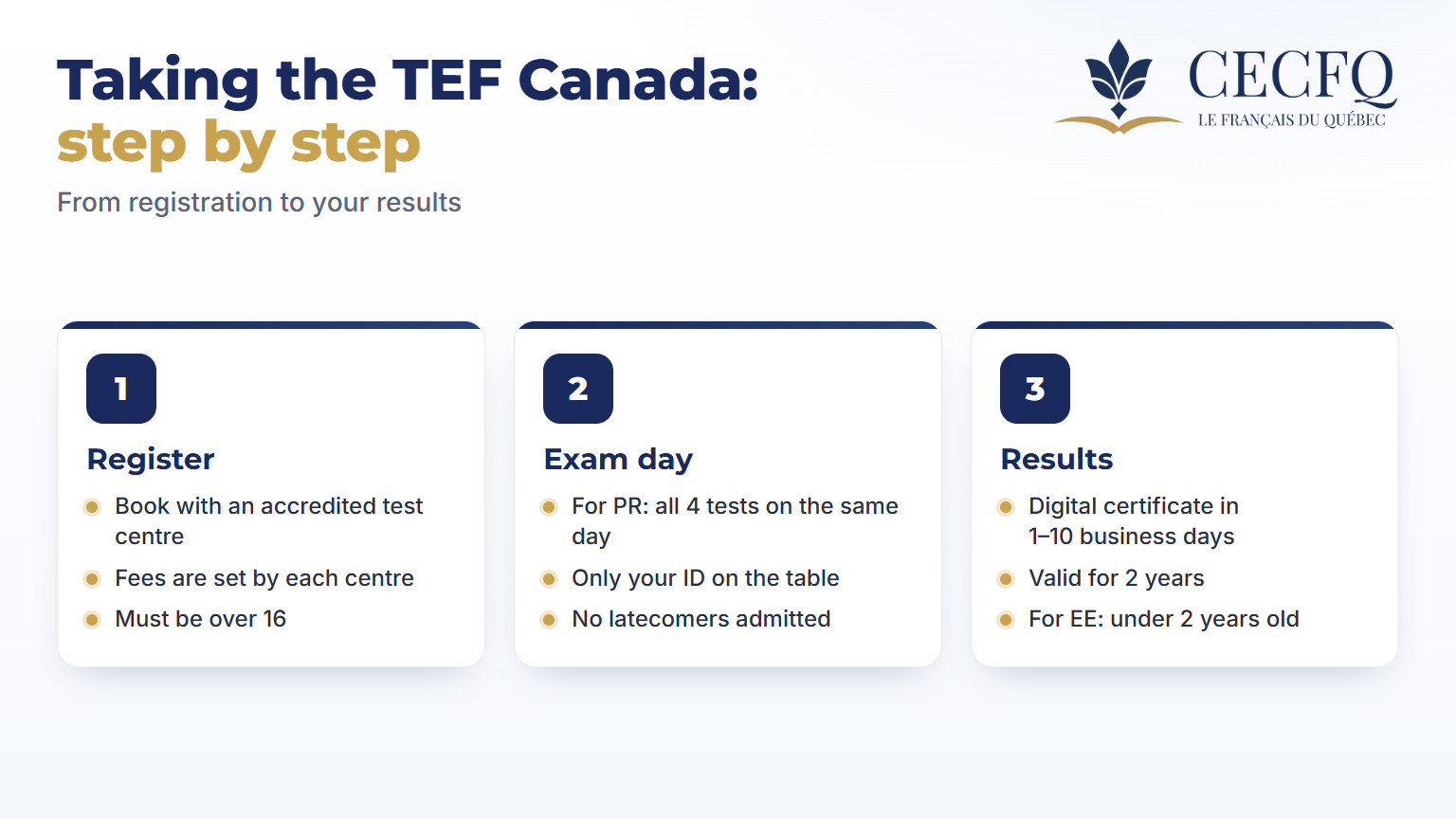
You register directly through an accredited TEF test center — there’s no central booking site that covers every location. Registration fees are set by each center individually, not by the operator, so the amount depends on where you test and how many of the four parts you book. Because of that, there’s no single “official” price to quote here; confirm the current fee with the center you plan to use.
A few conditions apply everywhere, regardless of center:
- You must be over 16 years old to register.
- Registration is firm and final — once you pay, the fee is kept by the center even if you change your mind or don’t show up.
- If you want to retake a test you already sat, you need to wait at least 20 days from your last attempt at that same test, across all versions of the TEF.
Missing your session isn’t automatically a lost cause, but the exception is narrow. A single postponement, to a session within 6 months of the original date, is possible only for a justified absence reported no later than one month after the session — and it must be approved by the operator, not just your test center. In any other case, a missed session is simply forfeited — the fee isn’t refunded. If in doubt, confirm the exact conditions with your test center before you register.
What Happens on Exam Day
Your invitation tells you exactly when to show up — report to the center at that time. At the center, a supervisor checks your ID and your invitation, asks you to confirm your personal details, and has you sign on a tablet.
A few rules apply strictly once you’re in the room:
- Your phone and any other electronic device must be switched off.
- Dictionaries and other reference material aren’t allowed.
- The only personal item allowed on your table is your ID — everything else stays off the table and out of sight.
- Latecomers aren’t admitted once the test has started, so plan to arrive with margin.
- No scratch paper, notes or documents are allowed during the reading, listening and speaking tests — practise those without writing anything down.
- You can’t leave the premises during the computer-based tests.

Getting Your Results
Results arrive as a digital certificate — no paper copy is issued. The operator sends it within 1 to 10 business days of your test date, through an email link to an online digital vault. For Express Entry and permanent residence, your results need to be less than 2 years old both when you complete your profile and when you submit your application; the certificate itself stays officially valid for 2 years from its issue date.
For each test, your certificate shows a score on a scale of 0 to 699, a CEFR level (A1 to C2) and a Canadian Language Benchmark / NCLC level from 1 to 12 — plus a fourth column, “Équivalence ancien score,” which the next section explains.

The Two-Column Trap: Don’t Enter the Wrong Score in Express Entry
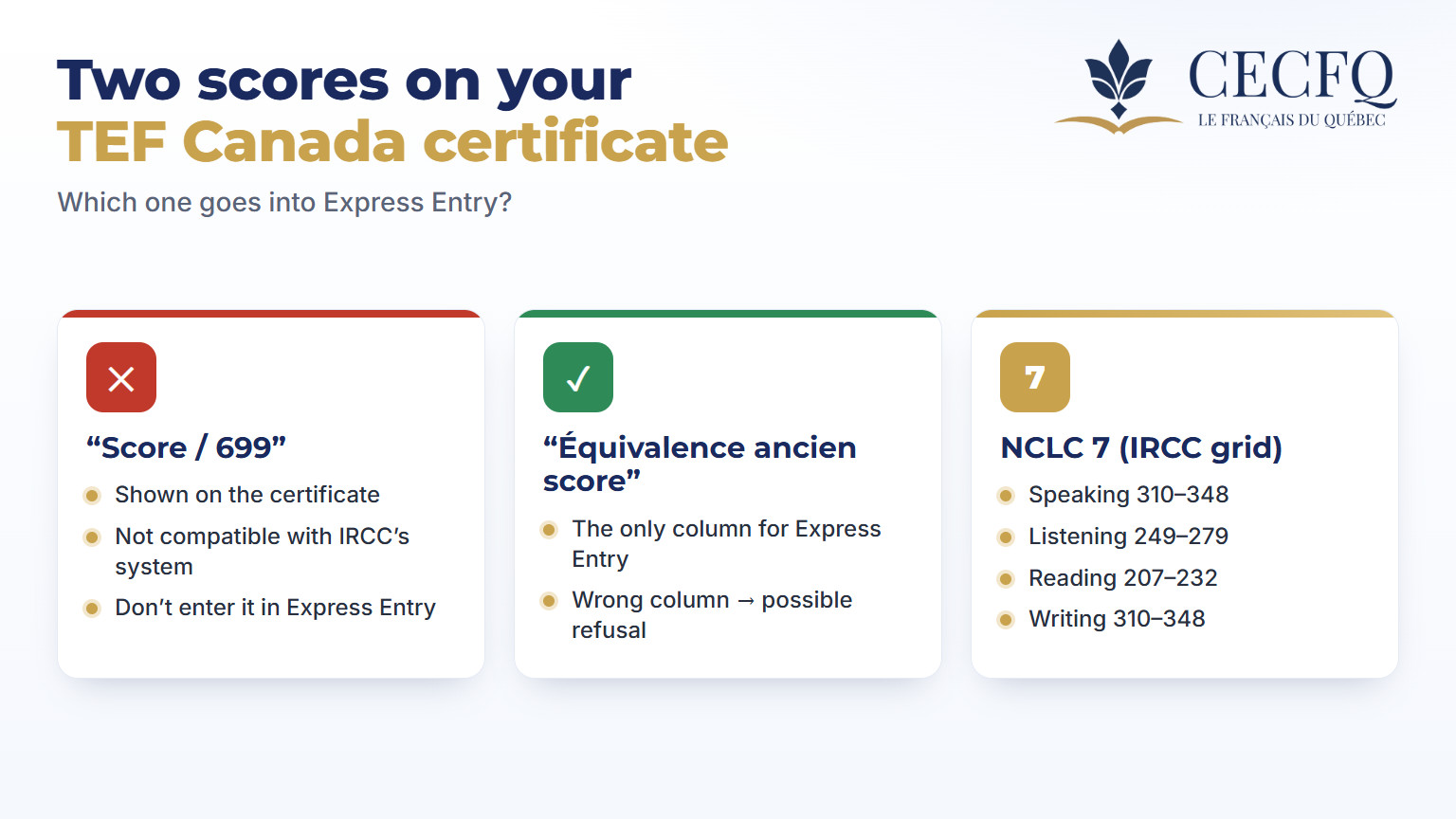
This is an easy place to lose points you earned. Your results certificate shows two different numbers for the same test: your raw “Score / 699,” and a separate column labelled “Équivalence ancien score” (old score equivalence).
For an Express Entry profile, IRCC is explicit: enter only the numbers from the “Équivalence ancien score” column. The Score/699 figures aren’t compatible with the current scoring system, and entering them instead can lead to a refused application. IRCC gives this instruction in a single line of its language-test page, so it’s easy to miss — before you touch your profile, find that column on your certificate.
Mixing up those two columns is a procedural mistake, not a language one — see why candidates fail TCF/TEF Canada despite a good level of French for other patterns that cost points regardless of how well you speak.
The table below shows how IRCC converts the “Équivalence ancien score” into NCLC levels for each skill:
| NCLC | Speaking | Listening | Reading | Writing |
| 10 | 393–450 | 316–360 | 263–300 | 393–450 |
| 9 | 371–392 | 298–315 | 248–262 | 371–392 |
| 8 | 349–370 | 280–297 | 233–247 | 349–370 |
| 7 | 310–348 | 249–279 | 207–232 | 310–348 |
| 6 | 271–309 | 217–248 | 181–206 | 271–309 |
| 5 | 226–270 | 181–216 | 151–180 | 226–270 |
| 4 | 181–225 | 145–180 | 121–150 | 181–225 |
Source: IRCC — Express Entry language test equivalency tables.
NCLC 7 is a recognized minimum in several Express Entry programs and categories — the first official language requirement for the Federal Skilled Worker program, Canadian Experience Class jobs classified TEER 0 or 1, and the French-language proficiency category — which is why candidates often aim for it specifically. If you want to know what hitting (or missing) NCLC 7 changes for your file, we break it down in a separate article.
For citizenship, the bar is lower: if you’re 18 to 54 when you sign your application, you must show “adequate knowledge” of English or French — defined as NCLC/CLB level 4 in listening and speaking.
TEF Canada and TEFAQ in Quebec
TEF Canada and TEFAQ come from the same operator, but they aren’t interchangeable: Express Entry accepts TEF Canada, not TEFAQ. If your file goes through Quebec’s provincial immigration process (PSTQ), the ministry (MIFI) doesn’t score your result on the federal NCLC scale at all — it converts TEF or TEFAQ results onto its own “Échelle québécoise des niveaux de compétence en français.” The TEF Canada format also changed on December 11, 2023, so MIFI’s correspondence table lists results from before and after that date separately.
Finding a TEF Exam Near You
CECFQ is an accredited TEF test center on Montreal’s South Shore, in Longueuil. Session dates and fees for our center haven’t been announced yet — email us at info@cecfq.ca to be told when registration opens. Our TEF preparation page outlines how we prepare candidates for the exam’s task types.
Elsewhere in Canada or abroad, use the operator’s test-center search on its registration page to find a session near you.
2 Real Cases:
A candidate preparing her Express Entry profile copied the numbers from the “Score / 699” column on her TEF certificate because they were the first ones she saw. She caught the mix-up before submitting, found the “Équivalence ancien score” column, and corrected her entries — but only after an evening spent re-reading the certificate line by line to figure out what had gone wrong.
A candidate applying for citizenship was about to register for all four TEF Canada tests, assuming the full exam was required. Before paying, he checked IRCC’s citizenship requirements, saw that only listening and speaking were needed, and registered for those two — saving both the fee and the prep time for reading and writing he didn’t need.
Frequently Asked Questions
1. How much does the TEF Canada cost?
There’s no fixed national price — each accredited test center sets its own fee, which depends on how many of the four tests you register for, so a citizenship candidate who books only listening and speaking pays less than for the full exam. As a rough order of magnitude, the full four-test exam at Canadian centers usually costs a few hundred dollars. CECFQ hasn’t announced its TEF fees yet — they’ll be posted with our session dates (see “Finding a TEF Exam Near You” above). For any other center, confirm the current amount directly with it.
2. How long does it take to get TEF Canada results?
The operator issues a digital certificate within 1 to 10 business days of your test date, sent by email as a link to an online vault. No paper certificate is issued.
3. Can I retake just one part of the TEF Canada, like speaking?
Yes, you can register for a single test, as long as at least 20 days have passed since your last attempt at that same test. Keep in mind that for permanent residence, IRCC only recognizes a certificate where all four tests were taken on the same day, so retaking speaking alone won’t work for an Express Entry profile. For citizenship, only listening and speaking are assessed, but confirm with IRCC and your test centre before booking a single-test retake, because accepted proof depends on the TEF version and the document issued.
4. Is TEF Canada the same exam as TEFAQ?
They share the same operator, but they aren’t interchangeable. For Express Entry, IRCC accepts TEF Canada (or TCF Canada), not TEFAQ. For Quebec’s PSTQ, MIFI converts TEF Canada or TEFAQ results onto its own Quebec scale rather than the NCLC.
5. Do I need all four TEF Canada tests for a citizenship application?
No. If you’re 18 to 54, citizenship applications require only two of the four tests — listening and speaking. Permanent residence applications through Express Entry require all four, taken on the same day.
6. How do I find a TEF exam near me?
The operator lists about 500 official test centers in over 110 countries on its registration page — CECFQ is one such center on Montreal’s South Shore, in Longueuil. Session dates and fees vary by center and change over time, so confirm directly before you plan around a date.
Disclaimer: This article is for general information only and isn’t immigration advice. TEF Canada formats, fees, scoring tables and IRCC requirements change over time — confirm current details with the test operator, your test center, and IRCC before registering or relying on any score for an application.
Ready to Work Toward Your TEF Canada Score?
If you want a clear read on where your French stands before you commit to a test date, start with our French level test — it’s CAD $20, returned to you as a promo code toward a course if you enroll. From there, our TEF-focused preparation targets the exam’s actual tasks, not just general French practice — and if you want a realistic timeline before you book a date, our TEF Canada study plan walks through how to build one.
Email: info@cecfq.ca
Website: cecfq.ca
Address: Longueuil, QC
Hours: Monday–Friday 9:00 a.m.–6:00 p.m., Saturday 9:00 a.m.–2:00 p.m.