Many adult learners preparing for DELF, TEF, TCF, or a TEFAQ module that includes reading comprehension start by translating each sentence into their first language. It can feel like a safe approach, but in real exam conditions it often creates a familiar problem: you may understand many words and still lose time, lose focus, or miss the answer.
For many learners in Quebec, the stakes are not only academic. You may need to learn French for immigration, prepare for a TEFAQ or TEF exam deadline, improve your French for work, or build confidence for study and daily life. In these situations, reading comprehension is not only about vocabulary. It also involves understanding quickly, staying calm, and finding the right information under pressure.
A more effective approach is often to train direct comprehension in French. When you learn to identify structure, keywords, and intent without decoding every word, you may read faster and answer more accurately.
This guide explains practical reading comprehension methods for French exams, including skimming, scanning, context clues, and text analysis. It focuses on French reading skills for DELF, TEF, and TCF in a way that can help adult learners in Quebec work more efficiently under current exam conditions.

Key Strategies for DELF, TEF, TCF, and TEFAQ Reading Comprehension
Reading comprehension is a core skill across DELF and the reading components of TEF, TCF, and TEFAQ, though the formats differ. DELF reading tasks are organized by CEFR level, from A1 to B2. The TEF Canada reading section includes 40 questions in 60 minutes, while the TCF Canada written comprehension section includes 39 questions in 60 minutes. These formats may be administered on computer depending on the exam version and test centre. TEFAQ, the Quebec version of TEF, is modular, so the reading component required depends on the modules selected.
Depending on the DELF level, candidates may work with practical notices, messages, articles, and longer opinion-based texts, following the official DELF exam framework. In TEF and TCF, tasks also test speed, detail recognition, and logical interpretation.
Many adult exam candidates face a similar obstacle: they know enough vocabulary to understand the general meaning, but they may lose time trying to translate every unfamiliar item. The issue is not always vocabulary size. In many cases, it is reading strategy.
A strong reader often does three things first: identifies the text type, predicts the topic, and looks for high-value information. This can reduce mental overload and support answer selection.
Reading for the Main Idea (Gist)
Reading for gist means understanding the main idea before focusing on details. Start with the title, subtitle, source, and first sentence. Then ask: Who is this for? What is the purpose? What topic is being discussed?
This method is especially useful for opinion articles, announcements, and formal messages. It gives you a mental map before you deal with unfamiliar words.
Reading for Specific Details
Once the general meaning is clear, move to detail. In exam tasks, detail questions often target dates, reasons, conditions, comparisons, or opinions. You do not need to translate the whole paragraph. You need to find the exact segment that supports the answer.
A practical rule is simple: locate the zone, then read locally. This is often faster than rereading the full text each time.
| Reading objective | What to focus on | Common mistake |
| Main idea | Title, intro, repeated words, tone | Translating line by line |
| Specific detail | Names, dates, numbers, connectors | Reading the whole text again |
| Writer’s opinion | Adjectives, contrast, conclusion | Ignoring nuance markers |
Vocabulary and Reading Comprehension in French Exams
Vocabulary matters, but not always in the way many learners think. You do not need complete lexical control to understand a text well. In many exam readings, a candidate can answer a large number of questions with partial vocabulary knowledge if they understand structure and context.
In practice, strong comprehension often depends on recognizing frequent words, text patterns, and discourse markers. For adult learners, the most useful vocabulary is not always rare academic language. It is often the recurring functional language of instructions, argumentation, administration, and daily communication.
Using Context Clues for Meaning
Context clues help you infer meaning from surrounding information. If a sentence includes a cause, example, or contrast, the unknown word may become easier to guess. Look at nearby verbs, adjectives, and connectors.
For example, if a paragraph says a service is “closed exceptionally” (fermé exceptionnellement) and then explains a holiday or maintenance issue, you may not need to decode every word to understand the practical message.
Leveraging French Word Families
French uses many word families that make reading easier once you start noticing them. If you know décider, you can often recognize décision. If you know former, you may infer formation in context.
This matters in DELF, TEF, and TCF because exam texts frequently recycle related forms. Training your eye to spot roots can reduce dependence on translation.
Skimming and Scanning for Efficient French Reading
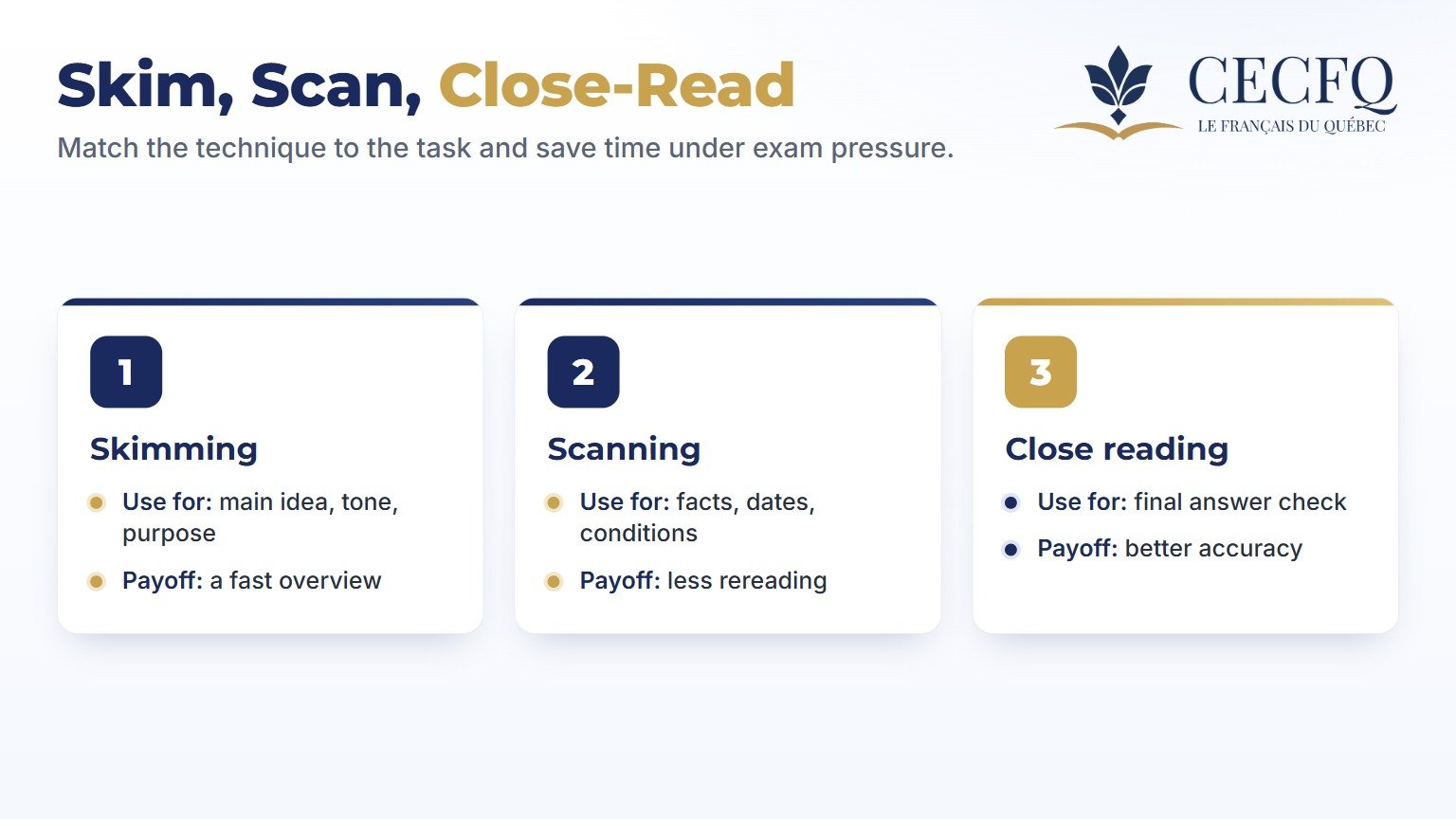
Skimming and scanning are essential timed-exam skills. They are not shortcuts. They are controlled reading techniques used to match the task to the text.
Skimming means reading quickly to understand the overall message. Scanning means searching for a precise item such as a number, location, condition, or name. Candidates who combine both techniques tend to manage time more effectively.
How to Skim Effectively
Read the title, the first line of each paragraph, highlighted words, and the conclusion if present. Ignore the urge to stop at every unknown term. Your goal is orientation, not perfection.
This is especially useful for longer or more complex TEF and TCF reading items, where the answer may depend on global understanding rather than one isolated phrase.
How to Scan for Answers
Read the question first. Underline key terms like dates, requirements, comparisons, or reasons. Then move through the text looking only for related elements.
Scanning works well for notices, schedules, workplace messages, and short informational texts. It can also reduce pressure because you stop trying to process everything at once.
| Technique | Best use in exam reading | Time benefit |
| Skimming | Main idea, tone, text purpose | Builds a fast overview |
| Scanning | Specific facts and conditions | Reduces rereading |
| Close reading | Final verification of answer | Improves accuracy |
Effective French Exam Reading Strategies
Each exam uses different formats, but several strategies apply across these French exams and test versions. The first is to read the question before the text when the format allows it. The second is to identify distractors, especially in multiple-choice tasks. The third is to track connectors that change meaning.
Words like cependant, en revanche, pourtant, donc, and en effet often signal the real logic of a passage. Missing them can lead to wrong answers even when vocabulary is strong.
Understanding Text Structure for Clarity
Most reading passages follow a predictable structure: topic, development, and conclusion. In practical texts, the structure may be purpose, condition, and action. Once you recognize the pattern, comprehension becomes faster.
This is particularly useful for administrative texts, workplace policies, and public information documents often seen in French exam preparation.
Managing Unknown Words Strategically
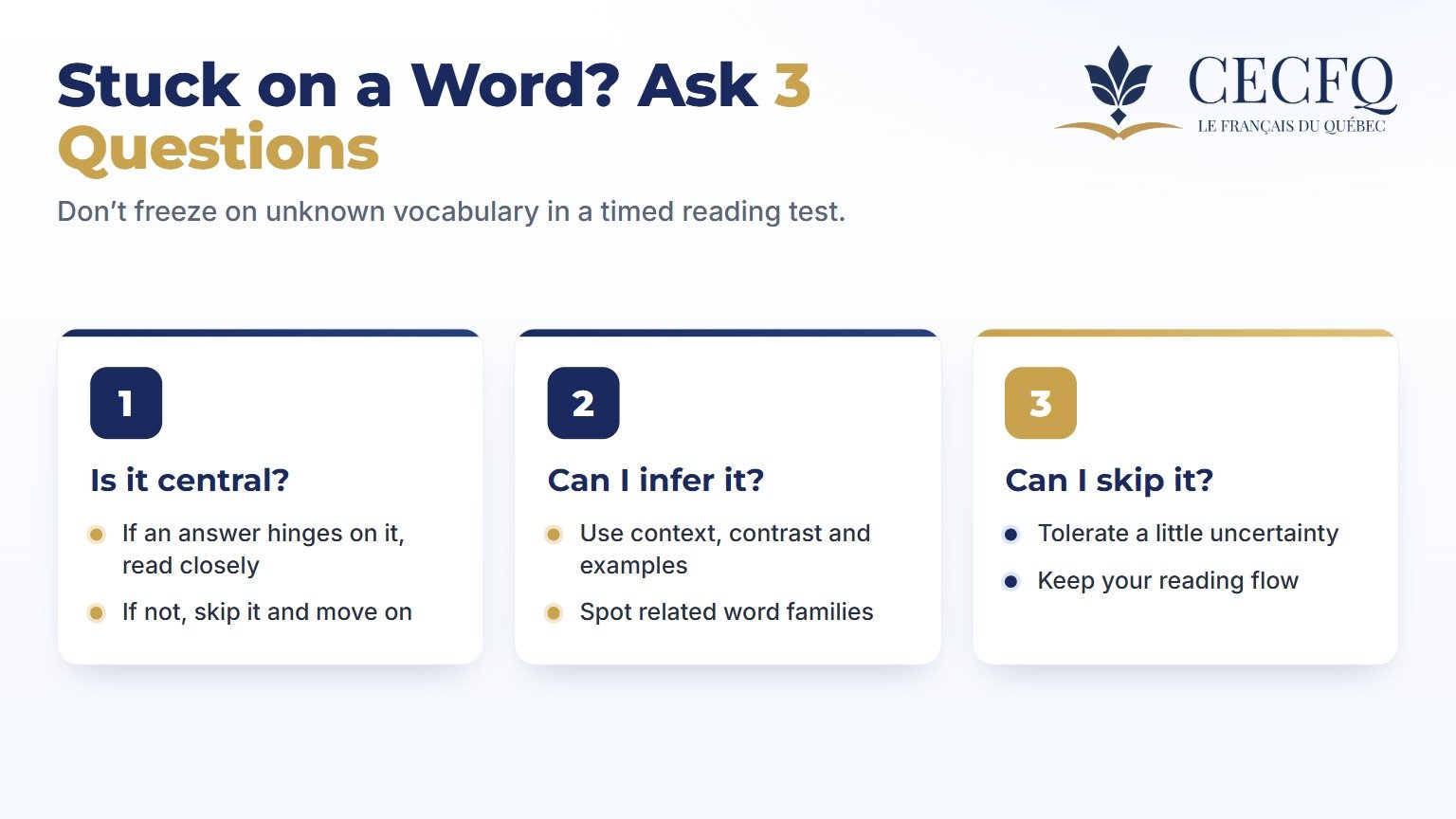
When you meet an unfamiliar word, ask three questions: Is it central? Can I infer it? Can I skip it? If the word is not central and you can answer the question without it, skip it. If it seems important, try to infer meaning from context, then check only if time allows.
This habit is important for learners who freeze during reading. Direct comprehension grows when you can tolerate a small amount of uncertainty.
Reading Skills for TEF, TCF, TEFAQ Modules & Quebec Immigration Contexts
TEFAQ candidates who take the written comprehension module often work with short functional texts: notices, public information, forms, instructions, emails, and workplace-style messages. Because TEFAQ is modular, confirm whether written comprehension is required for the specific immigration program or application you are pursuing, as requirements may vary by stream and can change over time.
These functional texts also relate to practical French skills for TEF and TCF, since exam reading across these formats similarly rewards speed and precision under time pressure. In Quebec, adult learners may also need to read practical information related to services, work, study, or everyday administration. Exact requirements can depend on the situation, so this article is not immigration advice.
Practice Methods to Boost French Reading Skills
Improvement usually comes from targeted, exam-style practice, not just more reading. Many adult learners read French texts regularly but still translate mentally because they do not train exam-style decision-making.
A better routine can include short timed readings, question matching, connector analysis, and summary exercises. In 20 to 30 minutes, learners may train more effectively than they would with long passive reading sessions. Aim for 3–5 short sessions per week if your schedule allows.
Timed Reading Drills for Speed
Choose a short article, notice, or email. Set a timer for two or three minutes and identify the main idea, audience, and purpose. Then answer two or three detail questions.
This helps build speed without sacrificing comprehension and is particularly useful for TEF and TCF reading sections, where time is limited.
Summarizing in Simple French
After reading, explain the text in one or two simple sentences in French. Do not translate it into your first language. This forces your brain to process meaning directly and strengthens active understanding.
Common Mistakes Slowing Adult Learners in French Exam Reading
Many adult learners work hard but still lose time because of a few repeated habits.
The first mistake is translating line by line. This feels precise, but it usually breaks the flow of the text and makes timed reading much harder.
The second mistake is spending too long on one unknown word. If you stop for too long, you lose time and confidence.
The third mistake is ignoring connectors and opinion markers. Words like cependant, donc, en revanche, or selon often carry the real meaning of the sentence.
The fourth mistake is reading the full text again instead of locating the answer zone. When a question asks for one detail, it is usually better to scan for the relevant part and read that section carefully.
The fifth mistake is practicing with passive reading instead of timed exam tasks. Reading French news or articles can help, but exam progress often comes faster when you practice with a timer, clear questions, and a specific reading goal.
2 Real Cases:
Case 1: A professional living in Quebec was preparing for the TEFAQ while working full time. The learner understood many practice texts but regularly ran out of time on notices, short administrative messages, and multiple-choice reading tasks. In private French lessons online, the focus shifted from sentence-by-sentence translation to a simple routine: skim the text first, scan for the answer zone second, and mark connectors before choosing an answer. After several practice sessions, the learner reported feeling less blocked by unknown words and more consistent in finishing reading tasks on time.
Case 2: An adult immigrant preparing for DELF B2 wanted stronger reading skills for both the exam and daily life in Quebec. Opinion articles were the main difficulty because one unfamiliar word could create panic. The learner used a structured routine with gist reading, word-family recognition, and short summaries in simple French after each text. In group French classes and guided homework, the learner gradually became more comfortable identifying the author’s viewpoint without translating every sentence and reported greater confidence during timed practice.
Who Benefits Most from Structured French Reading Support
Structured reading support helps different types of adult learners, starting with understanding your CEFR level, since reading demands differ between A2, B1, B2, and C1 texts. The same strategies apply directly to DALF preparation, particularly at the C1 level, where texts are longer and built around argumentative essays.

It suits immigration candidates preparing for TEFAQ or the reading sections of TEF and TCF, as well as professionals who understand vocabulary but still struggle with timed reading. Depending on their goals, learners may benefit from private lessons for targeted correction, group classes to practice exam methods with peers, or conversation practice that makes written French easier to process without translating every word.
For official details, candidates can consult the TEF exam structure. The TCF tout public test description covers the corresponding TCF format.
FAQ
1. How can I stop translating every word when reading French?
Start by reading for the main idea only. Focus first on the title, repeated words, and connectors before checking details. With regular timed practice, many learners become more comfortable understanding the text directly.
2. Which exam reading section is hardest: DELF, TEF, or TCF?
It depends on the learner. Many find TEF and TCF harder because of time pressure, while DELF can feel harder when longer texts require more interpretation.
3. How much vocabulary do I need for better French reading comprehension?
You need strong control of frequent words, connectors, and topic-based vocabulary. You do not need to know every word in a text to answer many reading questions well.
4. What is an effective way to practice French reading skills for exams?
Use timed texts, answer-focused scanning, context clue exercises, and short summaries in French. A short, structured routine is often more useful than long passive reading.
5. Should I read French news to prepare for DELF, TEF, and TCF?
Yes, if you read actively. Focus on identifying the main point, tone, structure, and supporting details instead of translating everything.
Disclaimer: This article is for informational purposes only and does not replace official exam guidelines or personalized immigration advice. Exam formats, time limits, and requirements for the DELF, TEF, TCF, and TEFAQ can change over time. For current, exam-specific requirements, consult the official exam operators (France Éducation international or Le français des affaires) or the relevant Canadian/Quebec immigration authorities.
Ready to Improve Your French Reading Skills with Structured Support?
If you are preparing for a DELF, DALF, TEF, TCF, or TEFAQ exam, our preparation courses can help make your practice more focused and efficient. If DELF or DALF is your focus, our DELF and DALF preparation courses are built around exactly these reading strategies, alongside listening, writing, and speaking.
Our Quebec-based school offers French courses online for adult learners who need practical progress for immigration, work, study, and integration. Depending on your goals, you may benefit from private French lessons, group French classes, French conversation practice, or focused exam preparation.
We also support professionals who want stronger reading and communication skills for work in Quebec, and we offer corporate French training for companies building their employees’ French skills.
Our school brings a structured, results-focused approach to online learning. Not sure where to start? Take your French level test or contact us to discuss the format that fits your level and schedule.