
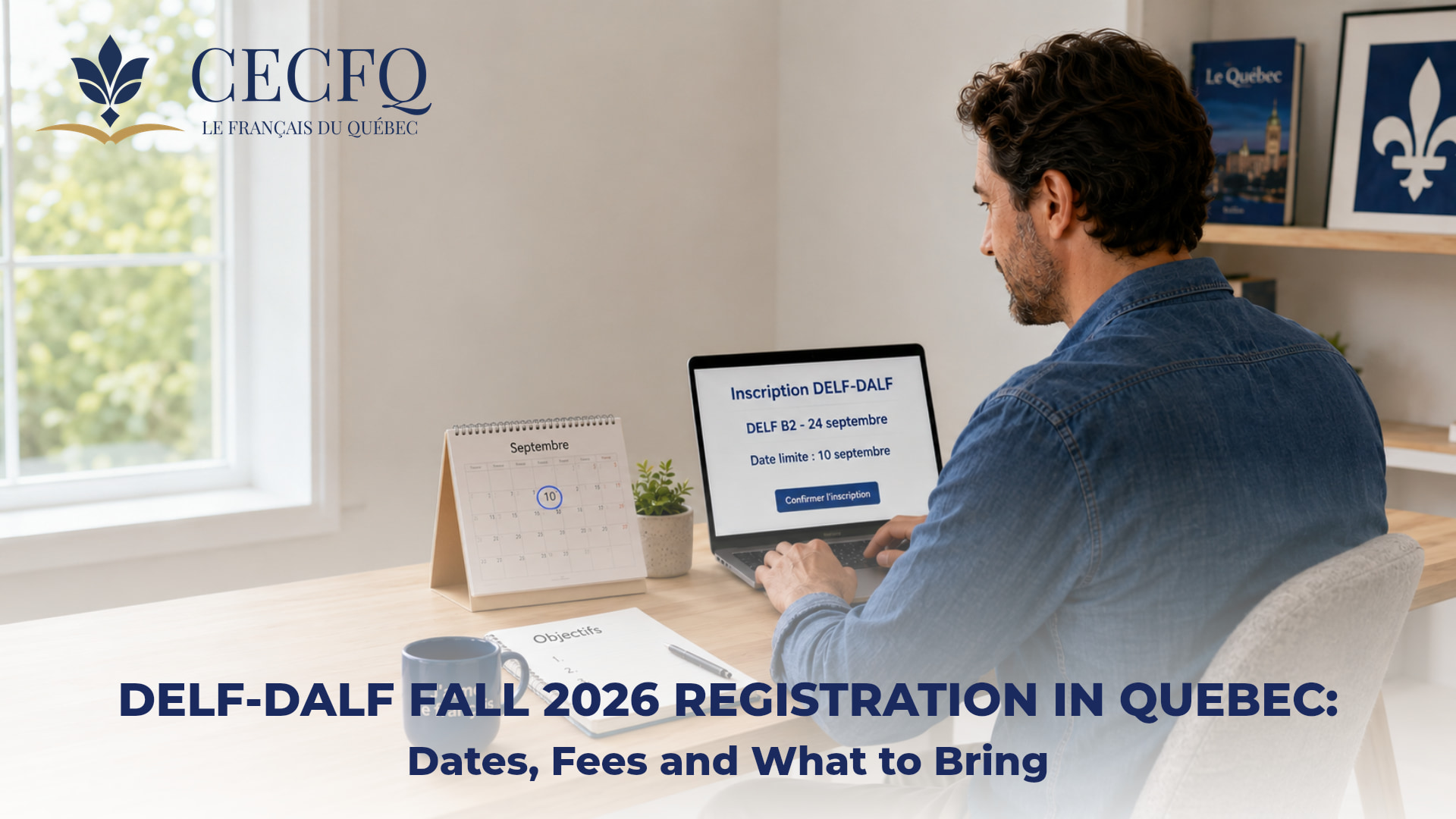
Two dates govern the fall DELF-DALF sessions in Longueuil. Registration and payment for the September session close on September 10, 2026, and for the November session on November 13, 2026. The intensive prep course for the September session starts earlier, on August 24, 2026.
This guide covers the session dates and fees by level, how registration works, where the exam is held, what to bring on exam day, what happens if you cancel, when your results arrive, how DELF-DALF compares with TEF, and how to prepare in the weeks you have left.
The Fall 2026 DELF-DALF Session in Longueuil
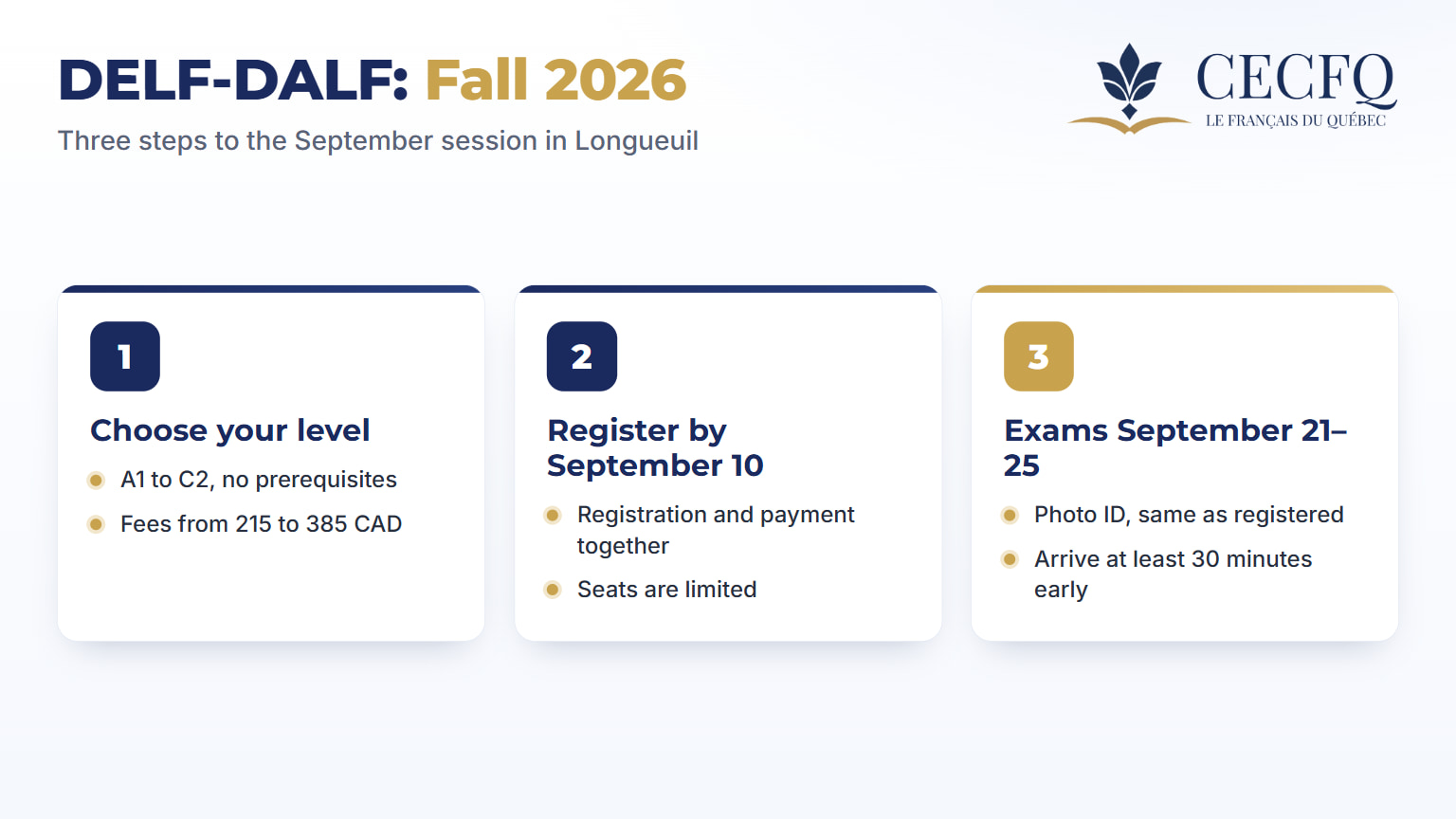
CECFQ’s Longueuil testing location runs several DELF-DALF sessions a year, including June, September and November. Each session covers all six levels, with fees from 215 to 385 CAD depending on the level. Seats are limited, so a level can fill before the deadline itself.
| Level | September session | November session | Fee |
| DELF A1 | September 21, 2026 | November 23, 2026 | 215 CAD |
| DELF A2 | September 22, 2026 | November 24, 2026 | 215 CAD |
| DELF B1 | September 23, 2026 | November 25, 2026 | 295 CAD |
| DELF B2 | September 24, 2026 | November 26, 2026 | 315 CAD |
| DALF C1 | September 25, 2026 | November 27, 2026 | 385 CAD |
| DALF C2 | September 21, 2026 | November 23, 2026 | 385 CAD |
There are no additional registration fees on top of these amounts. Registration and payment close on September 10 for the September session and on November 13 for the November one.
Levels are independent of each other, so you can register directly for B2 without having taken A1 or B1 first.
How to Register: What “By September 10” Actually Means
The deadline isn’t a soft target — it’s the date by which both your registration and your full payment need to be in. Your seat is confirmed only once payment is complete, not when you first sign up.
The process itself is straightforward. You choose your level on the DELF and DALF exam registration page, pay the fee for that level, and receive a confirmation by email. Before the exam date, you’ll get an official convocation letter with your exact time slot and room.
One detail worth getting right at this stage: the name on your registration has to match the photo ID you’ll present on exam day. Enter it exactly as it appears on that document — a mismatch is the kind of problem that surfaces at the door, when it’s too late to fix.
We recommend registering at least 1–2 weeks before the deadline to avoid last‑minute issues and ensure your preferred level is still available.
Why the South Shore Location Matters
CECFQ is an affiliated DELF-DALF testing location, administering the exam on behalf of the LBPSB DELF Examination Centre in Dorval, on the Island of Montreal. The Lester B. Pearson School Board holds the accreditation from France Éducation international, and that partnership is what allows the same official exam to be sat on the South Shore.
If you live in Longueuil, Brossard, Saint-Hubert or anywhere else in Montérégie, that means one less cross-island trip on a morning when you least need it. You sit the identical DELF-DALF exam, evaluated against the same standards, at 50 Rue Saint-Charles O, local 100, Longueuil, QC J4H 1C6.
Exam Day: What to Bring and When to Arrive
Four things decide whether your exam day starts smoothly:
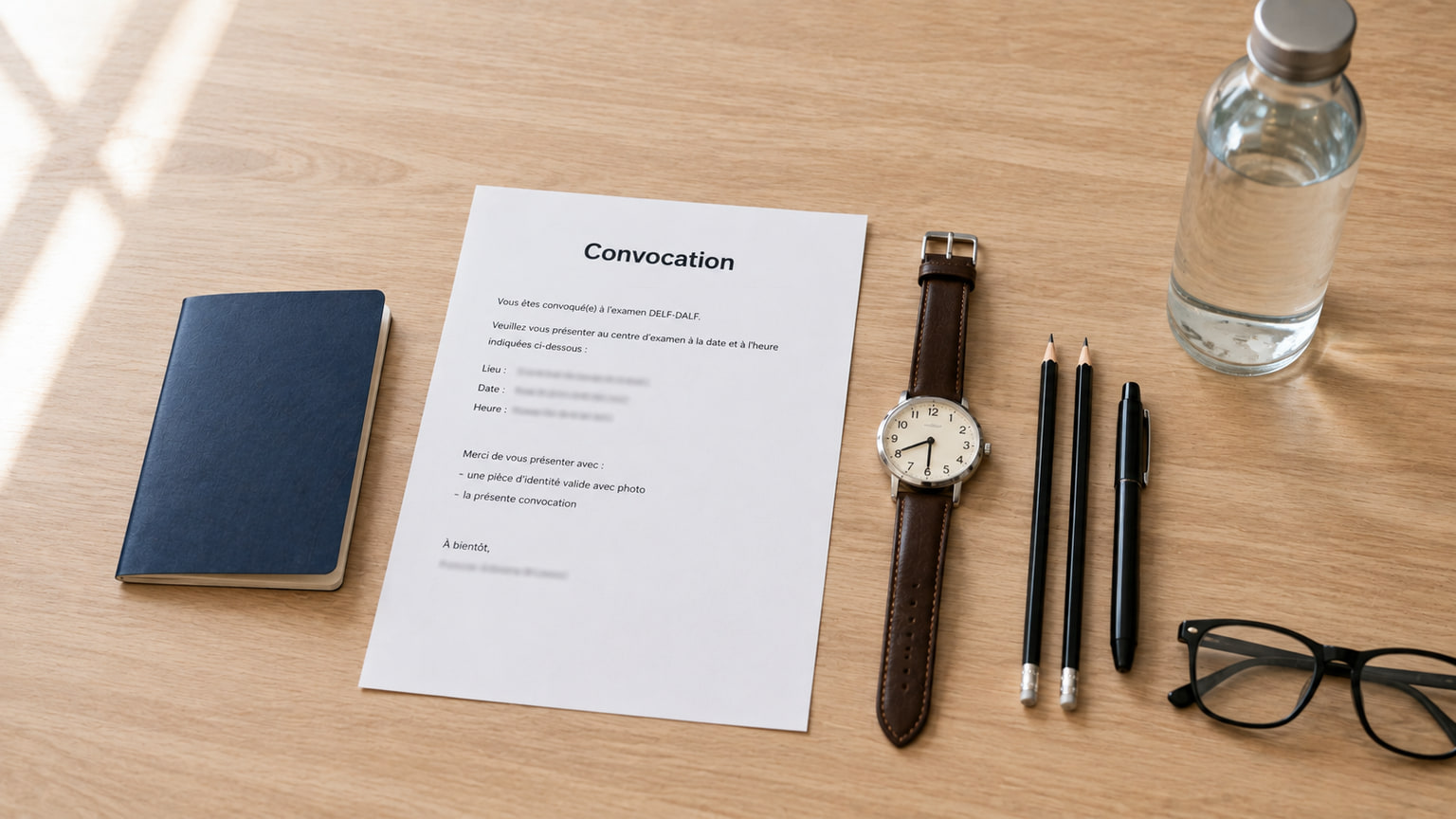
- Valid photo ID — a passport, driver’s licence or national ID card, in original form.
- The same document you registered with. Without valid ID matching your registration, you may not be admitted to the exam. This is why the name entered during registration should match your official document exactly.
- Your convocation letter, which carries your time slot and room.
- Thirty minutes of margin. Plan to arrive at least half an hour before the time stated on the convocation.
Everything else — dictionaries, phones, notes — follows the standard exam rules you’ll receive with your convocation.
Cancellations, Rescheduling and No-Shows
If your plans change after you’ve registered, cancellation requests need to go in writing to info@cecfq.ca. A refund is possible if the request is received at least 10 business days before your exam date; after that window, no refund is issued.
Other testing locations set their own terms. The LBPSB centre in Dorval, for example, requires written notice at least 7 days before the start of its session and deducts a 30 CAD administrative fee from any refund. Check the policy that applies to the specific location where you’re registered.
After the Exam: Results and How Long They’re Valid
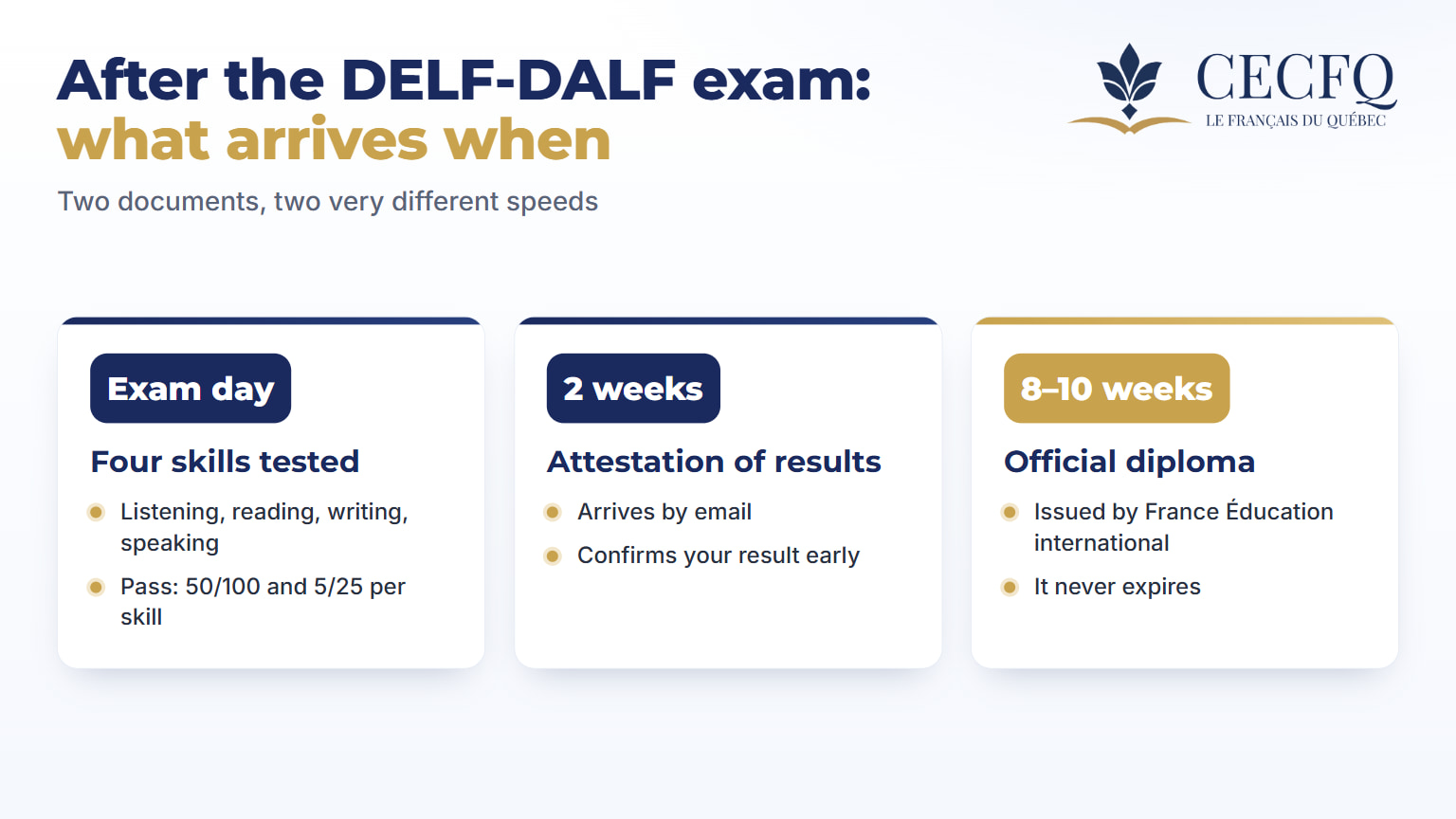
To pass, you need a minimum score of 50 out of 100 overall, along with at least 5 out of 25 in each of the four skills — listening, reading, writing and speaking. DALF C2 works slightly differently: a minimum of 50/100 overall and at least 10/50 in each section, according to the official France Éducation international scoring criteria. You can find more detail on how each skill is graded in our guide to DELF exam scoring.
Two documents follow the exam, and they arrive on different timelines.
| Document | When it arrives | What it does |
| Attestation of results (email) | ~2 weeks after the session | Confirms your result before the diploma exists |
| Official diploma (France Éducation international) | 8–10 weeks after the session | Permanent proof of your level — it never expires |
If you’re working to an application deadline, check which of the two your program or employer accepts: the gap between them is roughly two months.
Still Deciding Between DELF-DALF and TEF?
DELF and DALF are diplomas issued by France Éducation international. TEF and TEFAQ are tests run by Le français des affaires, registered directly with their own accredited centres rather than through CECFQ — though CECFQ does prepare candidates for them. Two practical differences tend to settle the choice.
Cost. TEF fees vary by accredited test centre and by module. For example, one Quebec City centre lists written modules at 85 CAD each and oral modules at 145 CAD each, but candidates should always verify the current fee with the centre where they plan to register. A full four-module TEF Canada therefore comes to roughly 460 CAD, against 315 CAD for a DELF B2 sitting that covers the same four skills. If your program only requires the two oral modules, TEF costs less than a full DELF — around 290 CAD — but you’re then certifying two skills, not four. Compare like with like: count the modules your program actually asks for.
Shelf life. For immigration and most official purposes, a TEF certificate is valid for 2 years from its issue date. A DELF or DALF diploma never expires, so it stays usable for employers, universities and your own record indefinitely. A DELF or DALF diploma is valid for life as a language diploma. However, immigration programs may set their own rules about accepted documents, recency, required skills and proof format. For Quebec immigration, always verify the current MIFI requirements for your specific program before relying on any language result or diploma. You can check the current rules on Québec’s page on French language requirements for the PEQ.
Requirements also differ from one program to the next, including how many skills you need to certify and at what level. Confirm what your specific program accepts before you pay for any sitting. If you’re weighing the tests themselves, our comparison of TEF Canada and TCF Canada goes through the formats side by side.

Intensive Prep Before the Session
CECFQ runs an intensive DELF-DALF preparation course from August 24 to September 16, 2026 — four weeks, two 1.5-hour classes per week, 12 hours in total, for levels B1, B2, C1 and C2. It costs 240 CAD plus a 20 CAD registration fee, materials included, and finishes five days before the session opens on September 21.
Four weeks is enough time to change how you sit the exam, if not to change your level: the course is built around exam format, scoring criteria and full timed simulations, corrected by certified DELF-DALF examiners. Misreading a task or running out of time can cost points that vocabulary alone won’t recover — that’s the kind of thing timed practice targets. A comparable course runs ahead of the November session, from October 26 to November 18, 2026.
If you’re deciding between B2 and C1 first, our comparison of DELF B2 and DALF C1 walks through what separates the two levels in practice. And if you’re unsure of your level at all, take your French level test (20 CAD) before you commit to a date. An adaptive Ev@lang test from France Éducation international is also available for 30 CAD. Neither is an official DELF-DALF certificate — they exist to help you pick the right level and course.
2 Real Cases:
Case 1: Racing a PEQ Deadline
A candidate applying under the Programme de l’expérience québécoise needed a documented French result for her file, with an application window closing in late October. The September 24 DELF B2 date worked on paper: her attestation would arrive by email roughly two weeks later, in early October.
Her first move wasn’t registering — it was confirming with her program that the attestation would be accepted, rather than the diploma that lands 8 to 10 weeks after the exam. Only then did the calendar make sense. She added the intensive course as well, since the exam fell about a month after she started preparing.
Case 2: September or November?
A parent looking at DELF B1 for a teenager weighed the two sessions directly. September meant less overall wait but landed in the first weeks of a new school year, competing with homework and extracurriculars. November gave the student two extra months of regular classes before the test, at the cost of results — and the diploma — arriving later. They chose November, paired with the October prep course, reasoning that a stronger score outweighed the earlier date.
Frequently Asked Questions
1. Can I still register after September 10?
Not for the September session — registration and payment both close on that date, and late registrations aren’t accepted. If you miss it, the next sitting in Longueuil is the November session, November 23–27, 2026, with its own deadline of November 13.
2. Which level should I register for?
The question is which level matches your current French and what your program, employer or university asks for. B2 is the level most often required for university admission and professional purposes, and C1 above it. If you’re not sure where you stand, a level test (20 CAD) gives you a reading before you pay for an exam sitting.
3. Do I need to be a CECFQ student to register for the exam?
No. Registration is open to anyone who needs the certification, whether or not you study with us — the exam and the preparation courses are separate things you can book independently. Many candidates prepare on their own or elsewhere and simply sit the exam in Longueuil.
4. What happens if I don’t pass?
Each level is independent, so you register again for the same level at a later session — after September, that’s November 23–27, 2026. You sit the level again in full, and the earlier fee doesn’t carry over. Your results show which of the four skills fell short, which is usually the most useful thing to build the next round of preparation around.
5. Is a DELF or DALF diploma recognized outside Quebec?
Yes. Both are issued by the French Ministry of Education and designed by France Éducation international, and they’re widely recognized by universities, employers and institutions internationally. What varies is what each organization requires — the level and the skills asked for depend on who’s asking.
Disclaimer: This article is for general information purposes only. Exam dates, fees and cancellation policies can change between sessions, and language requirements for immigration, studies or work are set by the relevant authorities and institutions. Always confirm current dates, fees and eligibility criteria directly with the exam operator and with the authority handling your application before making decisions based on this guide. Nothing here constitutes immigration advice.
Next step, depending on where you are: register for the September session before September 10, or for the November session before November 13. If you want structured preparation first, the DELF-DALF preparation page lists both the August and October intensive courses. Still choosing a level? Take your French level test.
Questions about registration? Contact CECFQ:
Email: info@cecfq.ca
Website: cecfq.ca
Exam location: 50 Rue Saint-Charles O, local 100, Longueuil, QC J4H 1C6
Courses and exam preparation are available in English and French.