
Production écrite — the DELF B2 writing exam — is the one skill where “I know a lot of French” doesn’t automatically turn into a passing score. Examiners work from a fixed grid worth 25 points, and more than half of it has nothing to do with vocabulary or grammar. A technically correct text built on the wrong structure, or pitched in the wrong register, can cost more points than a handful of small mistakes ever would.
This guide walks through exactly what that grid measures, what separates a B1 text from a B2 one, and how to structure the 250 words you’ll need to produce in 60 minutes. For the other skills, see our guides to oral exam preparation and reading comprehension, or how DELF candidates are evaluated for the scoring picture across all four.

What Production Écrite Actually Asks For
The DELF B2 writing exam gives you one task, 60 minutes, and a minimum of 250 words — there’s no upper limit, only a floor. According to the official Manuel du candidat DELF B2 published by France Éducation international, that single task can take one of several argumentative forms, such as a contribution to a debate, a formal letter, a critical article, or another structured argumentative text. The Manuel du candidat DELF B2 sets out the full format.
Whichever form the prompt takes, the job is the same: take a position and argue it convincingly for a named reader. That reader might be a newspaper’s letters page, a town council, or a colleague — the prompt tells you who, and your register has to match them.
The 60 minutes go to one task, not several short ones the way compréhension écrite is structured. That’s an advantage in one sense — no switching between texts — and a trap in another: with a single task, a plan and a work-timer matter more than they would in a shorter format. It also sits inside a longer exam day: 30 minutes of listening, 60 of reading and 60 of writing run together as one group session (2 hours 30 minutes total). The oral test — preceded by 30 minutes of preparation — may be scheduled separately depending on the exam centre and session. Always follow the exact timing on your convocation.
How It’s Scored: The 25-Point Grid
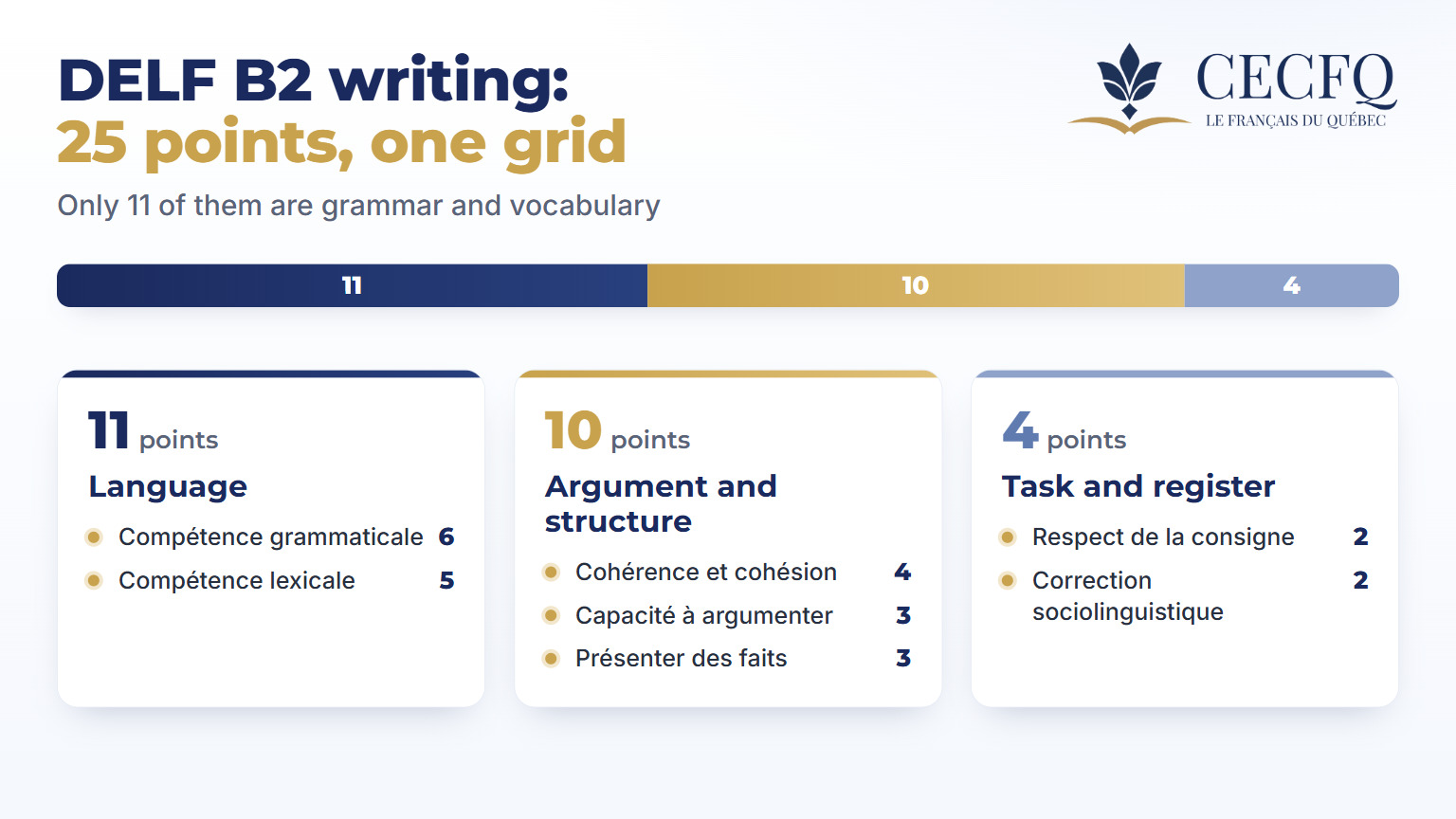
For clarity, the official 25-point grid can be grouped into seven scoring areas.
| Criterion | Points |
| Respect de la consigne — matches the requested text type, topic and minimum word count | 2 |
| Correction sociolinguistique — register and politeness formulas suited to the reader | 2 |
| Capacité à présenter des faits — facts and examples that support the argument | 3 |
| Capacité à argumenter une prise de position — how well the position is argued | 3 |
| Cohérence et cohésion — structure, punctuation, connectors | 4 |
| Compétence lexicale / orthographe lexicale — range, precision and spelling of vocabulary | 5 |
| Compétence grammaticale / orthographe grammaticale — verb forms and sentence complexity | 6 |
| Total | 25 |
Add up the two language-focused rows — lexical competence (5 points) and grammatical competence (6 points) — and they total 11 points out of 25. The other five criteria, worth 14 points, have nothing to do with whether your verb conjugations are perfect: they reward following the task, matching your register to your reader, presenting facts, building an argument, and structuring the text with clear connectors. A flawless subjunctive in a text that ignores the letter format the prompt asked for still loses points on respect de la consigne — and that’s checked before an examiner even gets to your grammar.
Quick takeaway:
Before you write, identify three things: the required text type, the reader, and the position you need to defend. If you miss one of these, grammar will not save the score.
What “B2” Means in Writing
The gap between B1 and B2 writing isn’t mainly about how many words you know. According to the CEFR self-assessment grid published by Europass, a B1 writer can produce ‘simple connected text on topics which are familiar or of personal interest,’ including personal letters describing experiences and impressions. A B2 writer is expected to produce “clear, detailed text on a wide range of subjects” — specifically “an essay or report, passing on information or giving reasons in support of or against a particular point of view.” The CEFR self-assessment grid lays out the full scale from A1 to C2.
In practice, a B1-level text can describe an experience and stop there. A B2 text has to do more: state a position, back it with reasons, and — per the grading grid — engage with the other side of the argument. That’s the “capacité à argumenter une prise de position” line, worth 3 points on its own and separate from simply presenting facts.
| B1 writing | B2 writing | |
| What the text does | Describes an experience or impression | Defends a position and answers objections |
| CEFR descriptor | “Simple connected text on familiar topics” | “Clear, detailed text on a wide range of subjects” |
| Typical form | Personal letter, short account | Essay, report, formal letter, contribution to a debate |
| What the grid rewards | Being understood | Being structured, supported and convincing |
Structuring the Argument
Official guidance for candidates is specific about shape: a production écrite text should have a visible introduction, développement and conclusion — not necessarily labeled as such, but structurally distinct. The introduction states the topic and your position, the développement lays out your reasoning, and the conclusion restates where you land, sometimes with a closing appeal to the reader.
Cohérence et cohésion is worth 4 points on its own, and connectors are how you earn it. The Manuel calls out examples directly: néanmoins, bien que, ainsi, par conséquent, du fait de. Using two or three connector families across the text — contrast, cause, consequence — reads as more controlled than leaning on “et” and “mais” for 250 words.
A B2-level argument also nuances its position rather than stating it flatly. Raising the strongest counterargument and then answering it — “certains diront que… cependant…” — is exactly what the grid rewards under argumentation, and it’s often one of the easiest things to add to a draft that already has a clear stance.
Where Points Typically Get Lost
France Éducation international doesn’t publish a breakdown of where candidates lose points, but the patterns are consistent across DELF prep centres working with this exam. Writing the wrong type of text — a personal narrative when the prompt asked for a formal letter — is one of the costliest mistakes: it affects respect de la consigne, register, and often the argument structure all at once.
Other recurring issues — again per the experience of prep centres, not any official statistic — tend to repeat:
- an argument stated without a concrete example behind it;
- a conclusion that trails off instead of closing the position;
- too few connectors, so the text reads as loose sentences rather than a structure;
- register that drifts from formal to casual mid-text;
- a narrow vocabulary that repeats the same few words.
These issues are particularly costly at B2 level, where argumentation and structure carry more weight than at B1.
None of these is catastrophic alone, but a text with two or three of these issues often loses more points than the sum of its parts.
Falling short of the 250-word minimum carries its own risk: the official grid specifies that texts between 176 and 224 words lose half the length points, and texts of 175 words or less lose all length points within respect de la consigne. There’s no published cushion for “close to 250 but not quite,” which makes the safer target comfortably past the minimum rather than right at it.
At CECFQ, when we review DELF B2 writing practice, the first correction is often not grammar, but task alignment: Did the candidate write the requested text type, for the right reader, in the right register?

How to Train in the Weeks You Have Left
With a fixed grid, practice works best when it mirrors how the copy gets marked, not just how much French gets produced. Three habits cover most of it:
- writing to the same 60-minute timer every time,
- counting words at the end instead of guessing, and
- reviewing each draft against the seven criteria instead of just “does this sound right.”
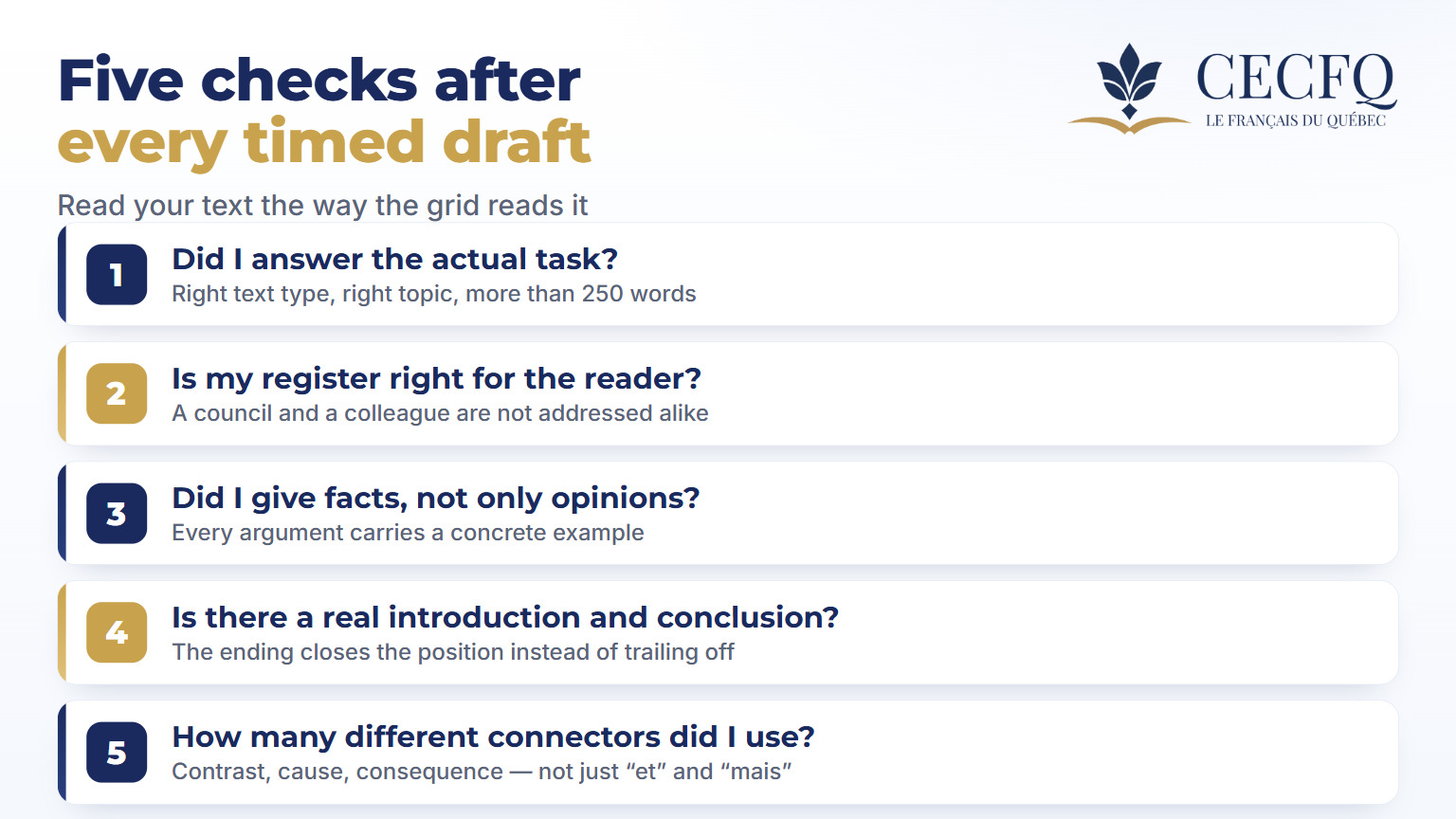
After each timed draft, spend 5 minutes checking: task type, register, word count, intro/development/conclusion, connectors, and one grammar focus (e.g., verb tenses or agreement). Aim for 2–3 timed writing sessions per week if your schedule allows.
A simple version: after finishing a timed draft, go line by line through the grid.
- Did I answer the actual task?
- Is my register right for the reader named in the prompt?
- Did I state facts and examples, not just opinions?
- Is there a visible introduction and conclusion?
- How many different connectors did I use?
That five-minute self-check catches gaps a spellchecker rarely will.
If you’d rather have someone else run that check, CECFQ’s intensive DELF-DALF preparation course starts August 24, 2026, and runs full timed simulations corrected against this exact grid by certified DELF-DALF examiners — useful if you’re aiming for the September 24 DELF B2 date covered in our guide to fall 2026 registration deadlines. A comparable course runs October 26 to November 18 ahead of the November sitting.
One practical note for candidates in Quebec: the writing you’ll be marked on is standard written French, the same on both sides of the Atlantic. Everyday Quebec French is not the issue in itself; what can cost points is using spoken, informal or regionally marked expressions in a task that requires a formal written register. Candidates who already speak French daily in Montreal or on the South Shore usually need less work on vocabulary than on formality: reserving vous, avoiding spoken contractions, and keeping the closing formulas a formal letter expects.
The courses themselves are taught live online across Canada, so preparation doesn’t depend on where you live; only the exam itself is written in person, in Longueuil.
2 Real Cases:
Case 1: Where Near-Perfect Grammar Still Cost Points
A candidate preparing largely on her own felt confident about B2 writing — her grammar was close to flawless in practice exercises, verb tenses accurate, vocabulary varied. On a timed mock exam, the prompt asked for a formal letter to a municipal council contesting a decision. She wrote a well-argued opinion essay instead, addressed to no one in particular.
The language scored close to full marks. Respect de la consigne and correction sociolinguistique — together worth 4 points — scored close to zero, since there was no letter format, no addressee, no closing formula. The damage ran past those 4 points: without the letter structure the text also lost ground on cohérence et cohésion, and part of the argumentation score went with it, because an essay argues to no one in particular while a letter argues to a named reader. She rebuilt her routine around reading the required text type first and drafting the format skeleton — salutation, closing, addressee — before writing a single argument.
Case 2: An Average Writer Who Structured Well
A candidate preparing for a workplace French requirement described his written French as “solid, not brilliant” — occasional article mistakes, a narrower vocabulary than he’d have liked. What he built early in his practice was a habit: every draft opened with a one-sentence position, used at least three different connectors (bien que, par conséquent, néanmoins were his regulars), and closed with a conclusion that restated the stance in different words.
His grammar and lexical scores came in mid-range, as expected. But cohérence et cohésion, argumentation and respect de la consigne — 9 points combined — scored close to full marks, enough to clear B2 comfortably. The lesson wasn’t that grammar doesn’t matter; it’s that structure is worth fighting for even when the sentences underneath aren’t perfect.
Frequently Asked Questions
- How is DELF B2 production écrite scored?
DELF B2 production écrite is scored out of 25 points using the official writing grid. Examiners look at whether you respect the task, use the right register, present facts and examples, argue a clear position, organize the text with connectors, and use accurate vocabulary and grammar. Grammar matters, but it is not the whole score: structure, argumentation and task alignment also carry significant weight.
- What is the minimum word count for DELF B2 writing?
The minimum length for DELF B2 writing is 250 words. It is safer to aim slightly above the minimum rather than stopping exactly at 250, because a text that falls short can lose points under respect de la consigne. A longer text is not automatically better, especially if it leaves you less time to check grammar, connectors and structure.
- What happens if I write the wrong text type in DELF B2?
Writing the wrong text type can cost important points. For example, if the prompt asks for a formal letter and you write a general opinion essay, you may lose points for respect de la consigne, register and structure, even if your grammar is strong. Before writing, identify the required format, the reader and the position you need to defend.
- Does handwriting or presentation affect the score?
The grid does not include a separate criterion for handwriting, but legibility matters in practice. If an examiner cannot read a word clearly, it is harder to credit it. Clear paragraph breaks between introduction, développement and conclusion also make your structure easier to follow, which supports the cohérence et cohésion criterion.
- Is it better to write directly in French or think in English and translate mentally?
Neither approach is scored directly, but texts translated mentally from English often import English sentence patterns, connectors or word order. This can make the writing sound awkward, even when it is understandable. Timed practice directly in French usually helps candidates build more natural cohesion and stronger exam habits.
- If I fail production écrite but pass the other three skills, do I retake the whole exam?
Yes. DELF B2 is graded as one combined exam. You need at least 50/100 overall and at least 5/25 in each of the four skills. If your writing score is too low, you need to retake the full DELF B2 exam at a later session, not only the writing section.
Disclaimer: This article is for general information purposes only. DELF B2 formats, scoring criteria and requirements can change between sessions, and the assessment described here reflects the official Manuel du candidat DELF B2 in effect at the time of writing. Always confirm current exam requirements directly with the exam operator, and check specific language requirements with the institution, employer or immigration authority you’re applying to.
Ready to put the grid into practice? The next intensive DELF-DALF preparation course starts August 24, 2026, ahead of the September session. A second intensive course runs October 26 to November 18 for the November sitting. If you’re still confirming your level before you register, take your French level test.
Questions about production écrite or the course? Contact CECFQ:
Email: info@cecfq.ca
Website: cecfq.ca
Exam location, where DELF-DALF sessions are administered on behalf of the LBPSB DELF Examination Centre: 50 Rue Saint-Charles O, local 100, Longueuil, QC J4H 1C6
Courses and exam preparation are available in English and French.