In this article
- Re-correction Requests Are Paused, Resumption Expected in Fall 2027
- What the Exam Actually Tests
- How the Test Mechanics Should Shape Your Practice
- Where the TCF Canada Score Lands on NCLC
- Building a Study Plan That Matches Where You Actually Start
- Official Materials Worth Using Before You Look Anywhere Else
- Registration, Exam Day, Retakes and Results
- Frequently Asked Questions
Start your TCF Canada preparation by studying the test itself, not generic French practice. TCF Canada (Test de connaissance du français pour le Canada) has a fixed structure, strict word counts in the writing section, and a listening format that plays each recording only once. A study plan built around those specifics tends to pay off more than months of unfocused review.
This guide walks through a recent change that temporarily suspends the option of contesting your written and oral marks, what the exam measures and how scores convert to NCLC, and a realistic way to plan your weeks before test day.

Re-correction Requests Are Paused, Resumption Expected in Fall 2027
According to notices from TCF exam centres relaying, France Éducation international‘s update, re-correction requests for the oral and written sections are temporarily suspended for sessions held on or after September 1, 2026. The pause is expected to last roughly a year, with resumption planned for fall 2027. Candidates who sat the exam before that date are not affected by the change.
In practical terms: if, during this window, you feel your score doesn’t reflect your level, retaking the exam is still an option, but disputing the mark is not. That shifts more weight onto getting the writing and speaking tasks right the first time, rather than treating the correction process as a safety net.
What the Exam Actually Tests
TCF Canada has four sections, always taken together, for a total of 2 hours and 47 minutes.
| Section | Format | Duration |
| Listening comprehension | 39 questions, multiple choice | 35 min |
| Reading comprehension | 39 questions, multiple choice | 60 min |
| Written expression | 3 tasks | 60 min |
| Oral expression | 3 tasks, face to face with an examiner | 12 min (incl. 2 min prep) |
Listening and reading are entirely multiple choice, four options each, one correct answer. Wrong and blank answers both score zero, so an educated guess costs nothing — never leave a question empty. Writing and speaking are each marked twice, independently, against set criteria: speaking by the examiner in the room and a second trained marker, writing by two markers of whom at least one is human — on some computer-based sessions, the other is FIDELIA, the operator’s automated marking aid.
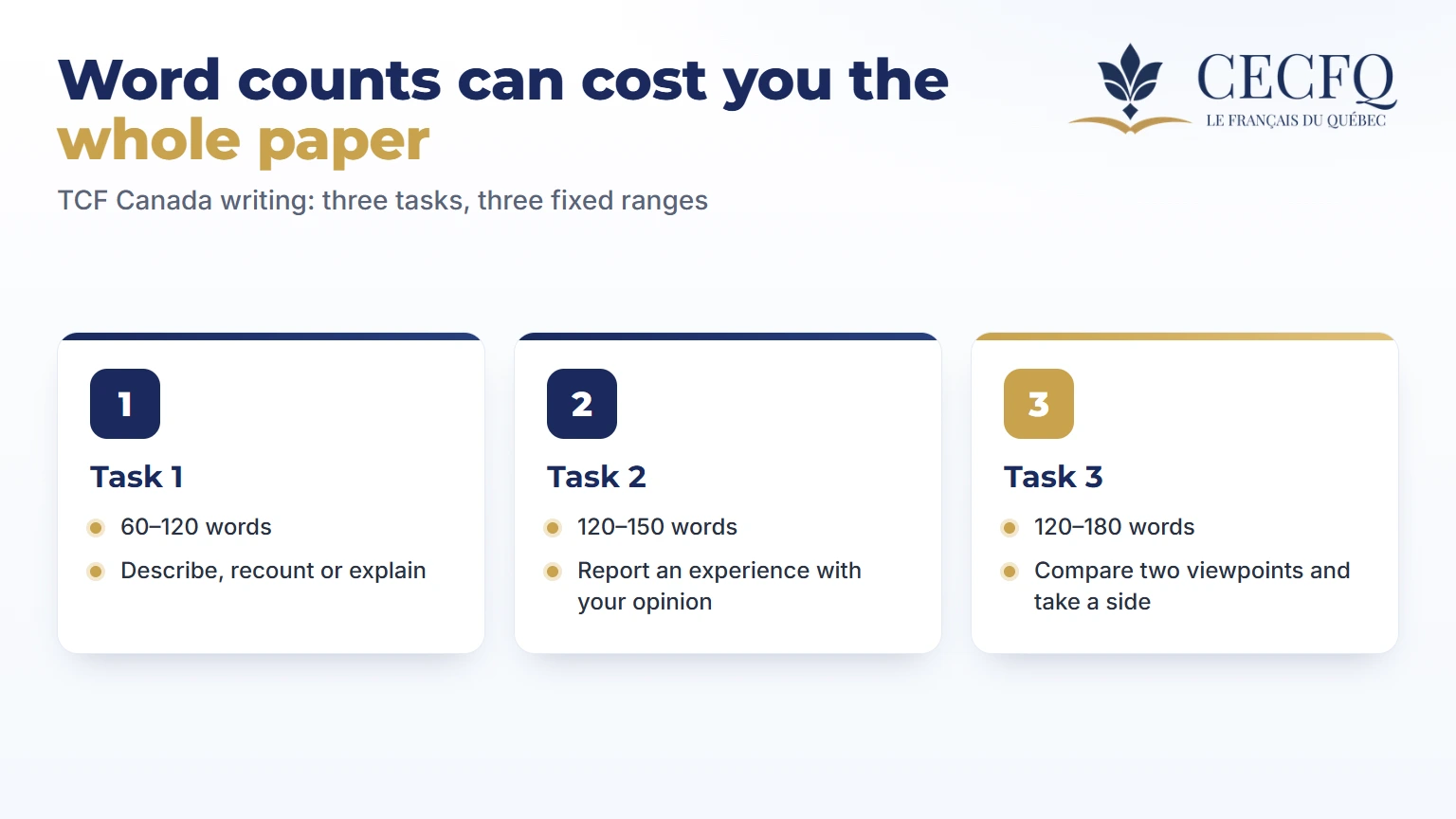
The written section has fixed word ranges per task, and they matter more than they look:
| Writing task | What it asks for | Word count |
| Task 1 | Describe, recount, or explain a situation | 60–120 words |
| Task 2 | Article, letter, or note reporting an experience with opinions and arguments | 120–150 words |
| Task 3 | Compare two viewpoints from two documents and give your own opinion | 120–180 words |
Here is the part that surprises a lot of candidates: France Éducation international states that your written paper can be marked “A1 non atteint” — A1 not reached, A1 being the lowest level on the CEFR (Common European Framework of Reference for Languages) scale — if a task doesn’t meet its required word count, the text is off-topic, a task is skipped, you copy sentences from the prompt or the documents, you write a text learned by heart, or your answer is left on the scratch paper. On the paper format, illegible handwriting counts too.
The operator’s wording refers to the copy as a whole, not only to the task that fell short — so a strong candidate who finishes one task twenty-five words short risks a result reflecting none of the French they actually demonstrated. The full conditions are set out in the Manuel du candidat TCF, the official candidate handbook (in French).
The practical answer is to make word counts automatic before exam day rather than counting mid-answer. Write a handful of timed responses at each required length, count them once, and you’ll learn to recognize 120 or 180 words by eye. Aim slightly above the minimum, never right at it and never past the maximum, and treat “finish every task” as a higher priority than “polish one task.”
The rules on copied and memorized text also shape how you use model answers: study them for structure and connectors, but don’t memorize whole texts, and in Task 3 put the two documents’ viewpoints in your own words rather than lifting their sentences.
How the Test Mechanics Should Shape Your Practice
A few features of TCF Canada are easy to overlook until they cost you points on test day. Questions are arranged by increasing difficulty within each section. In reading, where you manage your own clock, budget your time to reach the last items rather than polishing the easy opening ones: those later questions are the harder ones, and the scoring takes each question’s difficulty into account.
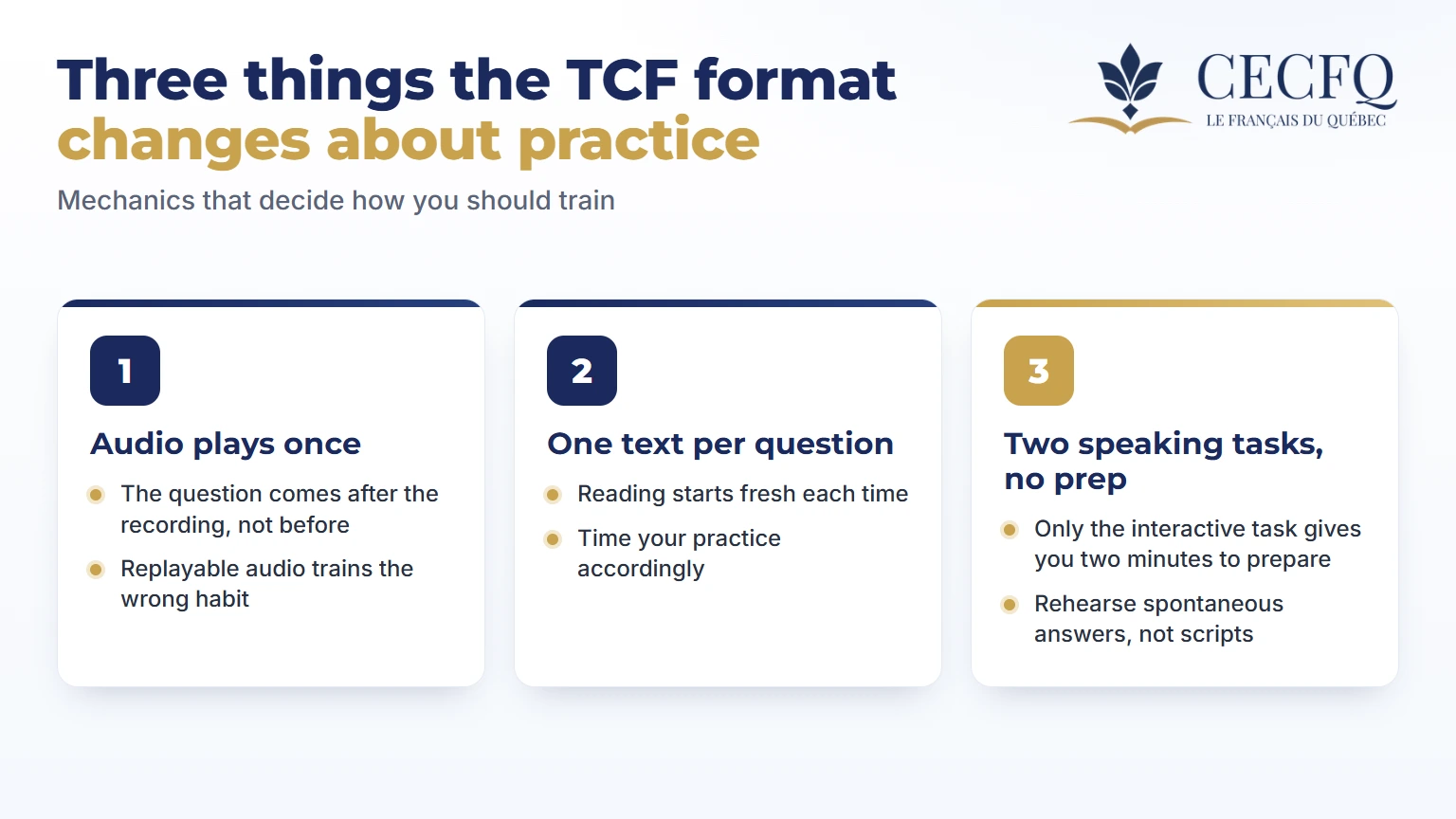
Reading has a further quirk: nearly every item comes with its own short document, instead of several questions sharing one passage. That makes the section feel slower than the question count suggests — you’re starting fresh each time, and practice should be timed accordingly.
Listening has its own trap. Each recording plays only once, and the question is put to you after the document rather than before it. Scanning for a keyword while the clip plays doesn’t work here; you need to follow the whole passage and hold the gist in memory before you even see what’s being asked. Practising only with audio you can replay can train the wrong habit.
In the oral section, only Task 2 (a role-play in which you question the examiner to get information, 5 minutes 30 seconds in total) gives you two minutes of preparation time. Task 1 (a directed interview, 2 minutes) and Task 3 (arguing a point of view, 4 minutes 30 seconds) both start with no prep at all — so practise spontaneous speech under a timer rather than rehearsing polished monologues you plan to recite. That matters beyond style: the candidate handbook states that reciting a memorized text in the speaking test can get your speaking result marked “A1 non atteint.”
For the strategy side of multiple-choice traps and time management, see our breakdown of why candidates fail the TCF and TEF Canada despite a good level of French; for how these mechanics compare to the other immigration exam, see TEF Canada vs TCF Canada. For TEF Canada’s four modules and its own score conversion, see our TEF Canada preparation guide.
Where the TCF Canada Score Lands on NCLC
Immigration and citizenship applications reference the NCLC scale (Niveaux de compétence linguistique canadiens, the French-language counterpart of the Canadian Language Benchmarks), not the raw TCF score — Express Entry’s language requirements are stated largely in these bands. Here is how the official conversion lines up.
| NCLC | Listening (/699) | Reading (/699) | Speaking (/20) | Writing (/20) |
| 10+ | 549–699 | 549–699 | 16–20 | 16–20 |
| 9 | 523–548 | 524–548 | 14–15 | 14–15 |
| 8 | 503–522 | 499–523 | 12–13 | 12–13 |
| 7 | 458–502 | 453–498 | 10–11 | 10–11 |
| 6 | 398–457 | 406–452 | 7–9 | 7–9 |
| 5 | 369–397 | 375–405 | 6 | 6 |
| 4 | 331–368 | 342–374 | 4–5 | 4–5 |
Note that each of the four skills is scored — and converted to NCLC — on its own. A strong reading score doesn’t offset a weaker writing one; programs that set a minimum NCLC generally look at your lowest section, not the average.
Which row matters depends on your goal. Under the Canadian Experience Class, Express Entry sets NCLC 7 across all four skills for TEER 0–1 occupations (managerial and professional roles) and NCLC 5 for TEER 2–3 occupations — TEER being Canada’s classification of occupations by training, education, experience and responsibilities. The Federal Skilled Worker Program also sets NCLC 7. On top of that, NCLC 7 or higher in all four skills earns the French-language bonus: 25 or 50 extra Comprehensive Ranking System (CRS) points, depending on your English level.
The same threshold also opens another door: Express Entry’s French-language proficiency category, which requires a minimum of NCLC 7 in all four skills. As one recent snapshot, on August 19, 2026, a French-language draw invited 5,000 candidates with a minimum CRS score of 382, while the Canadian Experience Class draw on September 1, 2026 required 521. Cut-offs change with every draw, so treat these figures as examples, not predictions.
Canadian citizenship sits far below NCLC 7: NCLC 4, speaking and listening only, for applicants aged 18 to 54. Quebec, for its part, has its own system. Its Skilled Worker Selection Program (PSTQ, from its French name) uses the Quebec scale of French proficiency rather than NCLC and accepts several tests from the same operator, including TCF Québec alongside TCF Canada.
Check your speaking before exam day
Speaking is the hardest part to assess on your own: without outside feedback, you repeat the same habits without knowing what they cost. A one-on-one TCF speaking simulation (CAD $45) runs the full speaking test in the real format and timing, with feedback from your teacher right after, so you see where you stand before the real exam.
Not sure of your level yet? Our French placement test places you on the CEFR scale before you plan.
Building a Study Plan That Matches Where You Actually Start
There’s no single number of weeks that works for everyone preparing for TCF Canada. Be wary of any plan that promises a specific NCLC level by a fixed date — your starting level, available study time, and how close French already is to your daily life all change the math.
As a rough frame: candidates already comfortable with everyday spoken and written French, aiming to confirm a level they largely have, often need only a few weeks of focused review. Candidates moving up by a full NCLC band or more — say from an intermediate level toward NCLC 7 — typically need several months of regular, structured study rather than a short sprint.
What tends to matter more than total hours is the order you work in. Three phases hold regardless of how long you have:
Diagnose first. Before planning anything else, run a timed check of all four sections. The official sample page offers only a handful of listening and reading items, not a full-length set, so add a block of questions from the TCF-Candidat simulator (both listed in the official materials below) under a timer you set yourself, write one sample topic per task at the required word counts within 60 minutes, and record yourself on the three speaking tasks from the official sample PDF. The point isn’t the score — it’s finding which section is furthest from your target NCLC band, since that’s the one deciding whether you meet a requirement.
Then build, skill by skill. Give your weakest section the largest share of your study time, while keeping light regular practice on the other three so they don’t slip.
Finish by simulating. In the last stretch, stop studying and start rehearsing: full-length timed sets, audio played once only, written tasks at the required word counts, spoken answers with no script. The goal is that nothing about exam day is unfamiliar except the questions themselves.
To make that concrete, here is one way eight weeks could be split for a candidate already close to the target band — an illustration, not a promise of a result: week 1, diagnosis; weeks 2–6, about half your study time on the weakest section and the rest spread over the other three; weeks 7–8, full timed simulations and a review of the errors they reveal. With more time or a bigger gap, stretch the middle phase rather than the first or last.
Track progress by section rather than overall, and re-test periodically — if your weakest section hasn’t moved after several weeks, change how you practise before adding more weeks. And if you’re still deciding between the exams rather than preparing for one, start with which French exam Canada actually requires.
2 Real Cases:
Case 1: A candidate preparing for Express Entry spent two months on general conversation practice but never timed a full writing task under real conditions. On exam day she ran out of time on Task 3, and her response landed at 95 words — under the 120-word minimum for that task — putting her written paper at risk of the “A1 non atteint” mark described above, regardless of the French she had shown in class.
Case 2: Another candidate, aiming for eligibility under Quebec’s Skilled Worker Selection Program, drilled listening almost exclusively with clips he could replay, then struggled on test day when each recording played only once. Before his retake, he spent the final weeks practising with single-play audio only, and credited that change with turning the section around.
Official Materials Worth Using Before You Look Anywhere Else
Before turning to third-party prep sites, it’s worth working through what France Éducation international publishes directly:
- The Manuel du candidat TCF — the official candidate handbook describing every task type in detail (in French).
- The Fiche de présentation du TCF Canada — a one-page PDF summary of the format, timing and results (in French).
- The Exemples d’épreuves du TCF page, with a handful of sample listening and reading items (plus language-structure items, which aren’t part of TCF Canada) and PDF samples of the speaking and writing tasks.
- The TCF-Candidat preparation area, which hosts a practice simulator with 600 questions plus podcasts and exercises aimed specifically at the speaking task. The same portal is where your results and attestation appear afterwards.
These come from the organization that designs and scores the exam, which makes them a more reliable benchmark than the generic “TCF practice test” content circulating online.

Registration, Exam Day, Retakes and Results
TCF Canada sessions run year-round, organized by accredited centers according to their own capacity. Each center sets its own exam dates, format (paper or computer-based), and price — so ask the center organizing your session about cost and dates; there is no fixed national rate. Ask too which format your session uses, and practise in that mode: 60 minutes of handwriting for paper, typing French accents for a computer. If you’d rather your writing not be marked by FIDELIA, the handbook says to choose a paper session.
On exam day, arrive on time: a late candidate isn’t admitted to the exam room or refunded, except in the cases the candidate handbook lists. Bring valid photo ID, such as a passport, residence permit, or identity card. Expect to be photographed, and to keep only your ID, your exam notice (convocation), and a blue or black pen on the desk.
If you need to retake the exam, you can do so as many times as needed, but you must wait at least 20 days between two sittings. Older official documents, including the April 2025 candidate handbook, still say 30 days; the current handbook and the operator’s French-language page say 20. Results appear in your TCF-Candidat account within 15 business days from the date France Éducation international receives your session’s materials — a different clock than the exam date itself, which may explain why some candidates report longer waits than others.
Your attestation de résultats is valid for 2 years from the date the results are issued. Note how Express Entry words this: your results must be less than two years old both when you create your profile and when you submit your permanent residence application, so sitting the exam too long before you apply can mean paying for it twice.
Frequently Asked Questions
1. Should I take TCF Canada or TCF Québec?
It depends on where your application goes, and the rules are narrower in one direction than the other. For Express Entry, only TEF Canada and TCF Canada are accepted. For citizenship, the list from Immigration, Refugees and Citizenship Canada (IRCC) is broader and includes TCF Québec, TCF, DELF and DALF alongside them. Quebec’s own programs also accept several versions from the same operator. TCF Canada is the safer choice if federal economic immigration is part of your plan, provided you take the full TCF Canada version with all four required sections; if you’re aiming only at Quebec or at citizenship, check which versions your specific program lists before booking.
2. When should I book the exam relative to my application?
Work backwards from your application date. Leave room for the reporting delay described above and for a possible retake (see question 3): at least 20 days before a second sitting, then another wait for results. At the same time, don’t sit the exam so early that your results will be two years old by the time you apply.
3. Can I retake just the section I did badly on?
No. TCF Canada is taken as a complete set of four sections, so a retake means sitting all four again, with at least 20 days between attempts. That’s a practical argument for not booking until your weakest section is ready.
4. My result is one level below what I need. Retake, or keep studying?
Look at which section fell short and by how much. A speaking or writing score just under the band often suggests the format cost you points — timing, word counts, an unprepared task — and targeted work on that section is the faster route. A gap of a full band across several sections is a language gap, and a retake booked too soon tends to repeat the result.
5. What happens if something goes wrong during the exam?
Tell the center the same day, as soon as the exam ends — that’s when France Éducation international requires candidates to report an incident, and no appeal is accepted once your attestation is issued. With re-correction requests suspended (resumption is planned for fall 2027), a same-day report may also be the only record you can point to later if conditions affected your performance.
Disclaimer: This article is for general information only. TCF Canada formats, deadlines, and requirements can change, and exam centers set their own pricing and scheduling. For exam-specific details, contact France Éducation international or your test center directly; for immigration eligibility, consult the official Express Entry language requirements or Quebec immigration authorities. This is not immigration advice.
Ready to prepare for TCF Canada with a study plan built around the real exam?
Explore our TCF Canada preparation course
Not sure where you stand yet? Take your French level test — the placement test is CAD $20, and if you enroll in a course within 5 days, that amount is deducted from your first invoice.
Email: info@cecfq.ca
Website: cecfq.ca
Address: 50 Rue Saint-Charles O, local 100, Longueuil, QC J4H 1C6
Hours: Mon–Fri 9:00 a.m.–6:00 p.m., Sat 9:00 a.m.–2:00 p.m.
Our TCF preparation is adapted to learners in Quebec and Canada, with clear standard French, exam-format practice and support for immigration and citizenship goals.