5 things you’ll learn
- Which exam fits your child’s age: DELF Prim or DELF Junior
- Why DELF Junior and DELF scolaire lead to the same diploma, and what actually differs
- What the exam looks like: the four skills, timing and the pass mark — and why one weak part can fail the whole exam
- How to choose the right level, from A1 to B2, without setting your child up to fail
- How to register your child if their school doesn’t offer the DELF
In this article (contents)
- Prim, Junior, or Scolaire: Three Tracks, One Diploma
- Junior vs. Scolaire: What Actually Changes
- Inside the Exam: Format, Timing and Pass Mark
- How to Choose the Right Level for Your Child
- If Your Child’s School Doesn’t Offer DELF
- Preparing with CECFQ
- Frequently Asked Questions
- Ready to Prepare Your Child for the DELF?
DELF Prim and DELF Junior are two tracks of the same official French diploma, built for children and teenagers rather than adults. France Éducation international (FEI), which administers the DELF for France’s Ministry of Education, states that the diploma is recognized worldwide and valid for life — a certificate your child earns at nine still counts years later.
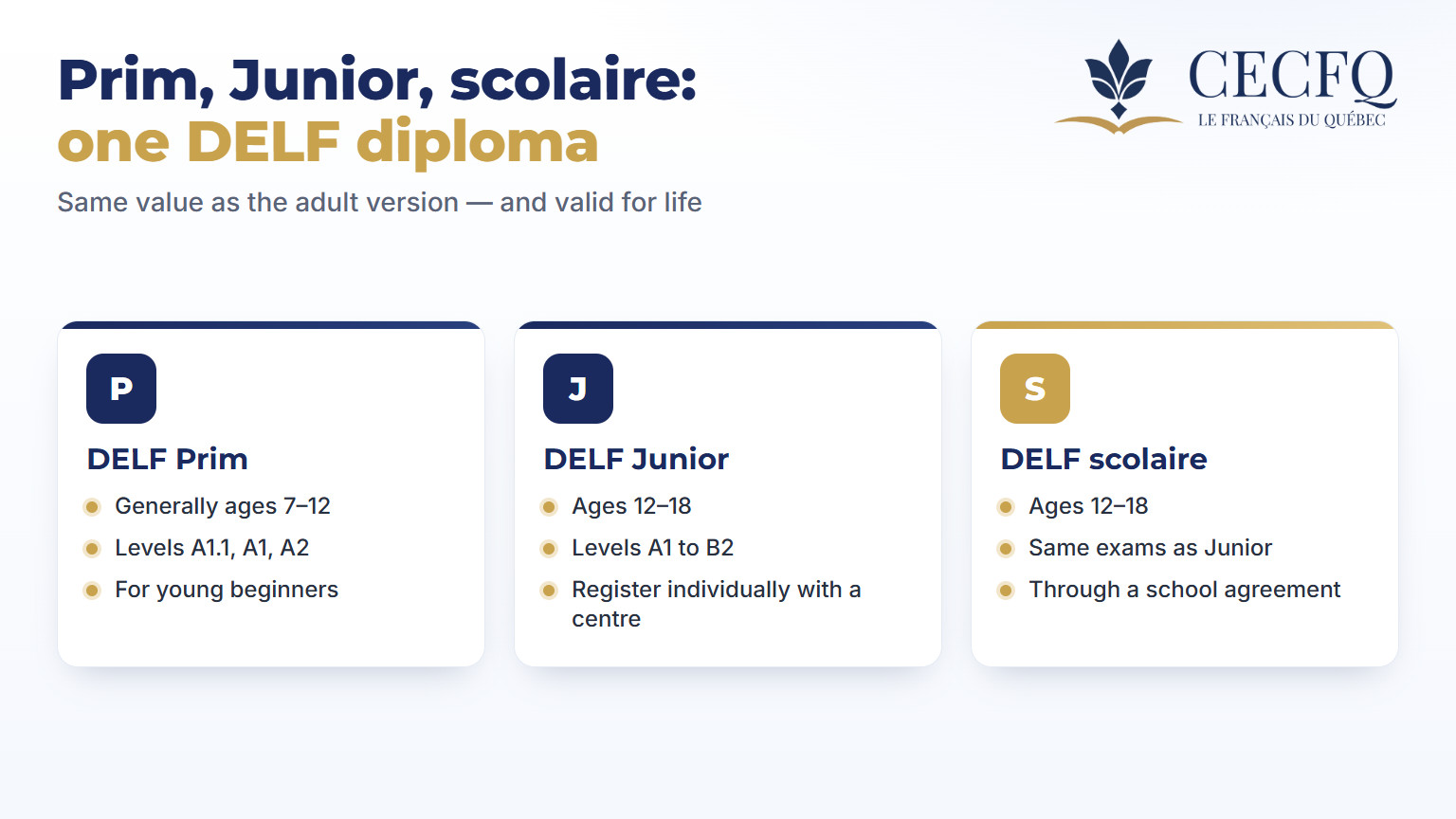
DELF Prim is designed for younger beginner children at the elementary level, with diplomas at A1.1, A1, and A2. DELF Junior covers secondary-school-aged teens, using the same A1-to-B2 scale found across the DELF, from early beginner to upper-intermediate. Whichever track your child takes, the diploma has the same value as the adult “tout public” version — nothing on the certificate marks it as a kids’ edition.
This guide separates two decisions parents often mix up: which track fits your child (Prim, Junior, or scolaire), and which level fits where they already are in French. It also covers what the exam actually looks like, and what to do if your child’s school doesn’t offer DELF at all.

Prim, Junior, or Scolaire: Three Tracks, One Diploma
These three names describe who the exam is built for and how a child gets registered — not three different diplomas.
| Track | Typical age | Levels offered | How a child registers |
| DELF Prim | Generally 7–12* | A1.1, A1, A2 | Usually individually, with a centre that runs Prim sessions (CECFQ does, in Longueuil) |
| DELF Junior | 12–18* | A1 to B2 | Individually, directly with an accredited exam centre — no school agreement needed |
| DELF scolaire | 12–18* (same exams as Junior) | A1 to B2 | Through the student’s school, under an agreement between its education authority and France Éducation international |
| DELF tout public | Adults | A1 to B2 (C1–C2 belong to the separate DALF) | The general-public version — outside the scope of this guide |
*The Junior and scolaire ranges come from the French Embassy in Canada; the Prim range comes from the Institut français du Canada. France Éducation international itself doesn’t publish an age cut-off for Prim, and centres set their own practical limits.
Junior vs. Scolaire: What Actually Changes
The difference between DELF Junior and DELF scolaire is administrative, not academic. According to FEI’s own description of the two, the skills tested and the topics covered are identical between the two versions.
What changes is how the sitting is organized: a “scolaire” session runs through an agreement between the school’s education authority (public or private) and France Éducation international, while a “junior” session is organized directly by an accredited centre, outside the classroom context. The diploma doesn’t show which version a candidate sat, so for a parent the choice is purely practical: whichever route lets your child register (more on that below).
Inside the Exam: Format, Timing and Pass Mark
Every DELF Junior or scolaire exam, from A1 to B2, is built the same way: four parts, worth 25 points each, for a total of 100. To pass, a candidate needs at least 50 points out of 100 overall — but also at least 5 out of 25 in each individual part. Scoring below 5 in any single part is eliminatory, even if the overall total clears 50.
Three parts are taken as a group — listening, reading, and writing — while the fourth, speaking, is individual: each candidate sits alone in front of two examiners. For a closer look at how examiners grade each part, see our guide to DELF exam scoring.
Timing grows with the level:
| Level | Listening | Reading | Writing | Speaking |
| A1 | 20 min | 30 min | 30 min | 5–7 min (+10 min prep) |
| A2 | 25 min | 30 min | 45 min | 6–8 min (+10 min prep) |
| B1 | 25 min | 45 min | 45 min | 15 min (+10 min prep) |
| B2 | 30 min | 60 min | 60 min | 20 min (+30 min prep) |
DELF Prim follows its own format, built around simple, everyday topics for young beginners, according to the Institut français du Canada, with separate diplomas at A1.1, A1, and A2. For exact exam structure and timing at each level, check FEI’s DELF Prim page or ask the centre running the session. FEI publishes official sample papers (in French) on its level pages — for example, DELF Prim A1 and DELF Junior B1 — with the audio, answer keys and marking grids; sitting one at home under real exam timing is the quickest way to check whether a level fits.

How to Choose the Right Level for Your Child
Age alone is a weak predictor of level. In practice, a child with several years in French immersion often tests higher than a child with the same number of years in a core French program, because of how much spoken French they use day to day.
A more reliable approach is to start from where your child already is in class: ask their teacher how they’d describe the child’s current comprehension and speaking, and treat that as a starting point rather than a guess based on grade or birthday. A short placement conversation with a tutor or exam centre usually settles the question faster.
One concrete benchmark is the writing task. At A1, your child fills in a form and writes a short message of at least 40 words; at A2, two short texts of at least 60 words each; at B1, a text of at least 160 words; at B2, at least 250 words. If a 160-word opinion piece in French would be a stretch, B1 is probably too early.
If Your Child’s School Doesn’t Offer DELF
Not every school runs a DELF scolaire agreement, and that doesn’t close the door. A few things to check before you register on your own:
- Registration for DELF Junior is individual. As the French Embassy in Canada explains, DELF Junior registration is on an individual basis, unlike DELF for Schools, which is organized through educational authorities — so a parent can book the sitting directly.
- Confirm the age window first. DELF Junior generally covers ages 12 to 18; outside that range, Prim or the tout public track may fit better.
- Check the centre’s consent requirement. Centres may require written permission from a parent or legal guardian for candidates under 18; ask your chosen centre what it requires.
- Book early. Registration closes before the exam day itself: at CECFQ, for example, the deadline falls about ten days before the first exam day of a session. Each centre sets its own, so check its calendar rather than guessing.
- Not every centre runs every track. Some centres offer Junior sessions but not Prim — confirm availability for your child’s specific track before assuming it’s local.
Preparing with CECFQ
CECFQ offers one-to-one lessons for children and teens preparing for DELF Prim and DELF Junior at the A1 and A2 levels through our DELF and DALF preparation program. Packages run 4 hours at 240 CAD, 8 hours at 464 CAD, or 20 hours at 1,100 CAD.
CECFQ also administers DELF Junior and DELF Prim exam sessions in Longueuil, in partnership with the DELF Dorval examination centre (Lester B. Pearson School Board), a centre accredited by France Éducation international. Candidates under 18 need written parental consent to register.
At the time of writing, exam fees at CECFQ are 215 CAD for every DELF Prim level and for DELF Junior A1 and A2, 295 CAD for Junior B1, and 315 CAD for Junior B2. Results are usually available a few weeks after the session, and the official diploma follows later. For upcoming session dates and registration deadlines, see our DELF and DALF exam sessions page.
2 Real Cases:
A 9-year-old in French immersion. After three years in a Quebec French immersion program, one parent wanted a credential that reflected what their daughter could already do, rather than waiting for a report card. Matching her everyday vocabulary and classroom routines against the A1 descriptors pointed to DELF Prim A1, and they registered her individually for a Prim session, with regular practice at home in the weeks before.
A 15-year-old preparing for a French exchange. A parent wanted their son’s six years of core French to count toward something concrete before an upcoming exchange program. His school didn’t run a DELF scolaire agreement, so they registered him individually for DELF Junior B1 (see what the DELF B1 level means), worked through the four-part format with a tutor over several months, and used past speaking topics so the individual oral felt less unfamiliar on exam day.

Frequently Asked Questions
1. What is the difference between DELF Prim and DELF Junior?
DELF Prim is the elementary-level track, with its own diplomas at A1.1, A1, and A2. DELF Junior is for secondary-school-aged teens, generally 12 to 18, across the full A1-to-B2 range. Both are official diplomas issued by France’s Ministry of Education and administered by France Éducation international, and they never expire.
2. Is DELF Junior the same diploma as DELF scolaire?
Yes. The skills tested and topics covered are identical between the Junior and scolaire versions; what differs is only how the sitting is organized — through a school agreement for scolaire, or directly with an exam centre for Junior. The diploma itself doesn’t indicate which version a candidate sat.
3. How old does my child need to be for each exam?
DELF Prim is generally aimed at children around 7 to 12, per the Institut français du Canada, since France Éducation international doesn’t set an exact age cut-off itself. DELF Junior and DELF scolaire are generally for ages 12 to 18.
4. Is the DELF useful for my child later on?
France Éducation international notes that, depending on the level, the DELF can make it easier to access university in France, elsewhere in Europe, or in another French-speaking country. Because the diploma is valid for life, a B1 or B2 earned in high school can still be used years later.
5. Can my child sit the DELF Prim exam with CECFQ in Longueuil?
Yes. Our Longueuil centre holds DELF Prim sessions at all three levels (A1.1, A1, A2), as well as DELF Junior sessions from A1 to B2. Registration usually closes about ten days before the first exam day, so check the exam sessions page for the next Prim date as soon as you’ve settled on a level.
6. What happens if my child scores well overall but fails one part of the exam?
Each part has a 5/25 minimum, so a very weak part fails the exam regardless of the total. If that happens, confirm the retake process and any fees directly with the exam centre, since practical policies can vary from one centre to another.
Disclaimer: This article is for general information only and does not replace official guidance from France Éducation international, an accredited exam centre, or your child’s school. DELF exam formats, age guidelines, fees, and registration deadlines can change from one session to the next, so confirm current details with the relevant examination centre before registering.
Ready to Prepare Your Child for the DELF?
A short level test (20 CAD, returned as a promo code toward a course) helps confirm whether your child is at A1 or already working at A2, and our DELF Prim and DELF Junior preparation — one-to-one lessons at the A1 and A2 levels — takes it from there. When your child is ready, they can sit the exam itself at our Longueuil centre.
Email: info@cecfq.ca
Website: cecfq.ca
Address: 50 Rue Saint-Charles O, local 100, Longueuil, QC J4H 1C6
Hours: Monday–Friday 9:00 a.m.–6:00 p.m., Saturday 9:00 a.m.–2:00 p.m.