If you plan to study or work in Quebec in 2026, the DELF B2 diploma is a powerful and internationally recognized proof of your French proficiency. Unlike local language tests, DELF is administered worldwide under the same conditions by France Éducation International, an official public institution of the French Ministry of Education.
This guide explains how the DELF B2 exam works in Quebec, how to prepare efficiently, and what study strategies suit learners aiming for university, professional orders, or permanent settlement in Francophone workplaces.

What the DELF B2 Exam Looks Like in 2026
The DELF B2 format is identical across countries. Quebec candidates take the same test topics as those in France or any other region.
| Section | Duration | Skills Tested | Points |
| Listening Comprehension | 30 min | Understanding radio/news reports, structured arguments | /25 |
| Reading Comprehension | 60 min | Interpreting opinion articles, reports, press texts | /25 |
| Writing Production | 60 min | Arguing formally in essays or letters | /25 |
| Speaking Production | 20 min (30 min prep) | Presenting and defending a viewpoint orally | /25 |
Passing mark: 50 / 100 overall, with a minimum of 5 / 25 per section. Diploma validity: lifetime.
Important Update: Format & Evaluation Notes (2024–2026)
France Éducation International has refined guidance and evaluation grids in recent editions and materials. Always verify with your Québec test centre which version you will sit and prepare against the official B2 task types and timing (CO 30 min, CE 60 min, PE 60 min, PO 20 min + 30 min prep).
DELF B2 and Life in Quebec: What’s Specific
Although the exam itself is not localized, preparing in Quebec offers unique advantages:
- Immersion: You can immerse yourself in everyday French, which strengthens fluency for real communication.
- Listening Training: Exposure to Radio-Canada, Ici Première, or Quebec podcasts helps your ear adjust to natural speech rhythm — even if exam recordings are from France.
- Local Expertise: Local preparation centers (Alliances Françaises, CEGEPs, universities) provide official mock exams and trained evaluators.
Pro Tip: Use Quebec content to enrich your vocabulary and spontaneity, but focus your listening and writing practice on standard international French used in the exam.

Recommended Preparation Strategy (3 – 6 Months)
- Evaluate your level: Take a diagnostic test or an internal placement exam to identify gaps.
- Plan 150–200 hours: This is the standard study time needed if you are currently around B1 level.
- Divide time by skill: 30% comprehension, 40% production, 20% grammar, 10% strategy.
- Alternate self-study and guided practice: Combine group courses or tutoring with autonomous activities such as essay writing and oral simulations.
- Simulate exam conditions: Use official past papers or certified materials (from publishers like Hachette FLE or Didier). In the final month, take two full mock exams to master timing and stress management.
See our DELF B2 preparation courses in Montreal.
Deep Dive: Mastering the 4 Skills
1. Listening Comprehension (Compréhension de l’oral)
- The Challenge: You will hear two recordings (interviews, news bulletins, or speeches) and answer multiple-choice questions.
- Quebec Context: While the exam audio is standard French, your daily life in Quebec is your training ground.
- Strategy: Listen to Radio-Canada and Ici Première. Even though the accents differ slightly from the exam, the speed and vocabulary complexity are perfect for B2 training.
- Tip: Practice “Active Listening.” Don’t just listen passively; sit down and try to summarize a 3-minute segment in 5 bullet points.
2. Reading Comprehension (Compréhension des écrits)
- The Challenge: You have 1 hour to read two texts (one informational, one argumentative/opinion).
- Preparation: Read distinctively French media like Le Monde or L’Actualité (Quebec). Focus on connecteurs logiques (however, therefore, consequently).
- 2026 Insight: In the new format, being able to pinpoint the exact reason for an author’s opinion is key to selecting the right multiple-choice answer.
3. Writing Production (Production écrite)
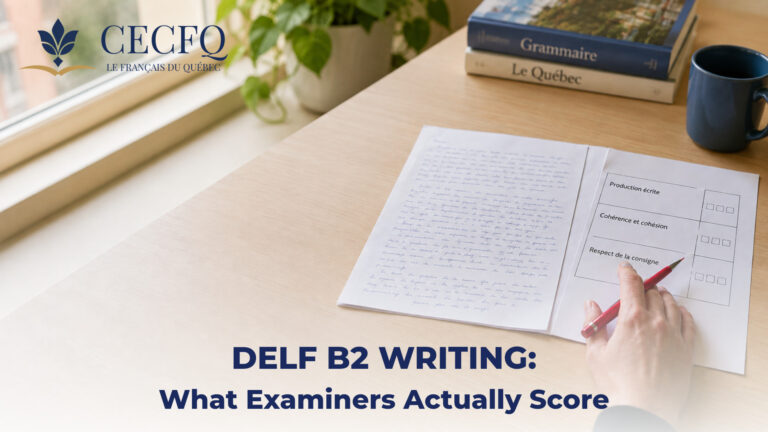
- The Challenge: Write a formal letter or an essay (approx. 250 words) arguing a specific point of view.
- Why it matters: This skill is vital for University admissions (e.g., UdeM, McGill). Officers look for your ability to structure complex thoughts.
- Key Strategy: Memorize the structure of a Lettre formelle (Introduction -> Problem -> 2-3 Arguments -> Solution -> Conclusion).
- Bonus: Using Quebec-relevant examples (e.g., referencing public transit or local environmental issues) shows cultural integration, which examiners appreciate.
4. Speaking Production (Production orale)
- The Challenge: A monologue (5-7 min) presenting an article, followed by a debate (10-13 min) where the examiner challenges your view.
- The Quebec Advantage: Quebec examiners are known for being encouraging but strict on communicative ability.
- Tip: If applying to a Professional Order (e.g., OIQ for engineers), practice vocabulary specific to your field.
Key Challenges and Quebec‑Focused Tips
| Skill | Common Difficulty | Effective 2026 Tactic |
| Listening | Fast speech, unfamiliar topics | Train with Radio‑France or RFI audio, transcribe key sentences |
| Reading | Long argumentative texts | Practice skimming titles, outlining premises/conclusions |
| Writing | Logical connectors, formality | Memorize linkers (cependant, en revanche, en conclusion) |
| Speaking | Sustaining structured argument | Rehearse opinion monologues 10–12 min + feedback session |
Preparation Options in Quebec (2026)
| Mode | Advantages | Ideal For |
| Group courses (Alliances Françaises, CEGEPs) | Structured schedule, professional correction, mock exams | Students and newcomers |
| Private tutoring | Personalized strategy, flexible hours, certified examiners as teachers (in CECFQ) | Working professionals |
| Self‑study + online support | Budget‑friendly, adaptable | Independent learners |
| Hybrid | Combines structure + autonomy – best results overall | Most candidates |
DELF vs TEF/TCF: What Counts for Immigration & Citizenship?
- Federal immigration (Express Entry / PR): IRCC awards language points for TEF Canada or TCF Canada only; DELF/DALF do not earn EE language points.
- Canadian citizenship: IRCC accepts DELF/DALF (A2+) as French-language proof.
- Québec selection programs (QSWP/Arrima): MIFI accepts standardized tests (TEF/TEFAQ/TCF variants) and DELF/DALF diplomas as evidence of French; check stream-specific rules on document type/recency.

DELF B2 and Quebec Institutions
DELF B2 remains highly respected by:
- Universities: Proof of academic French at B2 level.
- Professional Orders: Required for nurses, engineers, and teachers to demonstrate autonomy.
- Employers: A strong asset for clear written and spoken communication.
Target Score: Competitive profiles often aim for 70/100 or higher, with at least 15+ points in the productive skills (writing and speaking).
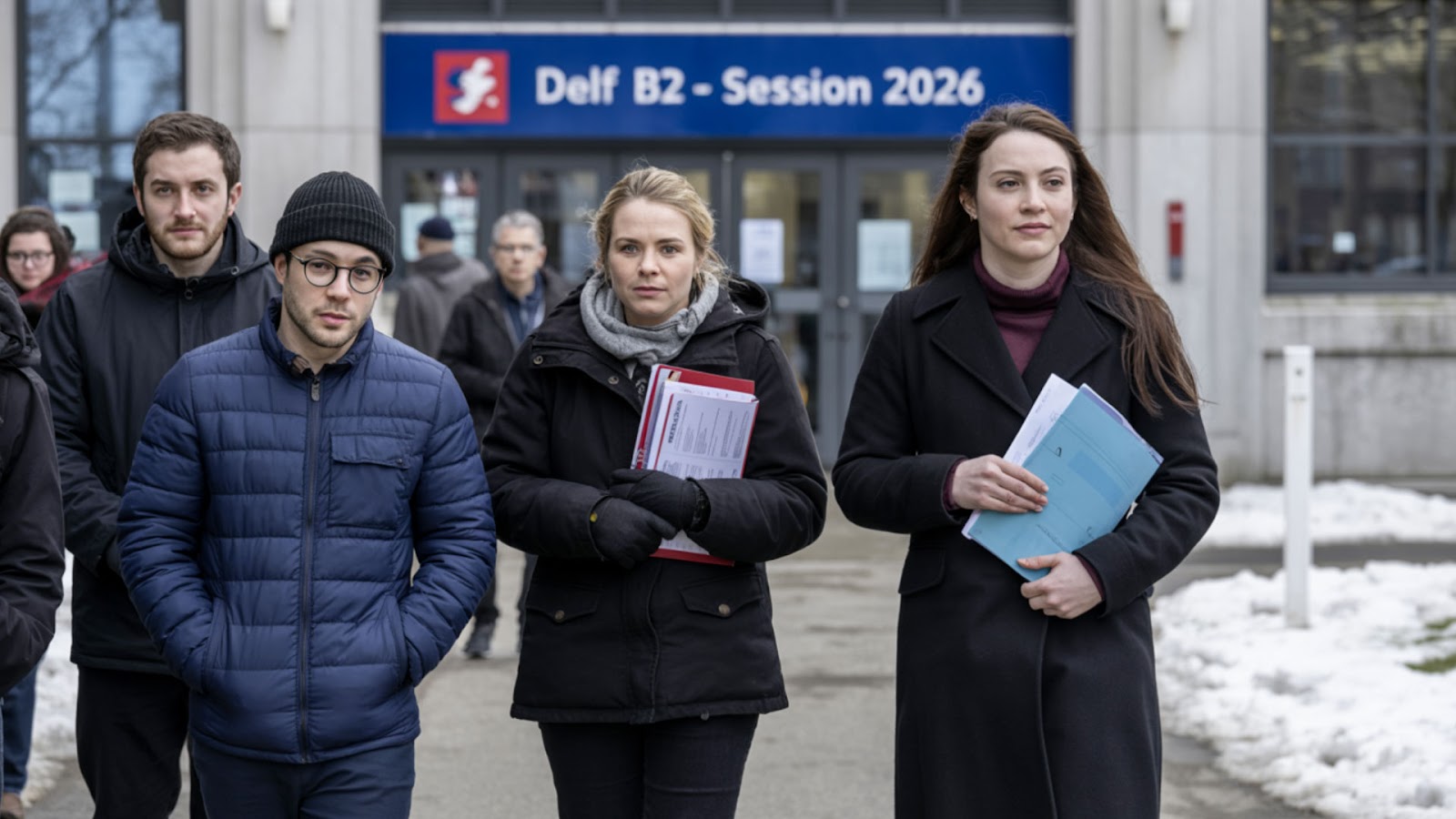
Registration and Exam Centers in Quebec
DELF B2 sessions are organized several times per year by:
- Lester B. Pearson School Board (Dorval)
- Selected universities and CEGEPs
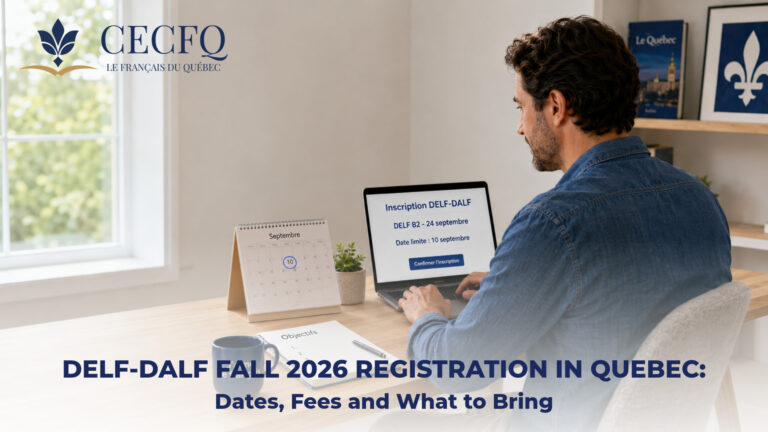
Book 2 – 3 months in advance due to high demand. Bring valid ID, printed confirmation, and arrive early; late candidates cannot be admitted.
Two Real Examples of DELF B2 Preparation in Quebec
Case 1 – University Admission (2026)
Challenge: A B1 student in Montréal struggled with structured writing.
Solution: 5‑month hybrid plan – weekly course + writing corrections + timed essays.
Result: Passed with 78 / 100 and entry into a Québec City bachelor’s program.
Case 2 – Professional Integration
Challenge: Skilled worker needed B2 proof for promotion.
Solution: 3 months of oral simulations with business scenarios.
Result: 72 / 100 score and successful job advancement.
FAQ
1. Is the DELF B2 exam different in Quebec?
No. The same exam is used worldwide. Only the exam location changes.
2. Is the DELF B2 accepted for immigration?
Generally no — TEF Canada or TCF Canada are required for PR. DELF B2 is ideal for study or work integration, and is accepted for citizenship language level proof.
3. How long to prepare?
Average 3 – 6 months (150 – 200 hours) if you start from B1.
4. Where can I register?
Through Alliances Françaises or partner institutions listed on FEI’s official website.
5. What score should I aim for?
Beyond the minimum (50 / 100), target 70 + to show solid independence in French.
Ready to Certify Your French?
Book a level assessment test with our team to design a custom DELF B2 plan for 2026. Contact us or simply reserve your spot in the next preparation session.